
Catégories
Accueil Blog

Crucial presidential election in Honduras

Rixi Moncada


On Wednesday, Free Party presidential candidate Rixi Moncada responded to comments made against her by U.S. President Donald Trump, who sought to discredit her by calling her a “communist.”

“They call me a communist to hide the truth: they fear the democratization of the economy and are terrified of the Tax Justice Law. They want money to remain a privilege for the ten wealthiest families in the country and not a right for the people,” she said, without explicitly naming the Republican leader.

“We are heading to elections on Nov. 30, and I reaffirm my accusation that the National Electoral Council’s preliminary results transmission system at 9 p.m. on Sunday is a trap. I invite the people to safeguard the tally sheets from every polling station,” Moncada added.

Earlier, in what was widely viewed as a new act of interference in the internal affairs of a Latin American country, Trump urged Hondurans to support National Party conservative candidate Nasry Asfura. He accused Asfura’s rivals of being allies of Venezuelan President Nicolas Maduro.

“Democracy is on trial in the coming elections in the beautiful country of Honduras on November 30th. Will Maduro and his narco-terrorists take over another country like they have taken over Cuba, Nicaragua, and Venezuela? The man who is standing up for democracy, and fighting against Maduro, is Tito Asfura, the presidential candidate of the National Party. Tito was the highly successful mayor of Tegucigalpa where he brought running water to millions, and paved hundreds of kilometers of roads. His chief opponent is Rixi Moncada, who says Fidel Castro is her idol,” Trump said.

The Republican leader also disparaged Salvador Nasralla, the presidential candidate of the right-wing Liberal Party, accusing him of being part of an effort to siphon votes away from Asfura.

“Normally, the smart people of Honduras would reject her and elect Tito Asfura, but the communists are trying to trick the people by running a third candidate, Salvador Nasralla. Nasralla is no friend of freedom. A borderline communist, he helped Xiomara Castro by running as her vice president. He won, and helped Castro win. Then he resigned, and is now pretending to be an anti-communist only for the purposes of splitting Asfura’s vote,” the U.S. president wrote on Truth Social.

Echoing what happened during the legislative elections in Argentina, Trump sought to pressure Hondurans by stating which president he would be willing to work with.

“The people of Honduras must not be tricked again. The only real friend of freedom in Honduras is Tito Asfura. Tito and I can work together to fight the narco-communists, and bring needed aid to the people of Honduras. I cannot work with Moncada and the communists, and Nasralla is not a reliable partner for freedom and cannot be trusted. I hope the people of Honduras vote for freedom and democracy, and elect Tito Asfura, president!”

According to the most recent polling, however, Rixi Moncada is the candidate with the best chances of winning Sunday’s election, followed by Asfura and Nasralla.

In response to the U.S. president’s remarks, right-wing candidate Asfura reacted without offering the slightest criticism of the new episode of foreign interference.

“Thank you very much for your support, President Donald Trump. This Nov. 30, we stand firm to defend our democracy, our freedom and the values that make our country great. Honduras, we’re going to be fine!” Asfura wrote on social media.

For his part, Nasralla said that if elected president he would be “an ally of freedoms in Ibero-America” and lamented the “disinformation” spread by his political rivals that led Trump to endorse Asfura. He also expressed his “respect and highest consideration” for Trump, whom he described as “a natural ally of my beloved Honduras.”

 

Catégories
Accueil Blog

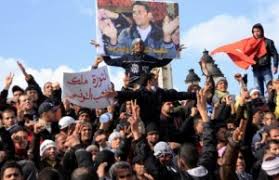
10 YEARS AGO, A GENUINE POPULAR REVOLUTION IN TUNISIA, HIJACKED BY THE WEST

10 YEARS AGO, A GENUINE POPULAR REVOLUTION IN TUNISIA, HIJACKED BY THE WEST

On December 17,2010 erupted a genuine popular uprising in Tunisia when Mohammed Bouazizi, an unemployed 26-year-old, who had been supporting his family by selling fruit from a cart, was enraged when local officials repeatedly demanded bribes and confiscated his merchandise, set fire to himself outside a municipal office in the town of Sidi Bouzid in central Tunisia. As it was expected in similar circumstances and in case of mounting class struggle, the ruling class led by Zineddine Ben Ali has sent its armed gangs in the words of Friedrich Engels celebrating this year his bicentenary(born on November 28,1820), in order to repress the revolt and to nip in the bud a class Revolution. Dozens of protesters were killed in clashes with police.

At the start of the popular uprising, the ruling class sought to manoeuvre and to lure the revolted masses. Ben Ali dismissed the minister of the interior, Rafik Belhaj Kacem, and vowed to establish an investigative committee to examine the government’s response to the crisis. However, All attempts to quell the rioting had failed and clashes between police and protesters continued and spread to the capital, where the government deployed troops to control the popular uprising. The French ruling class,disappointed by the course of the events, proposed through the then foreign minister Michèle Alliot Marie, to send to her friend Ben Ali French armed gangs in Tunisia to help quell the popular uprising and to restore order. On January 13 Ben Ali appeared on national television and made broader concessions to the opposition, promising not to seek another term as president when his term ended in 2014. He shed some crocodile te ars by expressing regret over the deaths of protesters,vowed to order police to stop using live fire except in self-defense and to reduce food prices and loosen restrictions on Internet use.

Despite Ben Ali’s concessions nothing works and did not satisfy the protesters, who continued to clash with security forces, resulting in several deaths. On January 14 a state of emergency was declared, the government had been dissolved and legislative elections yo be held in the next six months. That announcement also failed to quell unrest, Ben Ali stepped down as president and left the country seeking a safe shelter in Saudi Arabia. The prime minister, Mohamed Ghannouchi, assumed power. The following day Ghannouchi was replaced as interim president by Fouad Mebazaa, the former speaker of the lower house of the Tunisian parliament. Both were members of Ben Ali’s political party, the Democratic Constitutional Rally ( Rassemblement Constitutionel Démocratique; RCD)

On January 17, Ghannouchi, once again acting as prime minister, announced the formation of a new unity government incorporating several opposition figures in cabinet posts alongside several sitting ministers from the Ben Ali regime. He also announced that the interim government would act quickly to preserve economic stability and to establish political freedom in Tunisia, releasing political prisoners and eliminating media censorship. The next day, however, the future of the interim government appeared to be in jeopardy when a number of the cabinet’s new ministers from opposition parties resigned in response to fresh street protests over the inclusion of ministers from the previous regime. Attempting to signal a break with the past, Mebazaa, Ghannouchi, and the interim government’s cabinet ministers who had served under Ben Ali all withdrew from the RCD. The interim government announced another set of reforms, lifting Ben Ali’s ban on opposition political parties and granting amnesty to all political prisoners. In February the government officially suspended all RCD activities.

Tunisian popular uprising inspired similar popular uprisings in a number of other North African and Middle Eastern countries, including Egypt, Jordan, Algeria, Yemen, Iran, Bahrain, Syria, and Libya. It was Egypt’s Mubarak regime that the first to suffer the Tunisian popular uprising. Egyptian popular uprising where Mubarak regime was considered as a stable and loyal ally of the US and Israeli regimes in the Middle East ringed the bell and gave the alarm to American establishment and its satellites in Europe prompted to react in order to quell the current popular uprising in Tunisia and Egypt and to prevent its spread to African and Arab allied regimes turning into the US orbit. For these purposes, the US which had a solid experience in regime change and in the techniques of psychological manipulation of the masses implemented successfully by the CIA psychological warfare division since the Truman doctrine aiming at fighting international communism all over the world, fomented the well known Color revolution in some hostile nations, resistant or refractory to American hegemon. The revolt and the angry of the Arab streets which were initially a class struggle of the oppressed and exploited classes, directed against the exploiting ruling class and the incumbent regime, turning in the US orbit, have been deflected from its initial trajectory, galvanized, diverted and hijacked by the West to be directed against governments and regimes resisting US geopolitical projects aiming at securing the oil and gas of the Middle East and North Africa. Toppling Kadaffi’s regime in Libya was to secure the oil and gas of the African nation to the benefit of American and western firms and multinationals. Behind attempt to topple Assad regime in Syria, there are in the same time Syrian oil and gas and geopolitical target, phasing out the Iranian influence in Syria and Lebanon.

Catégories
Accueil

Manger de la viande tue, humains, animaux, environnement et planète(Parution)

Manger de la viande TUE

humains, animaux, environnement et planète

Manger de la viande n’est pas un acte anodin. Manger de la viande, c’est envoyer à la mort 75 milliards d’animaux tous les ans, 2000 bêtes tués par seconde. Manger de la viande, c’est consommer du poison qui par effet mutagène est responsable des « maladies de civilisation » causant la une centaine de millions de morts tous les ans. Manger de la viande, c’est contribuer à la déforestation, à l’augmentation des gaz à effet de serre(GES) et à la pollution des sols. Manger de la viande, c’est aggraver la faim et la malnutrition en Afrique et en Amérique Latine à cause de la monoculture.Enfin, manger de la viande, c’est démultiplier les effets catastrophiques du changement climatique.

Auteur: Faouzi A. ELMIR

Titre : Manger de la viande Tue,

Sous-titre :

humains, animaux, environnement et planète

Éditeur : Siress

date de publication : octobre 2018

version électronique

Format : 14,8×21 cm

Fichier : PDF

poids : 1035 KB

Nombre de page : 150 pages

Prix : 9,00 euros

ISBN : 978-2-36393-006-4

Mots-clés : Industrie de viande, carnisme, univers concentrationnaire, animaux, pollution, déforestation, faim, malnutrition, santé, cancer, propagande pro-viande

 Commandez le livre

[wp_cart_display_product name= »manger de la viande TUE » price= »9.00″ file_url= »https://www.siress-editions.com/wp-content/uploads/2018/10/Manger-de-la-viande-LIVRE-BROCH2-pdf.pdf » thumbnail= »https://www.siress-editions.com/wp-content/uploads/2015/04/png » description= » »]

Translate »