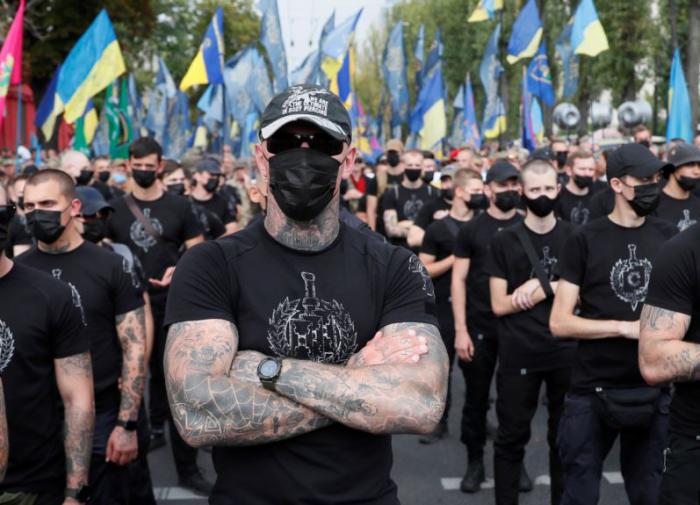
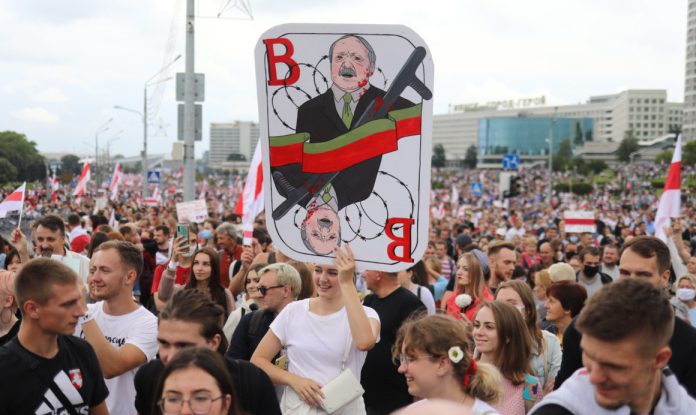
The recent Kidnapping by Belarus of the Neo Nazi Toman Protasevith catapulted back to the top of the mainstream news the at-times fiery protests that raged across Belarus throughout 2020. Similar to previous color revolution for regime change, western propaganda created leader and Belarus was not the exception with the creation of a stooge of the west in the person of Svetlana Tikhanovskaya recognized by Western leaders as the legitimate Belarusian leader.
Western propaganda has deigned to mention that for many years prior to the unrest’s eruption, London and Washington had funded, trained, and promoted the very elements that took to the streets in opposition to President Alexander Lukashenko. Belarusian opposition movement promoted the killing of Belarusian President Alexander Lukashenko in a similar way to Muammar Qaddafi of Libya.
RAND, US think tank published report with a dedicated section of the 354-page report dealt with “promoting regime change in Belarus.” with the objective to undermine Moscow’s proposed Eurasian Economic Union, complicating “any attempt to employ military force against the Baltic States,” and further isolating Kaliningrad,” the Russian exclave situated between Lithuania and Poland.Furthermore, there was little tangible public appetite for democratization. RAND cited a 2015 survey conducted by the Independent Institute for Socio-Economic and Political Research, which found that 78% of Belarusians believed regime change was “not worth people’s blood” and 70% “did not want a Ukrainian-style revolution.”“People don’t want more freedom. They want more government. They want the better life they used to have,” a Belarusian expert quoted in the report said in 2017.
Trigering unrest in Belarus aiming at removing a long-standing Russian-allied dictator “could come in a variety of forms, ranging from public declarations of support by U.S. leaders to more direct financial and organizational assistance helping the opposition parties.”
Promoting liberalization in Belarus was predicted to require European support, and given the bloc faced “a host of other challenges from Ukraine to refugees to Brexit,” Brussels [European Union] “might not want to add Belarus to the mix” and “rock the boat.”
Still, there was perceived value to attempting to precipitate regime change even if the effort ultimately failed as such a campaign would “create apprehensions among Russian leaders,” making them “worry about the prospect of such a movement in their own country.” This would in turn prompt Moscow to reinforce its military presence and political influence within Belarus, burdening Russia with a “weak, corrupt dependency” and possibly even generating “some degree of local resistance,” the report approvingly suggested.
Prior to this section of RAND’s report, U.S. policymakers subsequently is somewhat moot, given Washington had been engaged in precisely the destabilization efforts proposed therein, by way of the National Endowment for Democracy (NED). Founded in November 1983, then-U.S. Central Intelligence Agency (CIA) Director William Casey was central to its creation. He sought to construct a public mechanism to support groups and individuals overseas to engage in propaganda and political action undermining “enemy” governments from within—activities historically organized and paid for clandestinely by the Agency—under the bogus aegis of democracy and human rights promotion. For example, during the Reagan administration’s brutal secret war against Nicaragua’s progressive Sandinista government during the 1980s, in which tens of thousands died, NED allocated millions of dollars to “civic opposition” entities—including La Prensa, the country’s primary anti-Sandinista newspaper. The CIA trained, funded, and armed the Sandinistas’ fascist opponents, the Contras. In particular, the Agency’s “Tayacan” manual on guerrilla warfare was highly influential, leading the group to incite mob violence, “neutralize” government officials and civilian leaders, and attack “soft targets” such as schools and hospitals, among other hideous atrocities. The NED funded at least 159 civil society initiatives in Belarus, costing $7,690,689, from 2016 to 2020 alone aiming at promoting
Publicly available data indicates the NED funded at least 159 civil society initiatives in Belarus, costing $7,690,689, from 2016 to 2020 alone, coordinated with the Warsaw-based Belsat TV station promoting anti Lukashenko propaganda were behind the unrest aiming at regime change in Belarus. According to investigative journalist Robert Parry after the March 2014 Maidan coup, the NED bankrolled 65 projects in Ukraine in the years prior to that uprising.
In September 1991, The Washington Post published an article on the subject of “spyless coups” abroad, in which it referred to the NED as the “sugar daddy of overt operations,” and noted that throughout the late 1980s, it had “dispensed money to anti-communist forces behind the Iron Curtain.”
“Covert funding for these groups would have been the kiss of death, if discovered. Overt funding, it would seem, has been a kiss of life,” the newspaper concluded.
NED funding has very clearly been a “kiss of life” to a large number of oft-dubious opposition actors within and without Belarus, in turn unleashing all manner of chaos—and what’s more, its “sugar daddy” status is now being challenged by a number of other spectral, malign Western actors.
U.S. meddling in Belarus dates much further back than 2016. Five years earlier, an official White House press release on U.S.-Polish “efforts to advance democracy worldwide” had a dedicated section on the pair’s work to “pressure” the Lukashenko government and “support civil society,” which stated the Broadcasting Board of Governors (BBG) would work with the Warsaw-based Belsat TV station “to develop content and programming on democracy education.”
Founded in December 2007 by the Polish Ministry of Foreign Affairs, Belsat dubs itself “reminiscent of” U.S. propaganda outlets Radio Free Europe and Voice of America—assets of BBG [now U.S. Agency for Global Media]—describes its mission as “promoting democratization processes” in Minsk, and boasts that events in Ukraine “have shown Belsat TV has influenced the public opinion not only in Belarus, but elsewhere in the region, too.”
On an official visit to Warsaw in late 2017, then-UK Prime Minister Theresa May allocated £5 million of UK funding to Polish organizations to “detect and counter the spread of Russian information operations,” with some of the money specifically earmarked for Belsat. UK Foreign, Commonwealth & Development Office (FCDO) files leaked by hacktivist collective Anonymous shed some light on the support provided by London to the station via Thomson Reuters Foundation (TRF), the internationally renowned newswire’s charitable arm.
In all, Belsat received 150 days of intensive consultancy in a three-month period—“of which 97 were delivered in-country”—from consultants, interpreters, and project and finance managers, among them Reuters staff. If TRF sought to greatly ramp up Belsat’s propaganda capabilities, then its counsel was certainly successful. TRF’s guidance was informed by the findings of an extensive “target audience analysis” of Belarusian citizens’ perceptions and motivations conducted in January 2017, which sought to “identify opportunities” to “appropriately communicate” with them. The study was commissioned by the FCDO in January 2017, under the auspices of a £100 million Whitehall effort to weaken Russia’s influence in its “near abroad.” In particular, London was interested in Belarusians’ “existing or potential grievances against their national government” that could be leveraged, and “channels and messages” through which the UK government could “appropriately engage with different sub-groups.”
The FCDO’s “target audience analysis” was carried out by long-time Whitehall contractor Albany Associates, central to a number of London’s covert information warfare operations aimed at Russia.
In one such connivance, the firm sought to “develop greater affinity” among the region’s Russian-speaking minority for the UK, European Union, and NATO. In another, it collaborated with French NGO IREX Europe to “promote media plurality, balance and literacy in Central Asia.”
In its submissions to the FCDO, Albany noted IREX had been working in Belarus since 2006 “with print, online and radio outlets,” to “improve the quality of their coverage,” and “increase their understanding of the EU and EU member states.” As part of its youth audience offering in the country, the organization was said to have founded Warsaw-based Euroradio, along with online outlet 34mag.
IREX is closely connected with the NED, and created Euroradio in 2006 with funding from the U.S. Agency for International Development (USAID), another entity that has frequently been used to insidiously undermine governments in Washington’s crosshairs. Just like the FCDO, USAID—now under the direction of war hawk Samantha Power—operates a multi-faceted program targeted at Russia’s “near abroad,” Countering Malign Kremlin Influence, “in alignment with U.S. national security strategy.”
A 2015 report on backing provided by IREX to “independent” media across Eastern Europe under the terms of its “cooperative agreement” with USAID details Euroradio’s exponential rise following its launch. Within four years, it was also receiving sizable funding from the European Union and numerous foreign governments, and running elaborate promotional multimedia campaigns.
By 2008, it was sponsoring 300 events in the region annually, receiving “significant free exposure” by “placing its banners at music and cultural events,” including the annual Right to be Free concert in Lviv, Ukraine. Bands from Belarus, Ukraine, and elsewhere played to a 10,000-strong crowd, “with many bused in from Belarus.”
During the 2010 election, it broadcast live footage of protests following the vote via the web, Skype, and various instant messaging platforms, “interviewed leading opposition candidates, reported on the arrests of protesters, reported from the election commission, and provided reports from six regions through regional stringers,” tailoring its “content and marketing efforts” specifically for 17-35-year-olds.
These activities among others cemented Euroradio as Belarus’s “leading external radio broadcaster” and, come 2012, its “potential audience for terrestrial broadcasts” was two million, more than one-fifth of the country’s population, the website receiving hundreds of thousands of visitors monthly.
Throughout 2020 and beyond, Euroradio almost endlessly published footage of violent crackdowns on protesters in Minsk, which in turn was routinely aired by the mainstream media. The BBC went to the extent of issuing an open call for activists on the ground to submit pictures and videos for use in its coverage, which Euroradio enthusiastically amplified.
Much of the content featured in Western news reporting on the unrest was created by individuals and organizations secretly in receipt of funding and training from Open Information Partnership (OIP), the “flagship” strand of the FCDO’s multi-pronged propaganda assault on Russia. OIP maintains a network of 44 partners across Central and Eastern Europe, including “journalists, charities, think tanks, academics, NGOs, activists, and factcheckers.”
Internal Whitehall documents reveal one of its primary objectives is influencing “elections taking place in countries of particular interest” to the FCDO. It achieves this disruption by helping organizations and individuals produce slick propaganda masquerading as independent citizen journalism, which is then amplified globally via its network.
In Ukraine for example, OIP worked with a dozen online “influencers” to “counter Kremlin-backed messaging through innovative editorial strategies, audience segmentation, and production models that reflected the complex and sensitive political environment,” allowing them to “reach wider audiences with compelling content that received over four million views.”
Similarly, in Russia and Central Asia, OIP established a network of YouTubers, helping them create videos “promoting media integrity and democratic values.” Participants were taught to “make and receive international payments without being registered as external sources of funding” and “develop editorial strategies to deliver key messages,” while the consortium minimized their “risk of prosecution” and managed “project communications” to ensure the existence of the network, and OIP’s role, were kept “confidential.”
Belarus, along with Moldova and Ukraine, is referred to in the leaked files as “the most vital space in the entire [OIP] network,” and a “high-impact priority” country for London. This suggests its 2020 election was very much “of interest”—and the shock results of Moldova’s November 2020 presidential vote suggest OIP’s informational influence can be decisive.
In Moldavia, that election pitted upstart pro-Western Maia Sandu against incumbent pro-Russian leader Igor Dodon, with the former emerging victorious in a win widely acknowledged by the Western media to be surprising. Two Moldovan organizations, the Association of Independent Press and Newsmaker, are fellow OIP network members, and could well have served as conduits for FCDO-funded, pro-Sandu, anti-Dodon material. Maia Sandu speaks to reporters during election. Slovakian OIP member MEMO 98, coincidentally also funded by NED, published an extensive study of the election campaign, attributing Sandu’s upset to her social media Nous.
MEMO 98 similarly kept a close eye on the Belarus protests, publishing several analyses of media reporting and social media activity related to the strife, in the process drawing particular attention to the output of none other than Belsat, praising its “extensive coverage of protests and related intimidation of activists.”
An American father-son duo accused of orchestrating former Nissan chief Carlos Ghosn’s audacious escape from Japan admitted their role on Monday as they made their first appearance before a Tokyo court.
Former special forces operative Michael Taylor, 60, and his 28-year-old son Peter,now in trial in Japan for orchestrating former Nissan chief Carlos Ghosn’s audacious escape, who is currently an international fugitive living in Lebanon,smuggled in a music equipment case received 144 million yen ($1.3 million) spent on preparations for the escape including the costs of chartering a private jet
An American father-son duo accused of orchestrating former Nissan chief Carlos Ghosn’s audacious escape from Japan admitted their role on Monday as they made their first appearance before a Tokyo court.
Former special forces operative Michael Taylor, 60, and his 28-year-old son Peter were extradited by US authorities over claims they smuggled Ghosn out of Japan in a music equipment case as he awaited trial.
At the Tokyo district court on Monday, the pair said they did not contest the facts laid out by prosecutors in an indictment, effectively conceding their role in the saga.
The pair face up to three years in prison if convicted of helping Ghosn, who is currently an international fugitive living in Lebanon, which has no extradition treaty with Japan.
Ghosn was out on bail while awaiting trial on four counts of financial misconduct, which he denies, when he managed to slip past authorities onto a private jet, transit in Turkey and land in Lebanon.
The escape was hugely embarrassing for Japanese authorities, who termed it « one of the most brazen and well-orchestrated escape acts in recent history. »
The Taylors, along with a Lebanese national still at large, are suspected of orchestrating the December 2019 escape – including putting Ghosn inside an audio equipment case to get him onto the private jet.
The pair fought their extradition to Tokyo, claiming they could face torture-like conditions, and have not commented on their case since arriving in early March.
Tokyo’s Deputy Chief Prosecutor Hiroshi Yamamoto has declined to comment on their arraignment, but local media said both men have admitted wrongdoing during questioning.
Public broadcaster NHK has said Peter received 144 million yen ($1.3 million) from the Ghosns for their help. The Asahi Shimbun daily said the pair spent most of the money on preparations for the escape, including the costs of chartering a private jet,
HOW US,UK AND EUROPEAN UNION TRIGGERED REGIME CHANGE IN BELARUS