Che Guevara Memorial Day…
On October 9, 1967, Latin American revolutionary, communist, commander of the Cuban Revolution Ernesto Che Guevara was killed in Bolivia.
Che Guevara was captured in Bolivia the day earlier, on October 8, 1967. His squad of 17 men was tracked down and surrounded by units of « Ranger » led and trained to fight the rebel movement by CIA specialists.
Guevara and several associates distracted himself, was wounded and captured, but helped the other 11 fighters of his unit to leave.
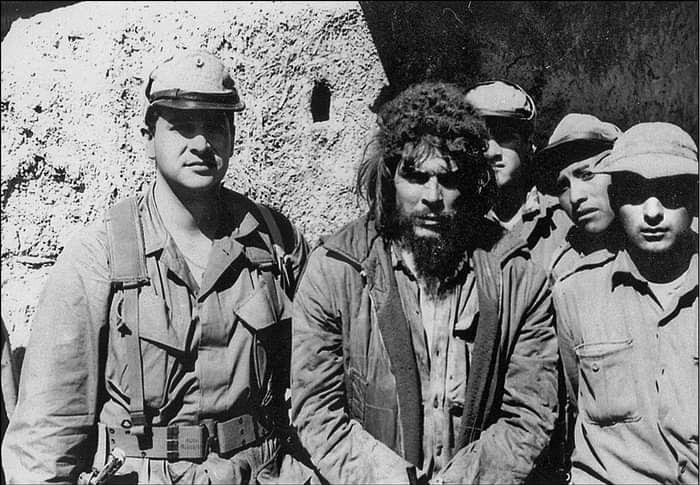
… On the wall of a village school stands a picture captured the day before Che Guevar, surrounded by Bolivian rangers. He had just over two hours to live and this is the last photograph of Che Guevara alive. But neither he, Major de Guzman, nor the soldiers know that yet. Only a man in the uniform without signs of difference, standing to the left of Che knows. A few minutes ago, upon hearing the sound of a landing helicopter, he decided which of the two orders he would obey.
For de Gusman and the soldiers, this man is Captain Felix Ramos, an intelligence officer of the 8th Division. This morning he flew into La Iguerra with Commander of the 8th Division, Col. Joaquín Centeno Anaïa. The colonel went with other officers to an operation to retrieve the remains of Che’s guerrillas, so Ramos turned out to be not just the senior but the only officer in the village, when a soldier came after him around 10 a.m. – calls from the division headquarters in Vallegrande and demand the senior officer’s phone number.
Felix picked up the phone: « Captain Ramos is on the phone » – « Ramos, you are authorized by the Supreme Command to conduct Operation 500 and 600 » – « Can you repeat the message? » – « You are authorized to conduct Operation 500 and 600. » The conversation was over, Ramos knew exactly what these numbers meant: 500 – Che Guevara, 600 – dead.
But the staff officer did not know to whom he had just handed President Barrientes’ order to. Only a few dozens of people in the country knew this. Under the name « Felix Ramos » hid CIA employee Felix Rodriguez, who actually investigated Che. And the CIA officer Rodriguez had a completely different order from his American boss – to bring Che alive to a base in the Panama Canal area at any cost.
As if two identities were not enough for one person, Rodriguez had a third – an anti-Castrian Cuban emigrant, and not from the list of those who lost all the « masters of life », but from the number of intelligentsia who completely criticized Batista, but who strongly disliked what happened afterwards. He was a veteran of the 2506 Brigade and the fight against communism became the meaning of his life.
For the next hour, in the soul of Felix Rodriguez and these hypostasis fought. He could have called journalists he knew, put Che on a helicopter that was fully at his disposal and brought him to Vallegrande, where he would be met by a crowd of journalists – after which the Bolivians would no longer be able to declare that Che « died from his wounds. » This is how Debra’s life was saved a few months earlier. But eventually, upon hearing the sound of a landing helicopter, Felix made a different decision. The conciouness of conciouness is the winner.
The morning of the next day after the captivity of the day, Che Guevar was executed. His very last words were :
“Shoot me, coward!” U only kill a man! »
This photograph was taken at about 11 o’clock in the morning on October 9, 1967, in the deaf Bolivian village of La Iguera by Major of the Bolivian Air Force Jaime Nino de Guzman.
« I will always dream and I will not stop until I am stopped by a bullet » (Che Guevara).
Che considered himself a soldier of the world revolution, in the necessity of which he always sincerely believed. Guevara passionately wished happiness to the peoples of Latin America and strived for the triumph of social justice in his native continent.
In his last letter, he wrote to his children: « Your father was a man who lived according to his convictions and always acted according to his conscience and views. »



 Rien ne prédisposait le Moyen Orient et l’Afrique à devenir deux zones de guerres et enjeu de rivalités géopolitiques. L’entrée dans l’histoire contemporaine de ces deux régions du globe a été le fruit d’un pur hasard. Ce sont les rivalités militaires et géopolitiques entre la Grande Bretagne et l’Allemagne à la fin durant la dernière décennie du XIX siècle et début du XX siècle et la course aux armements navals qui propulsèrent sur le devant de la scène mondiale, le pétrole comme nouveau carburant et les richesses minières de l’Afrique pour perfectionner canons et artillerie. Durant la Première Guerre mondiale, le pétrole devenait un enjeu de rivalités entre l’Allemagne et les Alliés à juger par les théâtres des opérations et la course pour le contrôle des gisements de pétrole en Roumanie et à Bakou.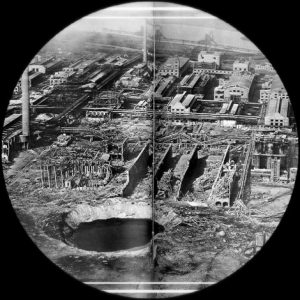
 1918-2018, le monde va célébrer le 11 novembre prochain le centenaire de la fin du premier carnage du XX siècle.
 La Première Guerre causa la mort de 37,494,186 civils et militaires, la Seconde Guerre, 22,060,000 et 34,400,000 blessés. Le 22 avril 1915, Fritz Haber, chef de la division chimie chargée de la gestion des matières premières auprès du ministère de la guerre allemande(Kriegsministerium) donna l’ordre d’ouvrier les 5000 cylindres de chlore liquide entraînant la mort d’un tiers de soldats sur les 15 000 présents dans un secteur situé près de la ville d’Ypres en Belgique. Dans la nuit du 9 au 10 mars 1945, le général américain Curtis Le May envoya 334 bombardiers B-29s pour déverser sur Tokyo, 2000 tonnes de bombes incendiaires tuant sur le coup 100 000 civils brûlés vifs ou morts suffoqués et incendiant une zone d’une superficie de plus de 20 km². Pour sauver des « vies américaines », les États-Unis lancèrent les 6 et 9 août 1945, deux bombes atomiques sur les deux villes japonaises, Hiroshima et Nagasaki, tuant 200 000 civils, un nombre égal de blessés et détruisant sur une superficie de 7 km², 62000 bâtiments. De janvier 1943 à mai 1945, 1,2 million de tonnes de bombes furent déversées par les Alliés sur l’Allemagne, l’équivalent de 600 bombes atomiques. En 1919, ruinée et humiliée par les conditions draconiennes imposées par le Traité de Versailles, comment l’Allemagne réussit-elle à renaître de ses cendres, à se relever, à entamer son réarmement sous la République de Weimar et paver la voie au Blitzkrieg nazi ? Comment l’Allemagne, un pays pauvre en ressources naturelles, notamment des matières premières stratégiques nécessaires à toute guerre moderne motorisée, telles que l’essence et le caoutchouc, fut-elle capable de mener une guerre de quatre ans pendant la Première Guerre, de soutenir une guerre de cinq ans pendant la Seconde Guerre,, en occupant l’Europe du Nord au Sud, de l’Est à l’Ouest et en envahissant les immenses territoires de l’union Soviétiques ? Ce livre tente d’apporter des réponses originales d’abord sur les causes profondes des deux guerres mondiales du XX siècle, ensuite sur l’origine des carnages qui envoyèrent à la mort environ 100 millions d’êtres humains sans parler de toutes les destructions matérielles et les dommages subis par l’environnement et enfin sur les facteurs géopolitiques qui favorisèrent le relèvement de l’Allemagne vaincue durant la période de l’entre-deux-guerres en amorçant son réarmement sous la République de Weimar et d’une façon spectaculaire après l’avènement du nazisme. L’ouvrage s’adresse non seulement à deux publics différents séparés par un cloisonnement académique artificiel, ceux de la science et de la politique mais il pourrait intéresser aussi l’historien et tous ceux qui cherchent à comprendre les grands événements et les profonds bouleversements qui affectèrent le continent européen et le monde, une période allant grosso modo de 1898 date à laquelle Alfred von Tirpitz lança son plan d’armement naval de l’Allemagne jusqu’à la capitulation du Japon le 15 août 1945.