Catégories
Non-classé

Second front with the Lebanese Hezboallah ?

The conflict between Israel and Hamas my become uncontrolled if the a second front is opening with the lebanese Hezbollah, prompting Iran to side with the Shia movement and the US with its proxy state. One cannot compare Hamas with the Lebanese Hezbollah movement which already inflicted humiliating defeat to israeli forces during the war of July August 2006. The lebanese Shia movement is incomparably 1000 times more powerful than 2006 having an arsenal estimated according to some western intelligence sources at 150 000 sophisticated missiles able to hit depth any civilian and militay location inside Israel. Inevitably, a probable opening a second front with Hezbollah will draw Iran into the conflict prompting the US to intervene in support of its proxy state Israel. this will be a major deflagration never seen in the XXI siècle

Catégories
Non-classé

The meaning of Josh Paul’s resignation

Josh Paul, high ranking official in Biden’s Administration noisily resigned Wednesday, the day his master has paid a lightening visit to the US protected darlin in the Middle East. Josh Paul, it’s not just anyone, till his resignation, he was showing by the title of the job director of congressional and public affairs within the US State Department’s Bureau of Political-Military Affairs, a position in which he was involved in arms transfers between the United States and allied countries like Israel. The timing of his resignation is highly telling as, undoubtedly, he witnessed both Hamas attack on innocent workers and residents of Kibbutz and mass killing of Gazans by US made bombs in particular the destruction of Gaza hospital and the massacre of almost 500 victims mostly, wounded, children and old people. The main reasons invoked by Paul is his remorse and  his sense of guilt since he took the job 11 years ago, by penning ““I am leaving today because I believe that in our current course with regards to the continued – indeed, expanded and expedited – provision of lethal arms to Israel – I have reached the end of that bargain” Through these words, Paul is breaking a taboo deep seated inside US political Establishment knowing the powerful of the Jewish lobby and its huge influence on the decision makers in US foreign policy. Before Paul’s denunciation of unconditional support of Israel and the lethal arms provided by Biden’s administration, it is worth nothing the courageous posture taken by former US president Jimmy Carter who published in 2006 a book with this telling title “Palestine not apartheid” describing the Israeli policy in occupied territories based on the theft and usurpation of Palestinian lands, the colonization and the humiliating condition imposed on the Palestinians. Jimmy Carter’s foundation has kindly sent to me this book for review and in the light of the current conflict between Hamas and Israel, it is highly recommended to read it in order to better understand the tragedy of the Palestinian people, admirably depicted without compromise by a former president of the bloodiest state never seen in all the history of humanity.

Catégories
Non-classé

The US flexing its muscles against Iran and Hezbollah

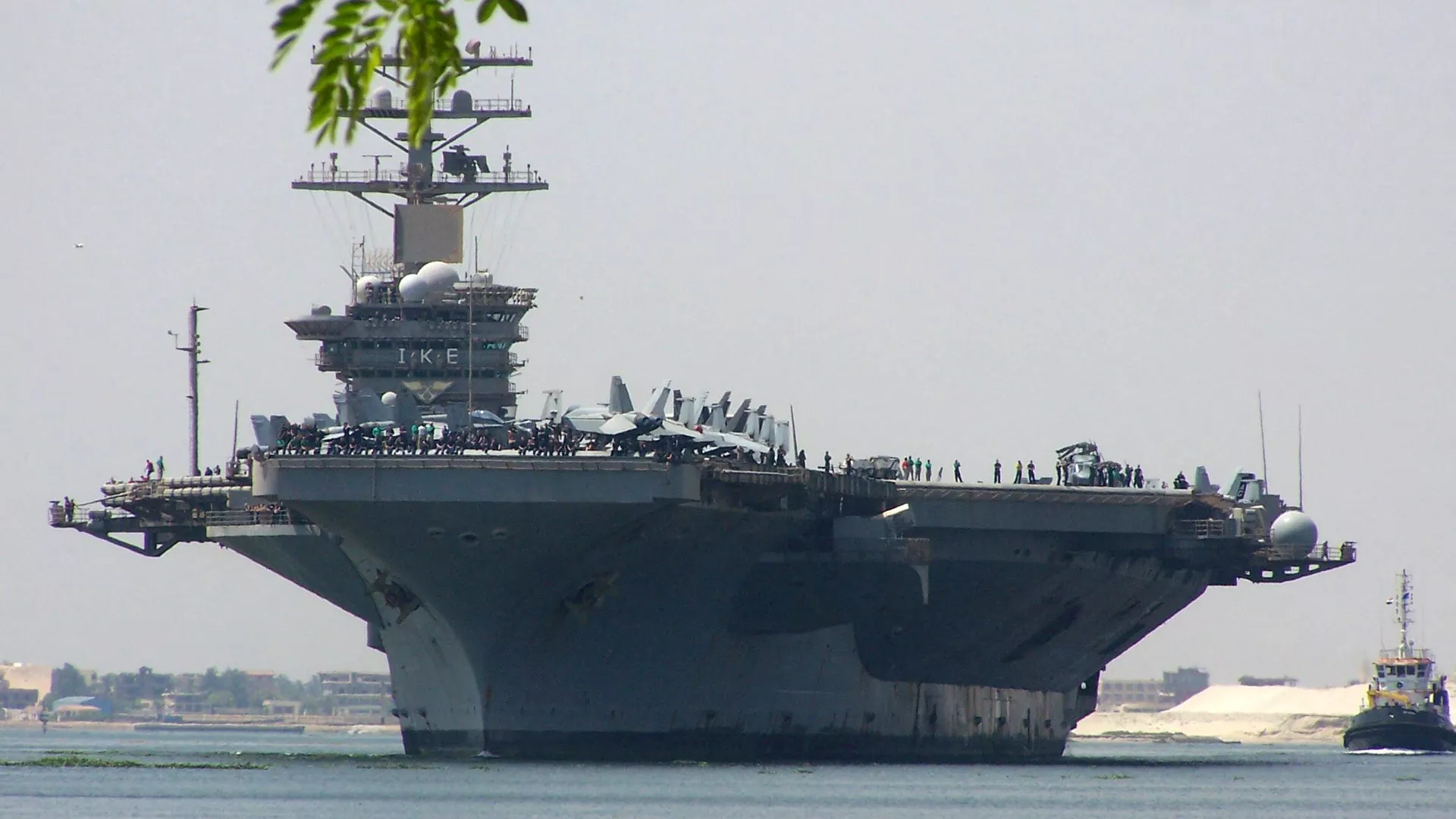
While the hostilities are raging in Gaza following Hamas’s attack on October 7 and Israeli riposte, the United States is flexing its muscles by sending on Tuesday the USS Gerald Ford carrier strike group reached already the eastern mediterranean Sea followed by the USS Dwight D. Eisenhower aircraft carrier including USS Philippine Sea guided-missile cruiser, USS Gravely and USS Mason guided-missile destroyers and Carrier Air Wing 3 with nine aircraft squadrons. US warmonger politician like Lindsey Graham, the man who called for the assassination of Putin, got to take a stand, has sent clear warning to both Iran and Hezbollah stating “ »If Hezbollah, which is a proxy of Iran, launches a massive attack on Israel, I would consider that a threat to the State of Israel, existential in nature… Iran, if you escalate this war, we’re coming for you. » If Hezbollah is a proxy of Iran, we can say the same thing about Israel which is not only a proxy of the US but it is mere military base in the Middle East, someone called the Jewish state, the neighbourhood policeman and Washington, the central police station. Like Israel in the Middle East, one can add Ukraine used by the US and its European vassals as proxy against Russia. To the long list of US and European Union proxies, one can add nazi groups, those who fomented Euromaidan in 2014 overthrowing Yanukovich’s government ; the Mujaheddins and Ben Laden in Afghanistan, created by the CIA and the support of Saudi and Pakistani Intelligence agencies, used as proxy forces to fight the USSR ; using armed mercenaries of fascist Croatian Ustase who claim to belong to Ante Pavilic’s movement, the equivalent of Ukraine’s Stepen Bandera ; myriad of Jihadists mercenaries used as proxy forces by the US+EU to destroy Iraq, Libya and Syria and to destabilize states in the Sahel region, Mali, Burkina Faso and Niger; the CONTRAS, counterrevolutionary groups created by the CIA, used drug dealers as proxy forces to overthrow the Sandinistas government in Nicaragua

Catégories
Non-classé

Borell’s Chimeric world

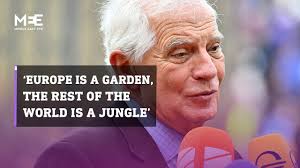
This man is living in chimeric world by stating EU would provide military and financial aid to Kiev regime without the support of the US. This racist man who said someday that Europe is a garden and the rest of the world a jungle didn’t read the history of master and slave between European continent becoming a mere US colony since the end of the WWI, during the interwar period and especially after the WWII. By creating NATO in 1949, the United States achieved its military and political control over Europe which has lost both its military and strategic autonomy, serving as auxiliary force for US endless wars and aggression against weak nations in Africa and the Middle east. In August 2013, former French president Hollande planned the destruction of Syria and the murder of Assad following the path of his predecessor Sarkozy who succeeded in Libya in 2011 by destroying the then prosperous African nation and the assassination of its leader Kaddafi. But Obama who already waged his aggression against Libya said no to Hollande who resigned himself by renouncing his criminal plan against Syria. By alleging EU aid to Ukraine without US seems to be ridiculous as both Europe and the US powerless to change the balance of power in the battlefield against Russia. Such military powerlessness of Europe and the US can be explained, before Ukraine conflict, the West was fighting against weak countries without powerful military industrial complex oble to cope with western military.

Catégories
Blog European Union fascism militarismus NATO Nazism OIL WAR ON TERROR WARS & CRISES

RUSSIA HAD NO CHOICE BUT TO CHANGE THE GAME ON HER BORDERS BY MILITARY MACHINE

Putin’s decision to launch military special operations in Donbass and Ukraine did not come out from nowhere.

On Monday, February 21st President Putin, also acting on the request of the Donbass Republics, and the recommendation of the Russian Security Council, made the momentous and logical decision to do exactly that.The Minsk Agreements, though supported by Russia, were being impeded and sabotaged by some European nations, by the Kiev regime and the USA. Since 1999,Putin witnessed the dismembrement of Yugoslavia,bombing by NATO of Serbia in 1999, American invasion of Afghnaistan in 2001,Iraq invasion in 2003,color revolution in Georgia in 2004 and in Ukraine the same year, color revolution in Georgia in 2008, the so called Arab Spring in 2011 used by the US and NATO to topple Libyan regime and the Syrian regime. Putin witnessed also NATO expansion in Eastern Europe whose members went from 16 after the demise of the USSR to 30 today.

The Americans and their satellites states go further and claim a right to expand their alliance, but on what legal, moral or security grounds this right is based they cannot say. They claim that nations have the right to join NATO of their own free will, but this again is a distortion of the facts. The NATO Treaty states that accession to the Treaty is by invitation only. So there is no right of any nation to freely choose to join NATO. That is a decision ultimately controlled by NATO, by the United States in fact, not the nation seeking to join.

Earlier this year President Putin sent to the American president a proposal for a Treaty which would guarantee the peace in Europe. The offer was met with contempt and rejected out of hand by the Americans who played games with the text and offered to negotiate on peripheral items, while ignoring Russia’s demands that NATO cease its expansion, withdraw American nuclear weapons from Europe, dismantle the bases and equipment it has placed all over eastern Europe in preparation for war on Russia and agree not to place missile systems close to Russia’s borders.

On December 17, 2021, the Russian Foreign Ministry released draft agreements on the security guarantees that Moscow expects to receive from Washington and NATO. The documents clearly require that NATO cease its eastward expansion and return its military infrastructure to the 1997 borders.The proposed measures include guarantees that NATO will not advance eastward, including the accession of Ukraine and other countries into the alliance, as well as non-deployment of serious offensive weapons, including the nuclear one

The United States and NATO handed their written responses to Russia’s security proposals over to Moscow on January 26, 2022 without any crucial concession.

Moscow’s reaction to Washington’s response on security guarantees published on February 17 underscored that the US provided no response to Russia’s proposal to bring back nuclear weapons to its soil, but just agreed to deal with the issue of non-strategic nuclear weapons without taking into account the specifics of its location

On February 24, Russian President Vladimir Putin announced a special military operation based on a request from the heads of the Donbass republics. The Russian leader stressed that Moscow had no plans to occupy Ukrainian territories and the goal was to demilitarize and denazify the country.

On the morning of February 24, Russia officially launched a « special military operation » against Ukraine, designed, as Russian President Vladimir Putin explained, to « demilitarize » and « denazify » the neighboring state. The goal of the operation is to protect the people of the Donetsk and Lugansk People’s Republics (DPR and LPR), he said. The Ukrainian authorities subsequently severed diplomatic ties with Russia, urging its partners to create an « anti-Putin » coalition against the Russian troops entering Donbass and shelling military infrastructure facilities throughout the country. On the evening of February 24, the press service of the Ministry of Defense reported that DPR and LPR troops advanced 6-8 km from the front line with the Armed Forces of Ukraine, and the Russian armed forces completed all the tasks assigned for that day. Also, two Su-27 and two Su-24 aircraft, as well as one helicopter and four Bayraktar TB-2 UCAV belonging to Ukraine were shot down, and 83 ground military infrastructure facilities of Ukraine were incapacitated.

So far, the US, its satellites states and NATO are waging hysterical propaganda against Russia and Putin becoming in the West Putler(Putin = Hitler) The question of when the DPR and LPR will liberate their territories within the borders of the Donetsk and Lugansk regions, as written in their Constitutions, remains open. In addition, Russia’s military operations should should change regime in Kiev and set up buffer zone including the entire left bank of Ukraine, as well as its Black Sea regions. Dnepr, Zaporozhye, Mariupol, Odessa, Ochakov, Nikolaev, Kherson, and other cities that have industrial and defense enterprises essential to the Russian Federation. If they are controlled by Moscow, this means that Russia has defeated the West and taken its Slavic partner out of the sphere of influence of the United States and NATO.

Catégories
Anti China Crusade Anti Russia Crusade Blog Geopolitics OIL WARS & CRISES

US NEW STRATEGY TO COUNTER CHINA AND RUSSIA

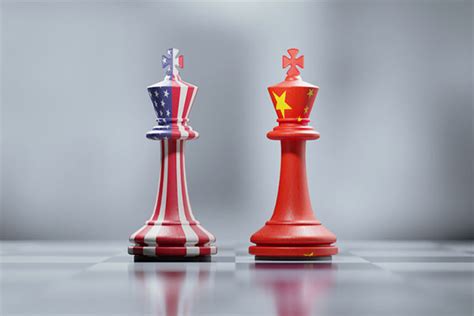
In 2018, the United States government has declassified its Indo-Pacific strategy initially set to be released to the public at the end of 2042. The strategy was initially devised throughout 2017, going on to be approved and enforced by President Donald Trump in 2018 shortly after the US National Defense Strategy was finalised. At its heart, the strategy highlights a deep concern with China’s rising influence in the Western and Central Pacific and plans to deal with an increasingly belligerent North Korea, while seeking to use its South-East Asian allies to contend with China and North Korea and to strengthen India to counter Chinese military power.

Countering China in the South China Sea

The strategists highlight China’s growing dominance in the Indo-Pacific and consider Beijing as is the United State’s primary adversary and strategic opponent in the area. While the document does not mention the South China sea dispute, it reflects a concern over China’s claims there and in other parts of the Western Pacific. The strategy to counter China aims to build US capabilities until they are “capable of, but not limited to” denying China control of the air and the sea in the “first island chain”, referring to a string of Pacific islands surrounding China that include Russia’s Kamchatka peninsula, Japan, Taiwan, Philippines, Malaysia and Vietnam. China claims most of these waters. Second, it emphasizes the strategy emphasizes the need to defend the first island chain, and dominate all areas outside it.

disputed zones in the South China Sea

A US Navy oceanographic survey

Since last September, a US Navy oceanographic survey ship has been conducting extensive activities in a large area of the South China Sea to collect underwater geographical and hydrological data to support its submarine warfare in the region against China.

This situation also drew attention from some military observers after a US nuclear-powered attack submarine struck an unidentified underwater object in the South China Sea earlier this month, which again highlighted the US Navy’s need to learn more about the region.

The USNS Mary Sears (T-AGS 65), a Pathfinder-class oceanographic survey ship, entered the South China Sea on September 26 and started extensive surveys. From October 1 to 4, the ship operated in waters south of China’s Hainan Island, from October 5 to 9, it approached the coastline of Vietnam, and by Sunday it had arrived in waters near the Nansha Islands. The Pathfinder-class oceanographic survey ship is specialized in the detection and surveying of underwater terrain, meteorology and hydrology.

The USNS Mary Sears (T-AGS 65)

While the ship seems to be conducting scientific research, its true mission is to support submarine and anti-submarine warfare, the USS Connecticut, a Seawolf-class nuclear-powered attack submarine, struck an underwater object in the South China sea on October 2.

the USS Connecticut, a Seawolf-class nuclear-

This accident means the sea map the submarine was using was outdated, and the US Navy was conducting scientific research to draw underrates maps with the mission to support submarine and anti submarine warfare and help navigate friendly submarines or place detection device to locate hostile submarines.

Countering China and Russia in the Middle East

President Joe Biden’s Interim National Security Strategic Guidance Lt. Gen. Ronald Clark, who spoke at the Association of the U.S. Army’s annual conference Oct. 12 emphasized the challenges of strategic competition with Russia and China to American interests, including nonmilitary events taking place across the Middle East. The major challenges to the command’s operations are China, Russia, Iran and “violent extremist organizations around the world,” he said. But the commander primarily cited Russia and China, which he said are making moves in the Middle East to “set conditions for future operations.” 

Both nations blur the lines between competition, crisis and conflict. While it falls short of actual conflict, Clark said these actions are a part of strategic competition and will shape future conflicts in the Middle East and beyond. Events in one theater will spill over — undoubtedly — to another,” he said. “Bottom line: All of our competitors are setting conditions in the [command’s area of responsibility] right now that we need to respond to.”

Middle East map

For example, China engages in unrestricted warfare, which consciously expands the battlefield from traditional domains such as land, air and sea to social spaces, politics, culture and economics. An important piece of that in the Middle East is the Belt and Road Initiative, which consists of a number of economic investments by the Chinese government and Chinese-owned companies in foreign countries. The Belt and Road Initiative touches virtually every country in [the command’s area of responsibility],” said Clark, pointing to a $300 billion investment by a Chinese-owned company into the port of Abu Dhabi in the United Arab Emirates. China continues to import massive amounts of oil from the Middle East, helping Iran build a new export facility that will allow it to continue pumping oil past the Strait of Hormuz. 

Hormuz Strait

Meanwhile, Russia is practicing its own form of hybrid warfare using nonmilitary means to create an operational environment where a smaller military force can come in and achieve its objective, Clark said. For example, a 2017 deal allowed Russia to expand the Port of Tartus in Syria, and it can now hold up to 12 nuclear-powered ships or submarines, he added. That now allows the Russians — if they want to — to project power into the Mediterranean and into Eastern Europe,” he said.

Syria’s Tartus port

The US Central command’s area of responsibility is vast. It includes 21 countries that make up more than 4 million square miles and are home to 550 million people in 22 ethnic groups speaking 20 different languages.

Oil locations in the Middle east

Importantly for American interests, he added, it’s also home to vast oil reserves. Nearly 30 percent of the petroleum and crude oil products from around the world flow through three chokepoints that fall under the command’s purview. Clark pointed to when the supercargo ship Ever Given recently clogged up the Suez Canal for days as an example of the importance of those chokepoints. That incident disrupted 12 percent of global trade with an estimated cost of $9 billion.


Catégories
Blog

HOW US,UK AND EUROPEAN UNION TRIGGERED REGIME CHANGE IN BELARUS

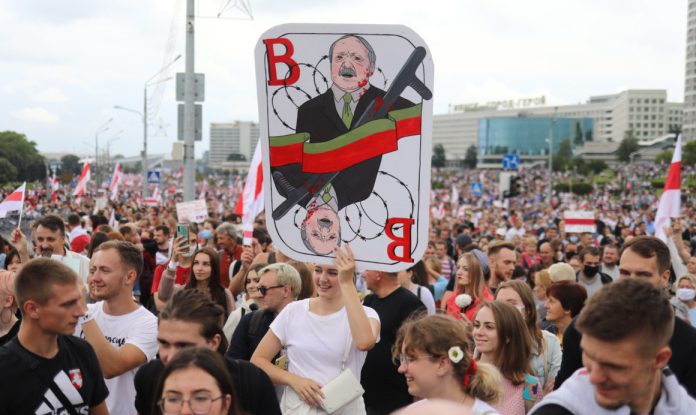
The recent Kidnapping by Belarus of the Neo Nazi Toman Protasevith catapulted back to the top of the mainstream news the at-times fiery protests that raged across Belarus throughout 2020. Similar to previous color revolution for regime change, western propaganda created leader and Belarus was not the exception with the creation of a stooge of the west in the person of Svetlana Tikhanovskaya recognized by Western leaders as the legitimate Belarusian leader.

Western propaganda has deigned to mention that for many years prior to the unrest’s eruption, London and Washington had funded, trained, and promoted the very elements that took to the streets in opposition to President Alexander Lukashenko. Belarusian opposition movement promoted the killing of Belarusian President Alexander Lukashenko in a similar way to Muammar Qaddafi of Libya.

RAND, US think tank published report with a dedicated section of the 354-page report dealt with “promoting regime change in Belarus.” with the objective to undermine Moscow’s proposed Eurasian Economic Union, complicating “any attempt to employ military force against the Baltic States,” and further isolating Kaliningrad,” the Russian exclave situated between Lithuania and Poland.Furthermore, there was little tangible public appetite for democratization. RAND cited a 2015 survey conducted by the Independent Institute for Socio-Economic and Political Research, which found that 78% of Belarusians believed regime change was “not worth people’s blood” and 70% “did not want a Ukrainian-style revolution.”“People don’t want more freedom. They want more government. They want the better life they used to have,” a Belarusian expert quoted in the report said in 2017.

Trigering unrest in Belarus aiming at removing a long-standing Russian-allied dictator “could come in a variety of forms, ranging from public declarations of support by U.S. leaders to more direct financial and organizational assistance helping the opposition parties.”

Promoting liberalization in Belarus was predicted to require European support, and given the bloc faced “a host of other challenges from Ukraine to refugees to Brexit,” Brussels [European Union] “might not want to add Belarus to the mix” and “rock the boat.”

Still, there was perceived value to attempting to precipitate regime change even if the effort ultimately failed as such a campaign would “create apprehensions among Russian leaders,” making them “worry about the prospect of such a movement in their own country.” This would in turn prompt Moscow to reinforce its military presence and political influence within Belarus, burdening Russia with a “weak, corrupt dependency” and possibly even generating “some degree of local resistance,” the report approvingly suggested.

Prior to this section of RAND’s report, U.S. policymakers subsequently is somewhat moot, given Washington had been engaged in precisely the destabilization efforts proposed therein, by way of the National Endowment for Democracy (NED). Founded in November 1983, then-U.S. Central Intelligence Agency (CIA) Director William Casey was central to its creation. He sought to construct a public mechanism to support groups and individuals overseas to engage in propaganda and political action undermining “enemy” governments from within—activities historically organized and paid for clandestinely by the Agency—under the bogus aegis of democracy and human rights promotion. For example, during the Reagan administration’s brutal secret war against Nicaragua’s progressive Sandinista government during the 1980s, in which tens of thousands died, NED allocated millions of dollars to “civic opposition” entities—including La Prensa, the country’s primary anti-Sandinista newspaper. The CIA trained, funded, and armed the Sandinistas’ fascist opponents, the Contras. In particular, the Agency’s “Tayacan” manual on guerrilla warfare was highly influential, leading the group to incite mob violence, “neutralize” government officials and civilian leaders, and attack “soft targets” such as schools and hospitals, among other hideous atrocities. The NED funded at least 159 civil society initiatives in Belarus, costing $7,690,689, from 2016 to 2020 alone aiming at promoting

Publicly available data indicates the NED funded at least 159 civil society initiatives in Belarus, costing $7,690,689, from 2016 to 2020 alone, coordinated with the Warsaw-based Belsat TV station promoting anti Lukashenko propaganda were behind the unrest aiming at regime change in Belarus. According to  investigative journalist Robert Parry  after the March 2014 Maidan coup, the NED bankrolled 65 projects in Ukraine in the years prior to that uprising.

In September 1991, The Washington Post published an article on the subject of “spyless coups” abroad, in which it referred to the NED as the “sugar daddy of overt operations,” and noted that throughout the late 1980s, it had “dispensed money to anti-communist forces behind the Iron Curtain.”

“Covert funding for these groups would have been the kiss of death, if discovered. Overt funding, it would seem, has been a kiss of life,” the newspaper concluded.

NED funding has very clearly been a “kiss of life” to a large number of oft-dubious opposition actors within and without Belarus, in turn unleashing all manner of chaos—and what’s more, its “sugar daddy” status is now being challenged by a number of other spectral, malign Western actors.

U.S. meddling in Belarus dates much further back than 2016. Five years earlier, an official White House press release on U.S.-Polish “efforts to advance democracy worldwide” had a dedicated section on the pair’s work to “pressure” the Lukashenko government and “support civil society,” which stated the Broadcasting Board of Governors (BBG) would work with the Warsaw-based Belsat TV station “to develop content and programming on democracy education.”

Founded in December 2007 by the Polish Ministry of Foreign Affairs, Belsat dubs itself “reminiscent of” U.S. propaganda outlets Radio Free Europe and Voice of America—assets of BBG [now U.S. Agency for Global Media]—describes its mission as “promoting democratization processes” in Minsk, and boasts that events in Ukraine “have shown Belsat TV has influenced the public opinion not only in Belarus, but elsewhere in the region, too.”

On an official visit to Warsaw in late 2017, then-UK Prime Minister Theresa May allocated £5 million of UK funding to Polish organizations to “detect and counter the spread of Russian information operations,” with some of the money specifically earmarked for Belsat. UK Foreign, Commonwealth & Development Office (FCDO) files leaked by hacktivist collective Anonymous shed some light on the support provided by London to the station via Thomson Reuters Foundation (TRF), the internationally renowned newswire’s charitable arm.

In all, Belsat received 150 days of intensive consultancy in a three-month period—“of which 97 were delivered in-country”—from consultants, interpreters, and project and finance managers, among them Reuters staff. If TRF sought to greatly ramp up Belsat’s propaganda capabilities, then its counsel was certainly successful. TRF’s guidance was informed by the findings of an extensive “target audience analysis” of Belarusian citizens’ perceptions and motivations conducted in January 2017, which sought to “identify opportunities” to “appropriately communicate” with them. The study was commissioned by the FCDO in January 2017, under the auspices of a £100 million Whitehall effort to weaken Russia’s influence in its “near abroad.”  In particular, London was interested in Belarusians’ “existing or potential grievances against their national government” that could be leveraged, and “channels and messages” through which the UK government could “appropriately engage with different sub-groups.”

The FCDO’s “target audience analysis” was carried out by long-time Whitehall contractor Albany Associates, central to a number of London’s covert information warfare operations aimed at Russia.

In one such connivance, the firm sought to “develop greater affinity” among the region’s Russian-speaking minority for the UK, European Union, and NATO. In another, it collaborated with French NGO IREX Europe to “promote media plurality, balance and literacy in Central Asia.”

In its submissions to the FCDO, Albany noted IREX had been working in Belarus since 2006 “with print, online and radio outlets,” to “improve the quality of their coverage,” and “increase their understanding of the EU and EU member states.” As part of its youth audience offering in the country, the organization was said to have founded Warsaw-based Euroradio, along with online outlet 34mag.

IREX is closely connected with the NED, and created Euroradio in 2006 with funding from the U.S. Agency for International Development (USAID), another entity that has frequently been used to insidiously undermine governments in Washington’s crosshairs. Just like the FCDO, USAID—now under the direction of war hawk Samantha Power—operates a multi-faceted program targeted at Russia’s “near abroad,” Countering Malign Kremlin Influence, “in alignment with U.S. national security strategy.”

A 2015 report on backing provided by IREX to “independent” media across Eastern Europe under the terms of its “cooperative agreement” with USAID details Euroradio’s exponential rise following its launch. Within four years, it was also receiving sizable funding from the European Union and numerous foreign governments, and running elaborate promotional multimedia campaigns.

By 2008, it was sponsoring 300 events in the region annually, receiving “significant free exposure” by “placing its banners at music and cultural events,” including the annual Right to be Free concert in Lviv, Ukraine. Bands from Belarus, Ukraine, and elsewhere played to a 10,000-strong crowd, “with many bused in from Belarus.”

During the 2010 election, it broadcast live footage of protests following the vote via the web, Skype, and various instant messaging platforms, “interviewed leading opposition candidates, reported on the arrests of protesters, reported from the election commission, and provided reports from six regions through regional stringers,” tailoring its “content and marketing efforts” specifically for 17-35-year-olds.

These activities among others cemented Euroradio as Belarus’s “leading external radio broadcaster” and, come 2012, its “potential audience for terrestrial broadcasts” was two million, more than one-fifth of the country’s population, the website receiving hundreds of thousands of visitors monthly.

Throughout 2020 and beyond, Euroradio almost endlessly published footage of violent crackdowns on protesters in Minsk, which in turn was routinely aired by the mainstream media. The BBC went to the extent of issuing an open call for activists on the ground to submit pictures and videos for use in its coverage, which Euroradio enthusiastically amplified.

Much of the content featured in Western news reporting on the unrest was created by individuals and organizations secretly in receipt of funding and training from Open Information Partnership (OIP), the “flagship” strand of the FCDO’s multi-pronged propaganda assault on Russia. OIP maintains a network of 44 partners across Central and Eastern Europe, including “journalists, charities, think tanks, academics, NGOs, activists, and factcheckers.”

Internal Whitehall documents reveal one of its primary objectives is influencing “elections taking place in countries of particular interest” to the FCDO. It achieves this disruption by helping organizations and individuals produce slick propaganda masquerading as independent citizen journalism, which is then amplified globally via its network.

In Ukraine for example, OIP worked with a dozen online “influencers” to “counter Kremlin-backed messaging through innovative editorial strategies, audience segmentation, and production models that reflected the complex and sensitive political environment,” allowing them to “reach wider audiences with compelling content that received over four million views.”

Similarly, in Russia and Central Asia, OIP established a network of YouTubers, helping them create videos “promoting media integrity and democratic values.” Participants were taught to “make and receive international payments without being registered as external sources of funding” and “develop editorial strategies to deliver key messages,” while the consortium minimized their “risk of prosecution” and managed “project communications” to ensure the existence of the network, and OIP’s role, were kept “confidential.”

Belarus, along with Moldova and Ukraine, is referred to in the leaked files as “the most vital space in the entire [OIP] network,” and a “high-impact priority” country for London. This suggests its 2020 election was very much “of interest”—and the shock results of Moldova’s November 2020 presidential vote suggest OIP’s informational influence can be decisive.

In Moldavia, that election pitted upstart pro-Western Maia Sandu against incumbent pro-Russian leader Igor Dodon, with the former emerging victorious in a win widely acknowledged by the Western media to be surprising. Two Moldovan organizations, the Association of Independent Press and Newsmaker, are fellow OIP network members, and could well have served as conduits for FCDO-funded, pro-Sandu, anti-Dodon material. Maia Sandu speaks to reporters during election. Slovakian OIP member MEMO 98, coincidentally also funded by NED, published an extensive study of the election campaign, attributing Sandu’s upset to her social media Nous.

MEMO 98 similarly kept a close eye on the Belarus protests, publishing several analyses of media reporting and social media activity related to the strife, in the process drawing particular attention to the output of none other than Belsat, praising its “extensive coverage of protests and related intimidation of activists.”

An American father-son duo ­accused of orchestrating former Nissan chief Carlos Ghosn’s audacious escape from Japan admitted their role on Monday as they made their first appearance before a Tokyo court.

Former special forces operative Michael Taylor, 60, and his 28-year-old son Peter,now in trial in Japan for orchestrating former Nissan chief Carlos Ghosn’s audacious escape, who is currently an international fugitive living in Lebanon,smuggled in a music equipment case received 144 million yen ($1.3 million) spent on preparations for the escape including the costs of chartering a private jet 

An American father-son duo ­accused of orchestrating former Nissan chief Carlos Ghosn’s audacious escape from Japan admitted their role on Monday as they made their first appearance before a Tokyo court.

Former special forces operative Michael Taylor, 60, and his 28-year-old son Peter were ­extradited by US authorities over claims they smuggled Ghosn out of Japan in a music equipment case as he awaited trial.

At the Tokyo district court on Monday, the pair said they did not contest the facts laid out by prosecutors in an indictment, effectively conceding their role in the saga.

The pair face up to three years in prison if convicted of helping Ghosn, who is currently an international fugitive living in Lebanon, which has no extradition treaty with Japan.

Ghosn was out on bail while awaiting trial on four counts of financial misconduct, which he denies, when he managed to slip past authorities onto a private jet, transit in Turkey and land in Lebanon.

The escape was hugely embarrassing for Japanese authorities, who termed it « one of the most brazen and well-­orchestrated escape acts in ­recent history. »

The Taylors, along with a Lebanese national still at large, are suspected of orchestrating the December 2019 escape – including putting Ghosn inside an audio equipment case to get him onto the private jet.

The pair fought their extradition to Tokyo, claiming they could face torture-like conditions, and have not commented on their case since arriving in early March.

Tokyo’s Deputy Chief Prosecutor Hiroshi Yamamoto has declined to comment on their arraignment, but local media said both men have admitted wrongdoing during questioning.

Public broadcaster NHK has said Peter received 144 million yen ($1.3 million) from the Ghosns for their help. The Asahi Shimbun daily said the pair spent most of the money on preparations for the escape, including the costs of chartering a private jet,

HOW US,UK AND EUROPEAN UNION TRIGGERED REGIME CHANGE IN BELARUS
Catégories
Blog Home

10 YEARS AGO, A GENUINE POPULAR REVOLUTION IN TUNISIA, HIJACKED BY THE WEST

10 YEARS AGO, A GENUINE POPULAR REVOLUTION IN TUNISIA, HIJACKED BY THE WEST

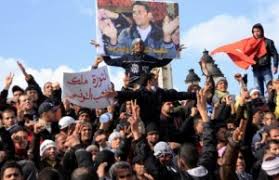
On December 17,2010 erupted a genuine popular uprising in Tunisia when Mohammed Bouazizi, an unemployed 26-year-old, who had been supporting his family by selling fruit from a cart, was enraged when local officials repeatedly demanded bribes and confiscated his merchandise, set fire to himself outside a municipal office in the town of Sidi Bouzid in central Tunisia. As it was expected in similar circumstances and in case of mounting class struggle, the ruling class led by Zineddine Ben Ali has sent its armed gangs in the words of Friedrich Engels celebrating this year his bicentenary(born on November 28,1820), in order to repress the revolt and to nip in the bud a class Revolution. Dozens of protesters were killed in clashes with police.

At the start of the popular uprising, the ruling class sought to manoeuvre and to lure the revolted masses. Ben Ali dismissed the minister of the interior, Rafik Belhaj Kacem, and vowed to establish an investigative committee to examine the government’s response to the crisis. However, All attempts to quell the rioting had failed and clashes between police and protesters continued and spread to the capital, where the government deployed troops to control the popular uprising. The French ruling class,disappointed by the course of the events, proposed through the then foreign minister Michèle Alliot Marie, to send to her friend Ben Ali French armed gangs in Tunisia to help quell the popular uprising and to restore order. On January 13 Ben Ali appeared on national television and made broader concessions to the opposition, promising not to seek another term as president when his term ended in 2014. He shed some crocodile te ars by expressing regret over the deaths of protesters,vowed to order police to stop using live fire except in self-defense and to reduce food prices and loosen restrictions on Internet use.

Despite Ben Ali’s concessions nothing works and did not satisfy the protesters, who continued to clash with security forces, resulting in several deaths. On January 14 a state of emergency was declared, the government had been dissolved and legislative elections yo be held in the next six months. That announcement also failed to quell unrest, Ben Ali stepped down as president and left the country seeking a safe shelter in Saudi Arabia. The prime minister, Mohamed Ghannouchi, assumed power. The following day Ghannouchi was replaced as interim president by Fouad Mebazaa, the former speaker of the lower house of the Tunisian parliament. Both were members of Ben Ali’s political party, the Democratic Constitutional Rally ( Rassemblement Constitutionel Démocratique; RCD)

On January 17, Ghannouchi, once again acting as prime minister, announced the formation of a new unity government incorporating several opposition figures in cabinet posts alongside several sitting ministers from the Ben Ali regime. He also announced that the interim government would act quickly to preserve economic stability and to establish political freedom in Tunisia, releasing political prisoners and eliminating media censorship. The next day, however, the future of the interim government appeared to be in jeopardy when a number of the cabinet’s new ministers from opposition parties resigned in response to fresh street protests over the inclusion of ministers from the previous regime. Attempting to signal a break with the past, Mebazaa, Ghannouchi, and the interim government’s cabinet ministers who had served under Ben Ali all withdrew from the RCD. The interim government announced another set of reforms, lifting Ben Ali’s ban on opposition political parties and granting amnesty to all political prisoners. In February the government officially suspended all RCD activities.

Tunisian popular uprising inspired similar popular uprisings in a number of other North African and Middle Eastern countries, including Egypt, Jordan, Algeria, Yemen, Iran, Bahrain, Syria, and Libya. It was Egypt’s Mubarak regime that the first to suffer the Tunisian popular uprising. Egyptian popular uprising where Mubarak regime was considered as a stable and loyal ally of the US and Israeli regimes in the Middle East ringed the bell and gave the alarm to American establishment and its satellites in Europe prompted to react in order to quell the current popular uprising in Tunisia and Egypt and to prevent its spread to African and Arab allied regimes turning into the US orbit. For these purposes, the US which had a solid experience in regime change and in the techniques of psychological manipulation of the masses implemented successfully by the CIA psychological warfare division since the Truman doctrine aiming at fighting international communism all over the world, fomented the well known Color revolution in some hostile nations, resistant or refractory to American hegemon. The revolt and the angry of the Arab streets which were initially a class struggle of the oppressed and exploited classes, directed against the exploiting ruling class and the incumbent regime, turning in the US orbit, have been deflected from its initial trajectory, galvanized, diverted and hijacked by the West to be directed against governments and regimes resisting US geopolitical projects aiming at securing the oil and gas of the Middle East and North Africa. Toppling Kadaffi’s regime in Libya was to secure the oil and gas of the African nation to the benefit of American and western firms and multinationals. Behind attempt to topple Assad regime in Syria, there are in the same time Syrian oil and gas and geopolitical target, phasing out the Iranian influence in Syria and Lebanon.

Catégories
Blog

THE BIRTH OF A MEGA FREE TRADE PACT : THE REGIONAL COMPREHENSIVE ECONOMIC PARTNERSHIP(RECEP)

THE BIRTH OF A MEGA FREE TRADE PACT : THE REGIONAL COMPREHENSIVE ECONOMIC PARTNERSHIP(RECEP)

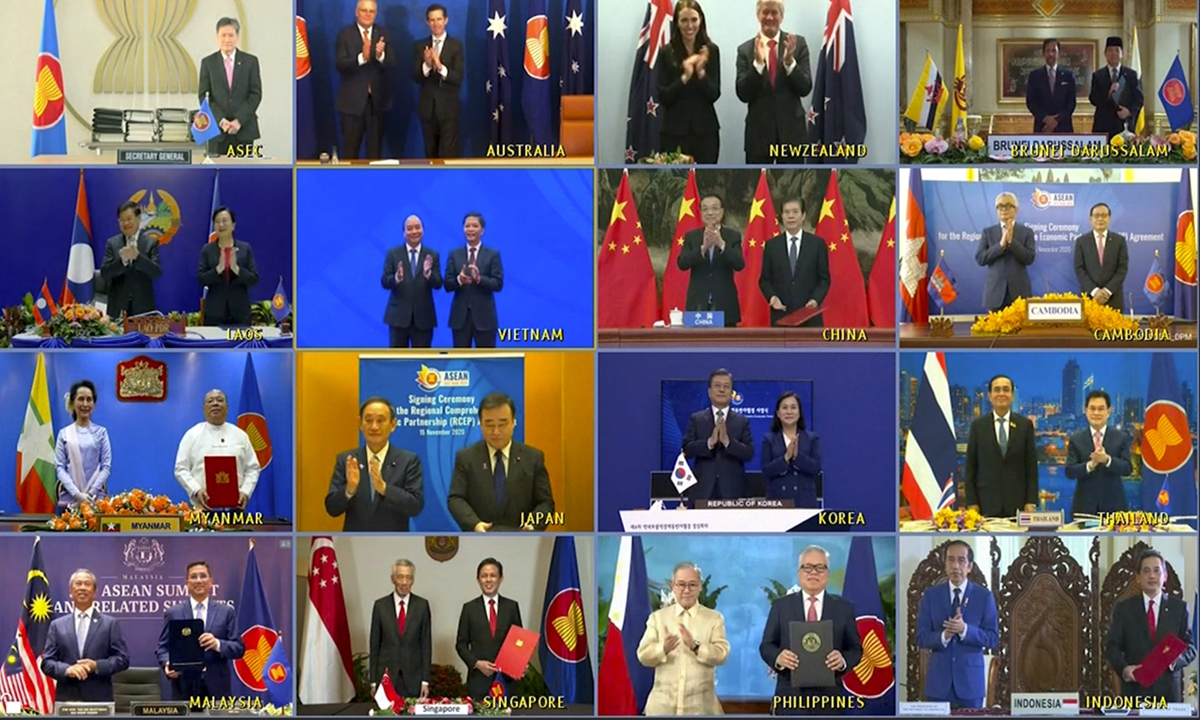
During a virtual summit was created on Sunday November 15, a mega trade bloc, the Regional Comprehensive Economic Partnership (RCEP) including the 10 ASEAN member states, China, Japan, South Korea, Australia, and New Zealand. The 14000 page agreement contains 20 chapters, dealing with tariffs on trade among member countries, including removing barriers for investment and travel. The RCEP is the world’s largest trade agreement, with a combined population of 2.27 billion, $26 trillion in GDP, and $5.2 trillion in exports.  The agreement could boost exports among member countries by 10.4% by 2025, investments by 2.6ù, and GDP by 1.8%.

The first steps that will be implemented by the agreement consist of removing tariffs on 90 percent of merchandise immediately after its implementation, and zero tariffs in 10 years, adopting a « negative list » for investments in manufacturing, agriculture and several other sectors, including arrangements for visas and money transfers.

The RCEP, as an integrator of regional economic and trade rules, will be a recipe allowing the countries at different development stages to engage in a trade deal and trade liberalisation for its diverse groups of its members but also it will become the platform to pursue more bilateral trade deals and resolve trade and other disputes.

Because of the very diverse political systems of its members, the implementation of the agreement will also face challenges and risks not only from internal disputes between its members but also from US and EU meddling.

Mainstream American outlets described the signing of the Regional Comprehensive Economic Partnership (RCEP) agreement, one of the world’s largest regional free trade pacts, as a “challenge” to US trade. Biden’s administration would probably riposte through the US participation US participation in the Asia-Pacific multilateral trade mechanism, the Trans-Pacific Partnership (TPP) – renamed the Comprehensive and Progressive Agreement for Trans-Pacific Partnership (CPTPP).

Likely,the US and EU will exploit internal disputes between the RECEP’s members in order to disrupt the process, by meddling for example in
trade disputes between Japan and South Korea and igniting diplomatic tensions between China and Australia accused for its role in helping the US attack on Beijing.
To increase confrontation, the US and EU will try to sow  the discord in some member countries and divide the 15 members at the same time.

Even before Donald Trump assumed office, the US was trying to contain the rise of China by initiating negotiations for the TPP, which was widely viewed as a strategy to isolate China. Although the Trump administration withdrew from the TPP, it has continued by stirring up tensions in the South China Sea. 

Joe Biden, who pushed for TPP might try to disrupt the RCEP but the US would not be able to disrupt the process as the US-led multilateral trade mechanism in the Asia-Pacific does not fit many in the region, because in the framework of the RCEP each country will focus not on services provided by the US partnership but on existing industrial advantage which is more attractive to ASEAN countries

As a sign of confidence after the signing of the agreement, stock markets stock soared across the Asia-Pacific rallied on Monday as the benchmark Shanghai Composite Index gained 1.11% at market close, in Japan, the Nikkei 225 rose 2.05%, in South Korea, the Kospi also gained nearly 2% and in Australia, the S&P/ASX 200 rose 1.23%. 

Catégories
Blog

What was behind the atomic attack against Japan ?

75th ANNIVERSARY OF HIROSHIMA AND NAGASAKI

What was behind the atomic attack against Japan?

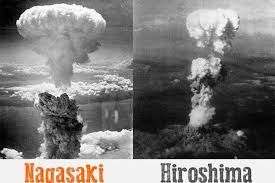
At the occasion of the 75th anniversary of bombing the two Japanese cities Hiroshima and Nagasaki on August 6 and 9, 1945, the debate over the use of nuclear arms against Japan is not yet close. The official story propagated by conventional historiography assumes that the US resorted to the atomic bomb against Japan in order to put an end to the WWII, to save American lives and to alleviate the suffering of the Japanese people. Eminent historians shunned the dominant these rejecting the humanitarian motivation highlighting rather the geopolitical reasons behind the atomic attack against Japan.

By April, 1945, Japanese leadership had no choice but to surrender as American forces had gained a firm foothold on Okinawa. The combined US-Australian island-hopping attack from the Solomons, near New Guniea, all the way to Japan had begun in 1943. By April 1945 it had reached Japan’s Okinawa, close to three months before the deadline Moscow had set for its attack on Japan.

Through the Allied intelligence operations, in particular Australian Military forces, the US leadership knew all about the imminent Japan surrender. There are leakages of information and interception of Japanese signals which contained details of Allied ‘plans for certain operations in the Philippines’ and details of recent Australian army intelligence estimates of Japanese strength there. There were messages from Moscow being passed on to the Japanese consulate in Harbin, northern Manchuria, and then on to Tokyo and among those messages were those US plans for the island-hopping attack on Japan.

From then, the Japanese Foreign Ministry established contacts with Moscow to broker a peace agreement. The emperor also still pinned hopes on those contacts with Moscow while US requested unconditional surrender. That wishful thinking only ended on August 8 when the USSR formally declared war on Japan and immediately began to attack into Japanese-occupied territories in Manchuria and elsewhere. On August 9 the US nuclear bombed Nagasaki. Six days later Japan surrendered unconditionally to the Allied forces.

Non conventional historical findings show irrefutably it was the prospect of Soviet war against Japan more than the nuclear attacks that forced Tokyo to surrender. After Nazi Germany’s defeat, Soviet forces turned toward Japan with the aim to gain some lost territories – southern Sakhalin and the Kuril islands. It was only hours from landing Soviet troops at Rumoi for the occupation of Hokkaido when Truman reportedly said the troops should go to take some traditionally Japanese islands in the Kurils close to Hokkaido, a deed which Tokyo still uses to refuse a peace treaty with Moscow.

Translate »