Catégories
Blog

What was behind the atomic attack against Japan ?

75th ANNIVERSARY OF HIROSHIMA AND NAGASAKI

What was behind the atomic attack against Japan?

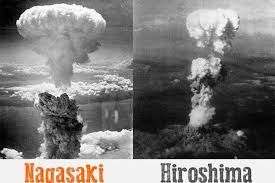
At the occasion of the 75th anniversary of bombing the two Japanese cities Hiroshima and Nagasaki on August 6 and 9, 1945, the debate over the use of nuclear arms against Japan is not yet close. The official story propagated by conventional historiography assumes that the US resorted to the atomic bomb against Japan in order to put an end to the WWII, to save American lives and to alleviate the suffering of the Japanese people. Eminent historians shunned the dominant these rejecting the humanitarian motivation highlighting rather the geopolitical reasons behind the atomic attack against Japan.

By April, 1945, Japanese leadership had no choice but to surrender as American forces had gained a firm foothold on Okinawa. The combined US-Australian island-hopping attack from the Solomons, near New Guniea, all the way to Japan had begun in 1943. By April 1945 it had reached Japan’s Okinawa, close to three months before the deadline Moscow had set for its attack on Japan.

Through the Allied intelligence operations, in particular Australian Military forces, the US leadership knew all about the imminent Japan surrender. There are leakages of information and interception of Japanese signals which contained details of Allied ‘plans for certain operations in the Philippines’ and details of recent Australian army intelligence estimates of Japanese strength there. There were messages from Moscow being passed on to the Japanese consulate in Harbin, northern Manchuria, and then on to Tokyo and among those messages were those US plans for the island-hopping attack on Japan.

From then, the Japanese Foreign Ministry established contacts with Moscow to broker a peace agreement. The emperor also still pinned hopes on those contacts with Moscow while US requested unconditional surrender. That wishful thinking only ended on August 8 when the USSR formally declared war on Japan and immediately began to attack into Japanese-occupied territories in Manchuria and elsewhere. On August 9 the US nuclear bombed Nagasaki. Six days later Japan surrendered unconditionally to the Allied forces.

Non conventional historical findings show irrefutably it was the prospect of Soviet war against Japan more than the nuclear attacks that forced Tokyo to surrender. After Nazi Germany’s defeat, Soviet forces turned toward Japan with the aim to gain some lost territories – southern Sakhalin and the Kuril islands. It was only hours from landing Soviet troops at Rumoi for the occupation of Hokkaido when Truman reportedly said the troops should go to take some traditionally Japanese islands in the Kurils close to Hokkaido, a deed which Tokyo still uses to refuse a peace treaty with Moscow.
Catégories
Archives

American and British anti-communist crusade during the WWII

American and British anti-communist crusade during the WWII 1939-1945

On June 22, 1941, German troops invaded Russia’s borders, from the Baltic to the Black Sea. Finland, Hungary Rumania and Italy joined in the War. The first gesture of American and European political establishment was they all were overjoyed cherishing fondly the idea that Nazi Germany represented the only bulwark against Bolshevism and that Hitler was the only western leader having enough power to get rid the whole world of Communism.  Senator Robert A . Taft expressed the state of mind of the American political establishment and also the European appeasers by declaring » A victory for communism would be far more dangerous to the United states than a victory for Fascism » (quoted by Foster rhea Dulles, The Road to Teheran).

After the invasion and occupation of France, it was Britain’s turn where German bombers had spread fear and terror among Britons. Now, British leaders, those who had helped Hitler and Nazi Germany to relive during the interwar years through the appeasement policy, were well aware that Britain could never defeat Germany without tremendous military aid. Winston Churchill anti-communist crusade was common knowledge, he who had been the power house of Britiain’s huge effort to ward out Bolchevism in Russia during the wars of intervention from 1918 to 1920. in his greatest war-time radio speeches Churchill had said no word of his anti-communist crusade. For the British political establishment, it was matter of life or death and no matter how could be the ally able to save the power, be it communist.

When Hitler invaded Russia, the anti-communist political class both in United States and Europe was convinced that Soviet Russia was doomed to quick conquest and Russia would soon be eliminated from the war and the Soviets would be smashed quickly before aid could arrive. American War Department intelligence officers estimated only one to three months the German campaign in the Soviet Union and this opinion was widespread among military officers in both the United States and Britain they all agreed that the Germans would slash through Russia like a knife through butter and most gave the Reds no more than four to six weeks. This miscalculation was the product of western ideological blindness based on the impression that the Soviet system was a totalitarian system being maintained  only by terror, purges and the so called Gulag system. This false ideas had been deepened by Russia’s poor performance in the early stages of the war with Finland.

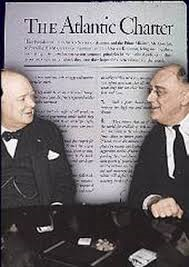
After four weeks of heroic resistance opposed by Russia’s armies to Nazi war machine, which was longer than the minimum life assigned to the Soviet government, American and British leadership began a new stratagem toward Communist Russia shaped at Argentia Conference off Newfoundland on August 9, 1941 at which the Atlantic Charter was drawn up. At this meeting, it was  decided to send a joint mission to Moscow for « help to Russia » through a lend-lease which was only a trickle and ridiculous support regarding the huge military need to resist the Nazi war machine. The Russians had turned the tide at Stalingrad before the alleged American and British help arrived.

the Atlantic Charter must be considered as the first step in the American and British anti-communist crusade during the second World War. This was confirmed by President Roosevelt’s message sent on December 5, 1941, to British Foreign Minister Anthony Eden preventing him of any agreement with Stalin about political agreement concerning Russia’s 1940 boundaries and in eastern Europe..

Catégories
Archives

WEST-USSR’s unnatural Alliance

 WEST-USSR’s unnatural Alliance

By entering the Second World War, war along the united States, Britain and France, the Soviet leadership was well aware not only that their alliance had been, all things considered, dictated by fortuitous conjunction of circumstances but also and at first, unnatural alliance. . Indeed, Stalin who directly participated in the Bolshevik revolution, the Soviet Government had learned the lessons of the their country since 1917 onwards and particularly the numerous declared and undeclared wars western imperialist powers the permanent war waged by the western imperialist powers during the interwar period until the breakup of the Second World War.  A survey of key facts provided by the diplomatic, political and military history and the policies implemented toward the Soviet Union since 1917 till the Nazi invasion of the U.S.S.R on June 22, 1941 were sufficiently eloquent and talking so that the Soviet leadership would aware and  could realize quickly that its Alliance with the West was but a short truce, an interlude dictated by exceptional circumstances before the re-starting of longer and continued anti-communist crusade.

Since 1917, the Soviet leadership understood the situation accurately and clearly  when the Western powers and its objective allies in the interwar period had adopted a definite position regarding the Soviet Union in the International life. Here it is not the appropriate place for detailing exposition of the West-U.S.S.R relations, but it is useful to mention briefly some of these hostile and ostracized diplomatic and political actions toward the Soviet Union or at least  they had been seen and interpreted as such by the Soviet Government. In reviewing the chronology of key facts characterizing the West-U.S.S.R relations during the Bolshevik revolution afterwards, and the interwar period till the outbreak of the Second World War, the Soviet leadership and Stalin at first, that the West supported by its natural offspring, the fascism and Nazism in Europe and in Japan, did not allowed the establishment first in European Continent and then over the world, of a political system based on the abolition of  the private ownership of the means of production and the setting up of collective ownership of these means of production. In short words, for the West and  its leading power, the United States, the struggle against  Bolshevism, and later against the Soviet Union during the interwar period and in the aftermath of the Second World War, against the communism and even against any political regime having any sympathy with the Soviet Union, became a matter of life or death.

here are some key facts suggesting this unnatural alliance and irreducible antagonism between the West and the Soviet Union.

-Western intervention on behalf the anti-Reds forces, the Czechs, the Kornilovs, the Kolchaks, the Denikins, the Yudenitchs, the Alexiev, the Wrangel, the Miller, the Der Glotz

-Allied intervention and foreign invasion by   United states (1918-21), Britain, France, Germany (after armistice=, Japan, Poland) of North and South Russia, Siberia, Odessa, Crimea, Murmansk, occupation of Kiev, in the Baltic (Estonia, Latvia Lithuania), Finland

British War Minister, Winston Churchill directed general Ironside to prepare for an offensive in the direction of Kotlas with the object of making a junction with Kolchak

The failure of foreign intervention to crush the Bolshevik revolution

the Social democrat leader Ebert called for the Army high Command, General Groner, Hindenburg and Ludendorff to crush with artillery the Communist Spartacus

The Soviet Russia not desired a a member of the League of Nations

An anti-red Crusade in the United States, in Britain and in France after the failure of their intervention in Russia

Pretexting the forged story called « Zinoviev », the British Conservatives  severed on May 26, 1927 their diplomatic with the Soviet Union

Chicherin ostracized and treated as pariah during the Genoa economic conference in April 10, 1922

In response, Chicherin concluded the Treaty of Rapallo on April 16, 1922 with Germany

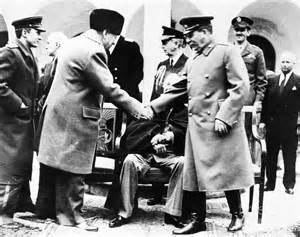
It was notorious that the so called Stalin-Churchill-Roosevelt Alliance was in fact an unnatural, hypocritical and fortuitous Alliance. At the end of the WWII, when the Russians came out of the war and they decided to take their own security measures, they were through with being treated as pariahs and inferiors and undermenschen.

Catégories
Archives

European totalitarianism (2)

European totalitarianism (2) 

In the aftermath of the First World War, the main concern of the victorious powers was less the peace in itself that of how dealing with this new and dangerous threat which was the Bolshevism. Indeed, Versailles’s peace-settlement imposed by the major victors (USA, Britain, France, Italy) was dominated by  two main considerations  : First how the surviving dictatorial regimes in Europe and in the USA  would deal with  the new revolutionary regime in Russia and second how to avoid its spread and its contamination of West European countries, the old and new ones,  by an alternative revolutionary regime, that of Bolshevism.  In short, the main preoccupation of the Victor powers during Versailles negotiations was how making the world safe from Bolshevism  and how re-mapping Europe domestic politics either within the Victor countries as well within the new states in eastern Europe those which had been built on the overthrow of the Russian and Habsurg empires. The  priority for the Allied was  to thwart Bolchevism through direct intervention into Russian territory or by setting up a mercenary and proxy troops, the « Whites » in order to stamp out the new revolutionary Bolshevik regime. The second thing was to redraw the map of Europe by creating proxies regimes and proxies states around dedicated to isolate it behind a « quarantine belt » (cordon sanitaire), in the contemporary language of diplomacy) of  anti-communist states built both on the spoils of the formerly Russian lands and on those of Austro-Hungary empire. This « quarantaine belt » went from north to South : from Finland an autonomous region allowed by lenin to secede; three new little Baltic republics(Estonia, Latvia, Lithuania) proxies states created ex-nihilo having any historical precedent ; Poland restored to independent statehood after 120 years and an enormously enlarged Rumania in size doubled by accessions from the Hungarian and Austrian lands of the Habsburg empire and ex-Russian Bessarabia. The attempt to form proxies states into the Caucasus failed because of the support brought by an anti-communist but  revolutionary Turkey to revolutionary Bolshevik Russia. The attempt to create proxies states such as Armenian and Georgian proxies states setting up after Brest Litowosk and attempts under the British to detach oïl-rich Azerbaijan, had failed after the victory of the Bolsheviks in the Civil War of 1918-1920 and the Soviet-Turkish treaty of 1921;  Other proxies states had been created out of nothing like Czechoslovakia and Yugoslavia combinations.

Catégories
Archives

European totalitarianism (1)

European totalitarianism (1) 


 European totalitarianism can be traced back first to the « total war » waged by the French armies during the Revolution, to Bonaparte dictatorship and to his nineteenth century’s offshoot the Bonapartism embodied by Napoleon III and Bismarck and then to the First World War which played a key role in the passage from Bonapartism and dictatorship with strong executive and strong government to totalitarianism properly so called.    Indeed, after the outbreak of the First World War, western totalitarianism has been progressively set up step by step when European governments transformed their civil societies into militarized societies. Henceforth European governments played not only a role in the management and the direction of military operations but actively intervened in all domains of social and material, by controlling economic production, nationalizing factories determining production targets, allocating manpower and resources During the Fist World War, European governments arrogate to themselves the right of life and death on their own citizens by imposing conscription introduced to strengthen military forces. All civil liberties and the privileges of the habeas corpus had been put aside by implementing press censorship and imposing strict punishments in order to silence any dissident voice. In order to control public opinion and to mobilize the masses for war, European government waged a huge psychological war and made extensive use of propaganda inventing a new device and new techniques in the mental manipulation.

Catégories
Archives

American totalitarianism (1)

American totalitarianism (1)

Making a pretext of sinking of eight American vessels and of revealing of a « plot » to involve the United States in a war with Mexico and Japan, President Wilson appeared on April 2 1917 before the Congress and asked for a declaration of a state of war and on friday April 6, 1917, the United States went to war. Wilson’s slogan « force, force to the uttermost, force without stint or limit » was a declaration for a « total war and marked the passage from American dictatorship to American totalitarianism. At this juncture, the austere and stern scholar turned, under the circumstances of the war, into one of the greatest of war Presidents controlling every aspect of the war effort maintaining morale at home and abroad, mobilizing the nation for war and fight. The government became dictator over industry labor and agriculture ; it took over the railroads and the telegraph lines, farm production was increased  by one fourth and fuel and coal production was raised by two fifths, a colossal shipbuilding program, with more than three million tons in a single year was launched  Conscription had been voted putting Under arms some twenty-five million men; Wilson made use of propaganda at home and abroad. From the beginning of the war Wilson waged a wide and aggressive psychological warfare against Germany; He tried to sow dissension in Germany by insisting that the United States was not fighting against the German people but against his tyrannous and autocratic government. The hunt against dissent and “disloyalty” had been implemented and the First World revealed a constant continuity and a logical development between Alien and Sedition Acts of the 1790s and the Sedition and espionage Acts of Wilson’s presidency during the first World War or lately the Smith Act of 1940.

Translate »