Catégories
Archives

Totalitarianism according to the CIA sponsored western intelligentsia (2)

Totalitarianism according to the CIA sponsored western intelligentsia (2)

The theorist who shaped the notion of totalitarianism sponsored by the CIA and the American foreign policy decision makers during the second anti-communist crusade initiated by Winston Churchill and Harry Truman was indisputably the renegade William Henry Chamberlain who was journalist during the Bolshevik revolution and who knew very well and frequented its leaders especially Lenin. After his turnabout and after becoming a renegade after the Second World War, he been recruited like all renegades and Trotskyists and had been enlisted like American and European intelligentsia in its struggle and ideological and psychosocial warfare against the Soviet Union and the International communism. like all renegades et especially those who were presents in Russia during the Interwar years was the preferred target of the CIA and the American foreign policy’s decisions makers. William Henry Chamberlain had been one the founding fathers of the second anti-communist crusade camouflaging under the expression of Cold war to make believe that there was war between two parties  while there was only one attacker trying desperately to crush the defender. Chamberlain found with one, like him, who was in Russia and knew its leaders in 1930s, Charles E . Bohlen, a novel academic discipline known as Kremlinology. In around Chamberlain-Bohlen circle,  orbited other anti-communist crusaders such  as George Kennan, Isaiah Berlin, A.A. Berle former Secretary of State general William Donovan former head of the OSS, ancestor of the CIA, Allen W . Dulles, OSS representative in Switzerland, Joseph C . Grew, and Arthur Bliss lane, former Ambassadors.

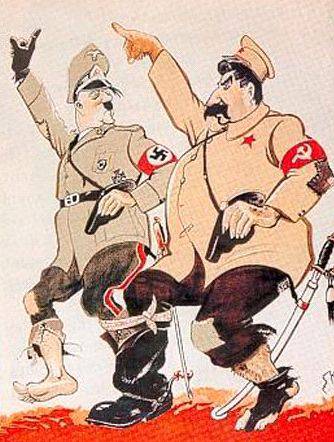
William Chamberlain’s « theory » of totalitarianism had been exposed in his book  » America’s second crusade, Chicago, Illinois, Henry Regnery Company, 1950″ where he expressed his debt and his gratitude to the founding fathers of the American warmongers after the WWII. in his Chapter 2, titled Communism and fascism, Offspring of the war, Chamberlain drew the founding scheme of what would be the imaginative story of totalitarianism, invented out of nothing by well and garssely paid western intelligentsia enlisted by the CIA and its numerous hidden agencies with the double mission, denigrate the Soviet communism and promote the pax Americana. Chamberlain’s ideological scheme was going to serve as model for the CIA’s  propaganda tool and for its pen’s mercenary, for anti communist crusaders,  for the western intelligentsia, for the Schlesingers, for the Arendts and Arons, for the Talmons, generally for « kampgruppe, a fighting squad unequivocally pledged to toppling Communism » (F . Stonor Saunders, Who paid the piper, p. 77)

Chamberlain’s ideological scaffolding of totalitarianism and its main features can be summed up as follows.

  1. Totalitarianism was offspring of the First World War
  2. the fathers founders of totalitalariansm were Vladimir Ilytich Lenin, Benito Mussolini and Adolf Hitler
  3. totalitarianism is a new type of plebeian dictatorship which had been begotten by the despair, brutalization and discarding of old economic forms and moral restraints associated to the First Wold War
  4.  Totalitarianism was a new kind of state based on the unlimited power of a single political party and this party regarded itself as an elite
  5. Totalirainsim is characterized by submission of the individual to a powerful state which paralyze and annihilate the dindivual’s will
  6. the all-powerfull and supposedly infaillible leaders who have been subject to no check or limit in law or public opinion
  7. Under Communism, fascism and nazism, only a single suling pary allowed to exist legally . parliaments in the Soviet Union, germany and Italy became mere rubber stamps for teh registration of the party décisions
  8. Under totalitarian regimes voting is virtually unanimous and altoghter meaningless no voice for independent criticism is ever heard
  9. Communism, fascism and nazism had teh monopole of propaganda, terrorism and flatetry of the masses. All three dictatrosphips developed very powerful methods for molding teh minds of the epople Under theri rule
  10. Under Communism, fascism and nazism there are Citizen, there aere only sub ject who had been envelopped in a cloud of state-directed propaganda; from the carddle to teh grave teh diea is drummed into his head through the newspapers, teh scholls, teh ardio, that he is living in the best of all possible wolrds, taht his highest glory and happiness are to be found in serving the existing regime.
  11. al open counetrpropaganda and free dsicusion are ibanned and impossible Those indivduals who arer not again convereted  the re was always the grim threta of the secrete political police, cheka, OGPU, NKVD, the MVD in Russia, gestapo in germany and teh Ovra in italy
  12. Under Communism, fascism and Nazism the Citizen enjoys not the slightest defense against the arbitrary violence of the state; he can be seized held in prison sent to a concentration camp, tortured killed all without the publicity which would inspire in some resisters the sprit of martyrdom more that his family exposed to reprisals if he falls into disfavour. A soviet law, published in the spring of 1934 authorizes the banishment « to remote parts of Siberia » of the relatives of a Soviet Citizen who leaves the country without permission Totalitarian secret police organizations habitually employ threats against relatives as a means of extorting confessions.
  13. Exaltation of militarism. Every soviet family, school, or political organization is in duty bound to instil in the Soviet youth from the earliest age those qualities necessary to the Red soldier : military sprit, a love of war, endurance, self-reliance and boundless loyalty; This statement appeared in Komsomol-skaya Pravda, official organ of the Soviet Union of Communist Youth on may 21, 1941. One of the reasons for abolishing coeducation in soviet elementary schools was to give boys an earlier start on military starting
  14. full government control of Labor power  in this field the original methods of the totalitarian regimes Communism started out as a violent social revolution expropriating all kinds of private property which profit was derived and confiscating almost all private wealth; Labor was organized, regimented and prorpagndized in very similar fashion Under all three regimes. The labor movement in russia, in germany and in Italy were run by Communist, Nazis and fascists . the individual worker came always second to the supposed intérêts of the state and the Policy of the ruling party
  15. widespread use of slave labor this a a natural and logical conséquences of the Communist-fascist belief that the individual ahs no rights which the state is bound to respect. Nazi-imposed forced labor came to an end with the mùiliatry colaspes of germany in 1945. so a vast network of slave-labor réservations which no indepenedent foreign investigator has ever been allwoed to visit mostly located in northern Russia and Siberia developepd Under the direction of the political police s. Serious students of the subject estimate that there may be eight or ten million human beings in the Soviet labor camps. The methods of punsihment make negro slavery in the United States before the Civil War seem almost humane
  16. Hostility to religion dictatoshipare inevitbly hostile to any form of belief in a trasncendetn moral law with divine sacntions. ths modern dictator’s frirts demadn on his subjectsis unconditonal obedience the totaliatrina state recognizes no distinction between what is due to God and what is due to Caesar. the soviet Governement has persecuted all forms of religion
  17. chauvinism and antionalism Hitler and Mussolini made a national supeirority complex the very basis of their creeds the nazi »master race » theory has been denouced and aprodied soviet communsim preached and still preaches a doctrien of internaitonal revolution to be accomapgnied by an abolition of racila and antioanl disticntions but communist theory and russian rpactice have become  Stalin has been cultivating a form of Russian »mster arce » delusion this takes the form of announcing that some unknown or litthe-known Russian ahs anticipated almost
  18. The cultivation of fear hatred and suspicion of the outside world these were the three stock themes of the Nazi propaganda master Josef Goebbels and his counterparts in the Soviet Union and in Italy. the propaganda machines are adept in conjuring up demons to serve as scapegoats Jews in Germany, for instance Trotskyites saboteurs « grovelers before the West » in Russia. Normal free contacts with foreign countries are discouraged and forbidden  this policy has been carried to its greatest extreme in Russia  few foreigners are admitted to that country and they find themselves under constant police surveillance Foreign anti-communist newspapers are not sold and Russians may not receive them. Hitler and Mussolini never imposed such a complete blackout on foreign contacts;  But these was a constant attempt by Nazi and Fascist propagandists to cultivate a spriti of bellicose suspicion of foreigners as spies. Under all three dictatorships it was stock procedure to represent independent foreign journalists as malicious slanderers
  19. the most ominous common trait of the totalitarian creeds is an almost paranoid conviction of world-conquering mission. belief that the Russian revolution is only the first step toward a Communist Revolution that will encompass the entire globe is the every essence of Lenin’s and Stalin’s teachings. in his book problems of Leninism which has in Russia all authority which Hitler’s mein Kampf possessed in Nazi Germany, Stalin quotes with approval the following statement by Lenin . Hitler’s idea of Teutonic racial destiny is an equivalent of Stalin’s and Lenin’s faith in the messianic role of the proletariat and the international revolutionary Communist movement. Both Communism and Nazism created fifth columns(the Communist far more numerous and better organized) and thereby contributed one of the great divisive and subversive forces of modern times. and Mussolini boasted that » if every century has its peculiar doctrine, there are a thousand indications that fascism is that of the twentieth century
  20. Common trait of the Soviet and Nazi brands of totalitarianism is the capacity and willingness to commit atrocities(in the full sense of that much abused word) on a scale that makes the most ruthless and oppressive governments in the nineteenth century seem positively humanitarian. the Nazi slaughter of millions of Jews during the war stand on a lonely pinnacle of state-inspired criminality if it were not for much less publicized horrors which must be laid to the account of the Soviet regime First of these was the « liquidation of the kulaks as a class » officially decreed in March 1930; under this procedure hundreds of thousands of peasant families whose only crime that they were a little more prosperous than their neighbours were stripped of all their possessions and impressed into slave labour.  there were no gas-chamber of kulaks but many perished as a result of overwork underfeeding and maltreatment. Second was the man-made famine in the Ukraine and the North Caucasus in 1932-33; this was not a  an unavoidable natural disaster it was a deliberate reprisal inflicted by the government on the peasants because of their failure to work enthusiastically in the collective farms several millions people perished in the famine Third was the establishment of a vast system of slave labour as normal feature of the Soviet economy this system is far more cruel than was serfdom in Russia before the abolition in 1861 or slavery in the United states before Abraham Lincoln issued the Emancipation proclamation just because it I s completely dehumanized

 

Catégories
Archives

Totalitarianism according to the CIA sponsored western intelligentsia (1)

Totalitarianism according to the CIA sponsored western intelligentsia(1)

After the failure of the First anti-Reds crusade waged by the western powers, the United States, Britain, France, helped by their fascist proxy states, during the Bolshevik revolution and the interwar years, began in the aftermath of the Second World War, a second anti-communist crusade, this time, an ideological struggle aiming at nudging « the intelligentsia of western Europe away from its lingering fascination with Marxism and Communism towards a view more accommodating of the « American way » ( Frances Stonor Saunders, who paid the piper ? the CIA and the cultural cold war, London, Granta Books, 2000, first edition, 1999, page 1). In order to wage its worldwide anti-communist crusade, or inversely, to, communism and its contagion of the elites in the West, and in the same time to promote and to accompany the spread of the newly pax America,   the incipient CIA started from 1947 by enlisting an army of mercenary of the thought ( writers, poets, artists,  historians, scientists, journalists) and by building up « highly influential network of intelligentsia personal, political strategies, the corporate establishment », and  by stockpile of  » vast arsenal of cultural weapons : journals, books, conferences, seminars » (Ibid pp 1-2) The mercenaries of the thought recruited by the CIA had to wage a psychological war based on a broad campaign of persuasion, of a propaganda war  aiming at disseminating « information or  particular doctrine by means of news, special arguments or  appeals designed to influence the thoughts and actions of any given group » (Ibid p. 2)

the first step in this anti-communist crusade was to proceed to the demolition of the heroic and epic legend of the Russians, its leadership and its red Army which defeated at Stalingrad the German Juggernaut ending the dream of Hitler and his appeasers and supporters in Europe and in the United States to get rid of the Soviet Union and from communism. For tghus purpose, had been created both in the United States following the enunciation of the truamn doctrine, as specialized agency in the psychological warfare within the CIA and in Britain, the Information Research Department which had been set in February 1948 by Clement Atlee’s government whose mission was to attack communism and to « get rid of the Good Old Uncle Joe(Stalin) myth build up  during the war » (F. Stonor Saunders, ibid.pp 58-59) . In both sides of the Atlantic, had been recruited an army of intellectual workers working for the American and British governments  in their propaganda departments whose aim was to blacken the reputation of the Soviet union and the victor of barbaric Nazism, Stalin,  who after being a God in the past now became a pariah. In order to make more efficacious and percussive the anti Soviet and anti Stalin propaganda, the strategists in both the CIA and the IRD’s Psychological warfare department  had as target three kinds of recruit : the Trotskyists, the old communist renegades and members of the Non-Communist Left (NCL)

Catégories
Archives

Tools of Totalitarianism : state of exception, state of emergency

Tools of totalitarianism : state of exception, state of emergency

The origins of the state of exception or state of emergency can be traced back to the two American and French Revolutions. After the American Declaration of Independence, the Young American republic was to cope with Shays’s Rebellion of 1786 which was the trigger and the principal motive for elaborating of a constitution and provisions allowing the executive the instauration of the state of exception and the state of emergency. In France, a  » Revolutionary » Government had been set up by the Jacobin National Convention provided with exceptional measures of “public safety” to meet the needs of both war outside and chaotic situation inside especially  after the new situation provoked by General Dumouriez’s defection in March-April 1793 and by a next crisis of August-September giving way to serie of exceptional measures such as the decree of the levée en masse, the Law of Suspects, the control of food prices and the establishment of the armées révolutionnaires. such measures both extraordinary and exceptional were devised in order to deal with critical situations but their control contrary to the American constitution, remained strictly within the hands of the Assembly itself and did not, in themselves entail any strengthening of the executive at the expense of the legislature and these measures were perfectly compatible with the provision of the Constitution proclaimed by the new Jacobin majority in June 1793.

Catégories
Archives

European totalitarianism (1)

European totalitarianism (1) 


 European totalitarianism can be traced back first to the « total war » waged by the French armies during the Revolution, to Bonaparte dictatorship and to his nineteenth century’s offshoot the Bonapartism embodied by Napoleon III and Bismarck and then to the First World War which played a key role in the passage from Bonapartism and dictatorship with strong executive and strong government to totalitarianism properly so called.    Indeed, after the outbreak of the First World War, western totalitarianism has been progressively set up step by step when European governments transformed their civil societies into militarized societies. Henceforth European governments played not only a role in the management and the direction of military operations but actively intervened in all domains of social and material, by controlling economic production, nationalizing factories determining production targets, allocating manpower and resources During the Fist World War, European governments arrogate to themselves the right of life and death on their own citizens by imposing conscription introduced to strengthen military forces. All civil liberties and the privileges of the habeas corpus had been put aside by implementing press censorship and imposing strict punishments in order to silence any dissident voice. In order to control public opinion and to mobilize the masses for war, European government waged a huge psychological war and made extensive use of propaganda inventing a new device and new techniques in the mental manipulation.

Catégories
Archives

American totalitarianism (2)

American totalitarianism (2)

.

In the Postwar years, the United States became literally has bees benne firmly established. As in totalitarian Europe, the United States witnessed in the aftermath of the war and during interwar years witnessed the same phenomenon as in Italy and Germany. The slogan « American way of life » was not so different from European racism. during the interwar years, the executive remains dictatorial as during as that during the war enjoyed by Wilson. With Herbert Hoover who came to the presidency in 1929 the executive had been strengthened and became more efficient. Nationalism and chauvinism which had been planted during the war sprouted in terrifying form. Like in Europe, these nationalism and chauvinism had been expressed by widespread hostility to foreigners and to foreign ideas as Well against the political opponents Inside the United States. The American racism and the hunt against all not America, against foreigners and foreign ideas were the same as that which were at the same time widespread in Europe. Aliens suspected of radical ideas and radical notions were rounded up and deported by the scores ; legislatures were « purged » of socialists and states tried to enforce loyalty to political and economic institutions by repressive legislations. like the European racist and chauvinist movements, there was their equivalent in the USA with the Ku Klux Klan which boasted a membership of millions dedicated itself to that notion of Aryan supremacy which European dictators were to take up a decade later in two notorious cases that of Mooney and Billins in California and of Sacco and Vanzetti in Massachusetts in both cases the victims were punished more for their radicalism than for any crimes proved against them.

in the aftermath of the Second World War campaign for loyalty, conformity and hundred-per-cent Americanism reappeared in more virulent as it was the case the first World. Though the Communist party in the United States had at most seventy-five thousand members a number steadily diminishing a clamor arose for outlawing it and for a recklessly indiscriminate investigation of alleged disloyalty especially in the government, the press and the amusement Industry. The movement threatened basic civil rights and the Eugene Dennis secretary of the Communist party had been convicted and sentenced  in order to eradicate any disloyal and specially Communist activities two Committees had been set up : the House Committee on Un-American activities  in the Eightieth Congress and President Truman’s special Civil Rights Committee both of which reported in 1947. In the fall of 1946, Truman issued an executive order creating the President’s temporary commission on Employee Loyalty the following an elaborate machinery was created.  The Civil Service Commission established regional loyalty or subversive were giving hearings before a loyalty board with counsel

Just after Truman’s election for second tenure in 1949 Eleven Communist leaders, the « Politburo » of the party were brought to trial in 1949 on the charge of violing the Smith Act of 1940 which made conspiracy to « advocate and teach » the violent overthrow of the government a crime the jury found all eleven defendants guilty and ultimately they went to jail  Alger Hiss head of the Carnegie Endowment for international Peace went on trial he was charged with perjury. After one jury disagreed another found Hiss guilty and sentenced to five years jail. The government deported a number of aliens charged with Communist activities

Catégories
Archives

American totalitarianism (1)

American totalitarianism (1)

Making a pretext of sinking of eight American vessels and of revealing of a « plot » to involve the United States in a war with Mexico and Japan, President Wilson appeared on April 2 1917 before the Congress and asked for a declaration of a state of war and on friday April 6, 1917, the United States went to war. Wilson’s slogan « force, force to the uttermost, force without stint or limit » was a declaration for a « total war and marked the passage from American dictatorship to American totalitarianism. At this juncture, the austere and stern scholar turned, under the circumstances of the war, into one of the greatest of war Presidents controlling every aspect of the war effort maintaining morale at home and abroad, mobilizing the nation for war and fight. The government became dictator over industry labor and agriculture ; it took over the railroads and the telegraph lines, farm production was increased  by one fourth and fuel and coal production was raised by two fifths, a colossal shipbuilding program, with more than three million tons in a single year was launched  Conscription had been voted putting Under arms some twenty-five million men; Wilson made use of propaganda at home and abroad. From the beginning of the war Wilson waged a wide and aggressive psychological warfare against Germany; He tried to sow dissension in Germany by insisting that the United States was not fighting against the German people but against his tyrannous and autocratic government. The hunt against dissent and “disloyalty” had been implemented and the First World revealed a constant continuity and a logical development between Alien and Sedition Acts of the 1790s and the Sedition and espionage Acts of Wilson’s presidency during the first World War or lately the Smith Act of 1940.

Catégories
Archives

Political roots of western totalitarianism

Political roots of western totalitarianism

The struggle against the democracy and popular aspirations for democracy began before the American revolution through pamphlets and writings of its major leaders.  Among those who very early opposed democracy and popular aspirations for democracy ther was John Adams who “wanted to make sure that American revolution didn’t goo too far in the direction of democracy “ opposing Paine’s plan for single-chamber reprehensive bodies elected by the people, Adams denounced Paine’s plan as “s democratical without restraint or even an attempt at any equilibrium. Adams  also opposed “popular assemblies which needed to be chakec because there were “productive of hasty results and absurd judgments”  While proposing a representative bodies elected by the people, Paine, was resolutely opposed to crowd action of lower-class people. Later during the controversy over adopting the Constitution, Paine was partisan of conservative and strong government .

The language of popular control over government, the right of rebellion and revolution indignation at political tyranny , all these words sounded hollow as they merely aimed at uniting colonists and dissatisfied people against England  but in reality, a wide range of American people Indians, blacks slaves, women had been excluded from the great manifesto of freedom of the declaration.  “We the people of the United states”, a phrase coined by the very rich Governor Morris did not mean slaves Indians or blacks or woman or white servants but struggle for office and power between members of an upper class the new against the established ; the men who engineered the revolt were largely members of the colonial ruling class .

In order to protect the large economic interest of the makers of the United states constitution but also to cope with rebellion by discontented and oppressed people the new ruling class decide in 1787 in Philadelphia Convention to erect strong gand dictatorship legalized by the ratification of the Constitution. The main reason for the ratification of the constitution was an uprising in the summer of 1786 in western Massachusetts known as Shay’s rebellion.

Shays’s rebellion merits attention not because it was the only evidence of social disturbance but because it was the conspicuous uprising that startled the thoughtful men of every state and made wonder what the end of their great war for independence might prove to be; the rebellion by disclosing the danger helped to bring about a reaction, strengthen the hands of the conservatives discredit extreme democratic tendencies and aid the men that were seeking to give vigor to the Union.

The reaction immensely helped the establishment of new institutions and the creation of a government capable if insuring “domestic tranquility”

At the Constitutional Convention, Alexander Hamilton suggested a President and senate chosen for life . a constitutional dictatorship needed to not only for constitutional limitations for voting , il lay deeper beyond the constitutional, maintain of class structure and the division of society into rich and poor. For Hamilton the new Union and the new government would be able “to repress domestic faction and insurrection in referring directly to Shays’s Rebellion

Catégories
Archives

Western totalitarianism, its roots and its development (1)

Western Totalitarianism, its roots and its development  (1)

Chapter one : Social roots : era of popular and democratic revolutions

Between 1776 and 1825 took place in both sides of the Atlantic a series of interconnected revolutions during which had been expressed a genuine and real democratic aspirations and had been launched an idea of popular sovereignty and the Rights of Man. These interconnected revolutions were the American Revolution expressing herself in the Declaration of Independence of 1776, the Jacobin short interlude in France 1793-94), the Haitian revolution in the French colony of Saint-Domingue and its influence and its role it played in the accession to independence Spanish colonies in south and central America.

The American revolution and the Declaration of Independence could be considered as the coronation and the outgrowth of a long period of struggle and resistance and democratic aspirations of oppressed peoples in the New world against the European imperialist powers and the beginning of a new one that of model for modern freedom and genuine democracy. As conflicts within the European imperialist powers became planetary in the late seventeenth and early eighteenth centuries, we have to witness a parallel direction with increasing spirit of resistance and a rash of “freedom suits” and assertions of civic liberty, equality, liberty and brotherhood among oppressed people, whatever the color of their skin, whites, blacks and colored people. The slave revolt on both sides of the Atlantic had been joined by other oppressed layers of the society artisans, journeymen and port workers mostly white but some colored. Support for action against the imperial power came from all those felt that the imperial power was arbitrary intrusive and oppressing power and also from white elite and white colonists whither propertied or not and whiter their mother tongue was English German or Dutch. These oppressed people who came to embrace the American cause and to form the impetus and the fuel leading to the first and genuine and successful rebellion in the modern history, the American revolution and the draft of the first declaration of human rights, the Independence declaration of 1776.  The rebellious forces expressing strong convictions stemmed from a widely held doctrine of “republican” liberty seen as synonymous of “abject slavery” and colonial tyranny

Of course, the revolt against the slavery and the tyrannical  English colonialism in North America was not the outcome of spontaneous and unforeseeable movement initiated by  oppressed and disorganized masses but the result of centuries of revolt, rebellions, popular and slave uprising. It was through class struggles over centuries that the class conscious of oppressed masses had been shaped and formed. At the start of class struggle, there were a few occasions that white and black and colored layers did make common cause in their fight against their oppressor. In 1676 the Virginian revolt known as Bacon’s rebellion occasioned a brief allianace between rebellions whites and varying conditions (planters, small-holders, debtors, indentured servants) and eventually came to include rebellious blacks, though not Native Americans Indeed the revolt was ignited by Bacon’s claim that the royal governor was too indulgent to the Indians and that an expedition should ne mounted against them. While planters merchants and the colonial state were ultimately united by religion nationality and the stream of plantation the different contingents of oppressed immigrants and displaced natives were divided by language and tradition and found it difficult to forge a shared vision.  Such acts were isolated and did not come together in a challenge to planter power.

Translate »