Catégories
Archives

Marshall plan, tool of US informal imperialism in Europe

Marshall plan, tool of US informal imperialism in Europe 

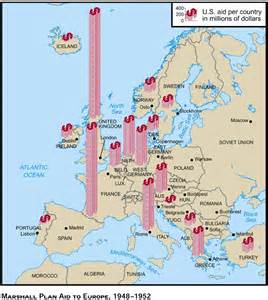
On March 25, 1947, shortly after the Truman Doctrine speech, rumours circulated that koura would be the next beneficiary of American aid after Greece and Turkey, but by June, the Marshal plan idea had replaced this program. The Marshall Plan’s idea originated both from the vacuum left by Britain after her bankruptcy and her collapse as important centre of world power and from the speech delivered by Under Secretary of State dean Acheson at Cleveland in which he proposed to add economic tool along the military aid of the Truman Doctrine. According to Acheson, American economic aid and assistance must be concentrated in « areas where it will be most effective in building world political and economic stability in promoting human freedom and democratic institutions, in fostering liberal trade policies and in strengthening the authority of the United nations » The terms « human freedom » and « democratic institutions » mean that American aid and assistance should be go to those countries which accepted U . S understanding and interpretation of these words.

On June 5, 1947, Secretary Marshall delivered his famous speech at Harvard University. exploiting the destruction of Europe’s economy, Marshall proposed American help so as to contribute to the revival of a working economy and to permit the emergence of political and social conditions in which free institutions can exist. Undoubtedly, the Marshal plan was the continuance of the Truman doctrine of containment and encirclement of the Soviet Union especially when he warned that « governments, political parties or groups which seek to perpetuate human misery in order to profit therefrom political or otherwise will encounter the opposition if the United States »  This was a cry from the principle of the Truman Doctrine that the Soviets must be ringed in and contained. Coming after the Truman Doctrine  the Marshall Plan must be seen as  economic weapon aiming at implementing the Truman doctrine. It was obvious that Marshall’s offer would not go to countries under Soviet control ; it was rather a move to consolidate Western Europe as a counter-weight to the concentration of Russian power in the east
Catégories
Archives

Cold War : the making up of legend

Cold War : the making up of legend

the Cold War is often misinterpreted as a global rivalry between the United States and the Soviet Union, According to dominant and wide-spread mythology in the West, the so-called Cold War began in the wake of the Second World War when  “pacific” western democracies and generally what we called the “Free world” led by the United States of America were assaulted and threatened by totalitarian system and by the thrust of “ remorseless Soviet expansion”. The binary and Manichean picture surrounding the Cold War reduced the post-war period to a mere rivalry and to a simplistic scheme between the “good and evil ”, a  struggle between two rival superpowers and two antagonizing ideologies competing both for the domination of international affairs and looking each and other for world hegemony. Basically, the Cold War was about the Free World versus Communist slavery and its outbreak was to be attributed to the Soviet Union accused to be the full responsible for the onset of the conflict while the United States was tally innocent. In the face of Soviet aggressiveness and territorial and ideological expansionism the United States had no choice only to protect both its own legitimate security interests and democracy in the various European nations and to cope with a real danger, the spread and the contagion of international communism sponsored by the government of the Soviet Union. At the end of his account Potsdam Conference Mr Truman accused the Soviet Union for “planning world conquest”

These assumptions by no means exhaust the various fallacies found in the literature on Cold War. When discussing the matter weal with abstractuions and try to isolate to mix and to generalize.  As declasiified U.S. policy documents revealed, the primary threat posed by the soviet Union was not its aggressivessness or its expansionary policy but rather its emergence as alternative pattern and a model for the newly independent countries born from the “decolonization” and its willingness to supply military and economic support to third world regimes that were targets of U.S aggression and subversion. The Soviet Union thus served to deter and restrain U.S imperialism and to restrain its actions in the Third World.


Catégories
Archives

Truman Doctrine : containment or Encirclement of Soviet Union and suppression of all revolution ?

Truman Doctrine : containment or Encirclement of Soviet Union and suppression of all revolutions ?

The Truman Doctrine is included in the message read by President Harry Truman to a joint session of the two Houses of Congress on marsh 12, 1947. The official and public reason for Truman message was Greece and turkey where « the Terroristic activities of several thousand armed men, led by communists had created a situation with which the Greek and Turkish Governments could not cope. In order to cope with these « communist subversion », Truman proposed to « help free people to maintain their free institutions and their national integrity against aggressive movements that seek to impose upon them totalitarian regimes »; To Truman, it was matter of life or death to choice between alternative ways of life, between free institutions and the other by terror and oppression  he believed that United States must implement a new policy aiming at supporting free people who are resisting attempted subjugation by armed minorities or by outside pressure » . by concluding his message, Truman asked for four hundred million dollars for Greece and Turkey and authority to detail civilian and military personal to them. In short words, the United States ought to suppress wherever a communiits rebellion developed the United Stets would become the world’s anti-communist, anti-Russian policeman.

Catégories
Archives

The Truman Doctrine and the Open Door policy

The Truman Doctrine and the Open Door policy

On march 6, 1947, President Truman made a speech at Baylor University on foreign economic policy laying down what we called the Truman Doctrine. In his speech, Truman announced united States planetary crusade for  : (1) rule of freedom of enterprise and (2) Containment of communism. Truman tried to explain that freedom of enterprise was more important than peace and that freedom of speech were dependent on freedom of enterprise. State trade or planned economy should be considered as contrary to both peace and freedom. For Truman, the Government of the United States had to fight both for markets and for raw materials and what was serious enough but more ominous in Truman’s speech that « the whole world should adopt the American system » and that « the American system could survive in America only if it became a world system.

Baylor speech was the pursuit of the American ideology of industrial Manifest  destiny and it fell into line with the old American open Door policy which can be traced back according to William Appleman Williams to James Madison’s federalist#10 but it really began at the end of the nineteenth century from McKinley onward and John Hay’s China-oriented declarations of 1899 and 1900;

Catégories
Archives

United States and the making of Europe

United States and the making of Europe

In early November 1946, the Republicans had won control of both houses of Congress and this unexpected election of an extremely conservative Republican Congress  gave an impetus to the anti-communist crusade inaugurated by Winston Churchill at Fulton, Missouri.  In their campaign of 1946, the Republicans moved over to the offensive and identified all dissent voice with communism which was one of the most potent forces in their electoral victory. It was expected the implementation of  a conservative foreign policy and a strong line against communism and Russia everywhere in the world. This new shift in American foreign policy in the aftermath of WWII was symbolized by The Truman doctrine.

 On January 17, 1947, John Foster Dulles adviser to the State department made a speech urging Western Europe to unite economically around the coal and steel power of the Rhine basin as a bulwark against Soviet Russia. Echoing Winston Churchill, Dulles was trying to establish hurriedly a military bloc of the united States, Britain and France. French diplomatic circles approved Dulles proposition. Dulles sought to restore Germany as bulwark against the Soviet Union and supported her reconstruction by pushing the German industrialists and cartelists to power.  Dulles’s posture was not starnge considering Mr Dulles long pre-war association with the same German interest.

Catégories
Archives

American totalitarianism (2)

American totalitarianism (2)

.

In the Postwar years, the United States became literally has bees benne firmly established. As in totalitarian Europe, the United States witnessed in the aftermath of the war and during interwar years witnessed the same phenomenon as in Italy and Germany. The slogan « American way of life » was not so different from European racism. during the interwar years, the executive remains dictatorial as during as that during the war enjoyed by Wilson. With Herbert Hoover who came to the presidency in 1929 the executive had been strengthened and became more efficient. Nationalism and chauvinism which had been planted during the war sprouted in terrifying form. Like in Europe, these nationalism and chauvinism had been expressed by widespread hostility to foreigners and to foreign ideas as Well against the political opponents Inside the United States. The American racism and the hunt against all not America, against foreigners and foreign ideas were the same as that which were at the same time widespread in Europe. Aliens suspected of radical ideas and radical notions were rounded up and deported by the scores ; legislatures were « purged » of socialists and states tried to enforce loyalty to political and economic institutions by repressive legislations. like the European racist and chauvinist movements, there was their equivalent in the USA with the Ku Klux Klan which boasted a membership of millions dedicated itself to that notion of Aryan supremacy which European dictators were to take up a decade later in two notorious cases that of Mooney and Billins in California and of Sacco and Vanzetti in Massachusetts in both cases the victims were punished more for their radicalism than for any crimes proved against them.

in the aftermath of the Second World War campaign for loyalty, conformity and hundred-per-cent Americanism reappeared in more virulent as it was the case the first World. Though the Communist party in the United States had at most seventy-five thousand members a number steadily diminishing a clamor arose for outlawing it and for a recklessly indiscriminate investigation of alleged disloyalty especially in the government, the press and the amusement Industry. The movement threatened basic civil rights and the Eugene Dennis secretary of the Communist party had been convicted and sentenced  in order to eradicate any disloyal and specially Communist activities two Committees had been set up : the House Committee on Un-American activities  in the Eightieth Congress and President Truman’s special Civil Rights Committee both of which reported in 1947. In the fall of 1946, Truman issued an executive order creating the President’s temporary commission on Employee Loyalty the following an elaborate machinery was created.  The Civil Service Commission established regional loyalty or subversive were giving hearings before a loyalty board with counsel

Just after Truman’s election for second tenure in 1949 Eleven Communist leaders, the « Politburo » of the party were brought to trial in 1949 on the charge of violing the Smith Act of 1940 which made conspiracy to « advocate and teach » the violent overthrow of the government a crime the jury found all eleven defendants guilty and ultimately they went to jail  Alger Hiss head of the Carnegie Endowment for international Peace went on trial he was charged with perjury. After one jury disagreed another found Hiss guilty and sentenced to five years jail. The government deported a number of aliens charged with Communist activities

Translate »