Catégories
Archives

The myth of Soviet expansionism in Eastern Europe (2)

The myth of Soviet expansionism in Eastern Europe (2)

What were the main motives, aims and purposes behind Soviet presence in Eastern Europe ? What did the Soviet they seek to achieve through their presence in Eastern Europe at the end of the Second World War ? The first driving and continuing motive was is security which was also the dominating factor in the outbreak of the so called Cold War. This imperative of security was not new in the Soviet foreign policy and its geopolitical perspective. The cardinal and outstanding motive behind the conclusion of the western propaganda called falsely Molotov-Ribbentrop or Hitler Stalin Pact was in fact a truce having requested by the Soviet Government for a security  purpose aiming at gaining enough time in order to build up its military defence and fortifications. how could anyone who lived the horrible war doubt it ?

Consider briefly the key facts. The Soviet Union had lost roughly 25 million of its citizens, 30 million made homeless and 60 million treated to very degrading and brutalising experience . The Nazis and their satellites destroyed completely or largely 15 large cities 1710 towns and 70 000 villages they burned or demolished 6 million buildings and deprived 25 million people of shelter. they demolished 31 850 industrial enetrprises, 65 000 kilometres of railway track and 41 000 railway stations ; 36 000 postal, telegraph and telephone officies ; 56 000 miles of main highway, 90 000 bridges and 10 000 power stations. The germans ruined 1135 coal mines and 3000 oil wells, carrying off to Germany 14 000 steam boilers, 14 000 turbines and 11 3000 electric generators. the Germans and their satellites sacked 98 000 collective farms and 2890 machine and tractor stations, slaughtered 7 million horses, 17 million cattle, 20 million hogs, 27 million sheep and goats 11 million poultry. the Nazis and their satellites attacked even Soviet cultural institutions by looing and destroying 40 000 hospitals and medical centres, 84 000 schools and colleges and 43 000 public libraries with 110 millions volumes. Some 44 000 theatres were destroyed and 427 museums and more than 2800 churches being wrecked.

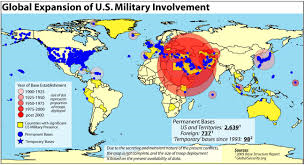
keeping all this figures in mind, we can say that no people in the world who had first suffered as the soviet people have and then won a tremendous military victory would go into eastern Europe merely for the ride. They would be bound to make sure that the invasion gate was closed. Only then could we understand how the Russians feel about their security from future attack through East Europe, since Russia had been invaded three times through eastern Europe  Surely the Reds must know also that frontiers do not mean anything any more. After all those devastations of their country, the Soviets must ask themselves why they were denying the right to buffer zone in Eastern Europe when in the same time they observe  American military bases mushroomed all over the world, located many thousands of miles from home, in Japon and the Philippines, in Greece and Turkey, in the Mediterranean and western Europe all around the Soviet Union. How then can the Russians forget what they have suffered at Germany’s hands through eastern Europe during the next century. Soviet-Union’s security is the beginning of all wisdom in the period after World War II. without a keen understanding of the deepest and strongest psychological posture left by that war all else is vain.  On November 6, 1944, Stalin made it clear in his Party speech in a strikingly statesmanlike utterance recognized that « the only fact which overrides all others is that the aim of Russia is security »
Catégories
Archives

The myth of Soviet expansionism in Eastern Europe (1)

The myth of Soviet expansionism in Eastern Europe(1)

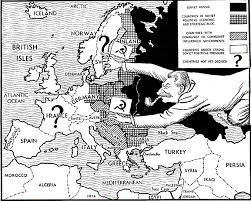
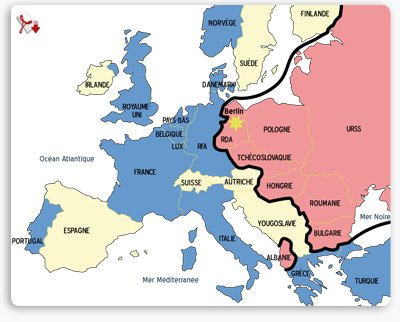
According to dominant belief and widespread ideas in the West, the Cold War was the logical answer to Soviet expansionism in Eastern Europe. Russian-Communist control of East Europe was the basis of western propaganda trying very hard to make believe that the Soviet Union was out to conquer the World. Was there really planned Soviet expansionism in Eastern Europe in the aftermath of the Second World War ?

it will be ridiculous to attribute to the Soviet Union any expansionist motives in Eastern Europe in comparison with Hitler’s crazy dream which was really based on  expansionist and imperialist motives. Contrary to France after Sedan defeat and her loss of Alsace Lorraine and Hitler claim to recover German territories lost after the First World War, there was no any claim on the part of the soviet union to recover all the gains of Peter the Great after the conclusion of the treaty of Brest-Litovosk. for example in Poland the Reds had a perfect reason to recover the 8 million Ukrainains and White Russians in east Poland but they never did so.

The Soviet occupation of east Europe was due simply and solely to the outcome of a huge war of aggression waged against the soviet Union. In this onslaught on Russia participated without exception all eastern European countries setting up by the West in the aftermath of the First World as buffer zone against Bolshevism; Finland, Rumania, Hungary and Austria were Hitler’s satellites and his step toward the soviet Union. Some 700 000 Austrians fought in Hitler’s armies and amount of human and matrial damage to Russains . the Finns also fought on several fronts other than their own. the Rumanuians carried out the brunt of the war in the southwestern Ukraine and they massacred 200 000 Soviet citizens in Odessa and troops were captured all the way to Stalingrad. All during 1944 there was no interference in Rumania’s internal affairs. Hungary helped Hitler in his invasion of Russia although the resistance of the Hungarian peasants who were forcibly conscripted by their native masters and sent off to Russia. At the Potsdam Conference Stalin said that the Hungarians had sent 26 divisions against Russia. Even Fascist Italy, as it was the case during the Spanish civil war, did her best by sending several divisions to Russia and Franco Spain contributed the large « Blue Division » Altogether the scores of divisions supplied by Hitler’s satellites contributed their full share to the immeasurable onslaught and devastation in the Soviet Union.

In conclusion, the Soviet Union presence and occupation of eastern Europe was not a planned aggression or the outcome of expansionist and imperialist motives but because of war of aggression waged by Hitler and his satellites to destroy red Russia. there is no other reason . It would be a mere folly on the part of the Soviets and the red Army to stop at their borders and wait. One can remember that at Teheran Conference Roosevelt and Churchill had agreed to concede a sphere of influence to Russia in eastern europe

Catégories
Archives

Truman Doctrine : containment or Encirclement of Soviet Union and suppression of all revolution ?

Truman Doctrine : containment or Encirclement of Soviet Union and suppression of all revolutions ?

The Truman Doctrine is included in the message read by President Harry Truman to a joint session of the two Houses of Congress on marsh 12, 1947. The official and public reason for Truman message was Greece and turkey where « the Terroristic activities of several thousand armed men, led by communists had created a situation with which the Greek and Turkish Governments could not cope. In order to cope with these « communist subversion », Truman proposed to « help free people to maintain their free institutions and their national integrity against aggressive movements that seek to impose upon them totalitarian regimes »; To Truman, it was matter of life or death to choice between alternative ways of life, between free institutions and the other by terror and oppression  he believed that United States must implement a new policy aiming at supporting free people who are resisting attempted subjugation by armed minorities or by outside pressure » . by concluding his message, Truman asked for four hundred million dollars for Greece and Turkey and authority to detail civilian and military personal to them. In short words, the United States ought to suppress wherever a communiits rebellion developed the United Stets would become the world’s anti-communist, anti-Russian policeman.

Catégories
Archives

European totalitarianism (2)

European totalitarianism (2) 

In the aftermath of the First World War, the main concern of the victorious powers was less the peace in itself that of how dealing with this new and dangerous threat which was the Bolshevism. Indeed, Versailles’s peace-settlement imposed by the major victors (USA, Britain, France, Italy) was dominated by  two main considerations  : First how the surviving dictatorial regimes in Europe and in the USA  would deal with  the new revolutionary regime in Russia and second how to avoid its spread and its contamination of West European countries, the old and new ones,  by an alternative revolutionary regime, that of Bolshevism.  In short, the main preoccupation of the Victor powers during Versailles negotiations was how making the world safe from Bolshevism  and how re-mapping Europe domestic politics either within the Victor countries as well within the new states in eastern Europe those which had been built on the overthrow of the Russian and Habsurg empires. The  priority for the Allied was  to thwart Bolchevism through direct intervention into Russian territory or by setting up a mercenary and proxy troops, the « Whites » in order to stamp out the new revolutionary Bolshevik regime. The second thing was to redraw the map of Europe by creating proxies regimes and proxies states around dedicated to isolate it behind a « quarantine belt » (cordon sanitaire), in the contemporary language of diplomacy) of  anti-communist states built both on the spoils of the formerly Russian lands and on those of Austro-Hungary empire. This « quarantaine belt » went from north to South : from Finland an autonomous region allowed by lenin to secede; three new little Baltic republics(Estonia, Latvia, Lithuania) proxies states created ex-nihilo having any historical precedent ; Poland restored to independent statehood after 120 years and an enormously enlarged Rumania in size doubled by accessions from the Hungarian and Austrian lands of the Habsburg empire and ex-Russian Bessarabia. The attempt to form proxies states into the Caucasus failed because of the support brought by an anti-communist but  revolutionary Turkey to revolutionary Bolshevik Russia. The attempt to create proxies states such as Armenian and Georgian proxies states setting up after Brest Litowosk and attempts under the British to detach oïl-rich Azerbaijan, had failed after the victory of the Bolsheviks in the Civil War of 1918-1920 and the Soviet-Turkish treaty of 1921;  Other proxies states had been created out of nothing like Czechoslovakia and Yugoslavia combinations.

Translate »