Catégories
Non-classé

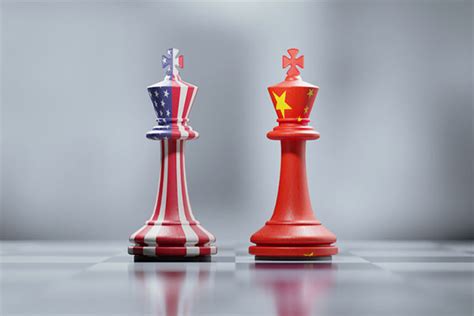
Pentagon’s new reprot hypes China

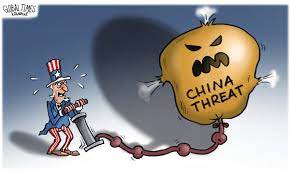
Year after year, the Pentagon releases annual report filled with biased facts and analyses aimed at hyping and denigrating those viewed as posing real threat to US hegemony. The newly 212-page annual Pentagon report, entitled “China Military power report” is but a piece of US propaganda aimed at spreading and hyping the so called “China threat” claiming that China has more than 500 operational nuclear warheads and they are in constant rising up to more than 1000 by 2030. Even if China does have 500 nuclear warheads, it is insignificant comparing to US size arsenal as its nuclear arsenal standing at about 5,800 nuclear warheads, in addition to the number of US strategic nuclear submarines, strategic bombers, and the number of warheads they carry are far higher than any other country in the world, including China. The global nuclear strategy of the US represents a real threat to the peace in the world when it comes to provide nuclear umbrellas and even nuclear sharing to some allies, ultimately exacerbating regional tensions, as it was the case in July, the US deployed a nuclear-armed ballistic missile submarine to South Korea for the first time since 1980s prompting North Korea to fire later two short-range ballistic missiles into its eastern waters as a response to the US provocation. 20 years ago, the European respondents to a poll requested by the European Union consider the US and Israel, the two biggest threats to world peace. Over half of Europeans think two decades ago that Israel presents the biggest threat to world peace. According to the same survey, Europeans believe the United States contributes the most to world instability along with Afghanistan, Iran, Iraq and North Korea. Another to new poll. The US presenting itself as the chief guardian of global democracy is seen around the world as more of a threat to democracy than even Russia and China.

Catégories
Anti China Crusade Anti Russia Crusade Blog Geopolitics OIL WARS & CRISES

US NEW STRATEGY TO COUNTER CHINA AND RUSSIA

In 2018, the United States government has declassified its Indo-Pacific strategy initially set to be released to the public at the end of 2042. The strategy was initially devised throughout 2017, going on to be approved and enforced by President Donald Trump in 2018 shortly after the US National Defense Strategy was finalised. At its heart, the strategy highlights a deep concern with China’s rising influence in the Western and Central Pacific and plans to deal with an increasingly belligerent North Korea, while seeking to use its South-East Asian allies to contend with China and North Korea and to strengthen India to counter Chinese military power.

Countering China in the South China Sea

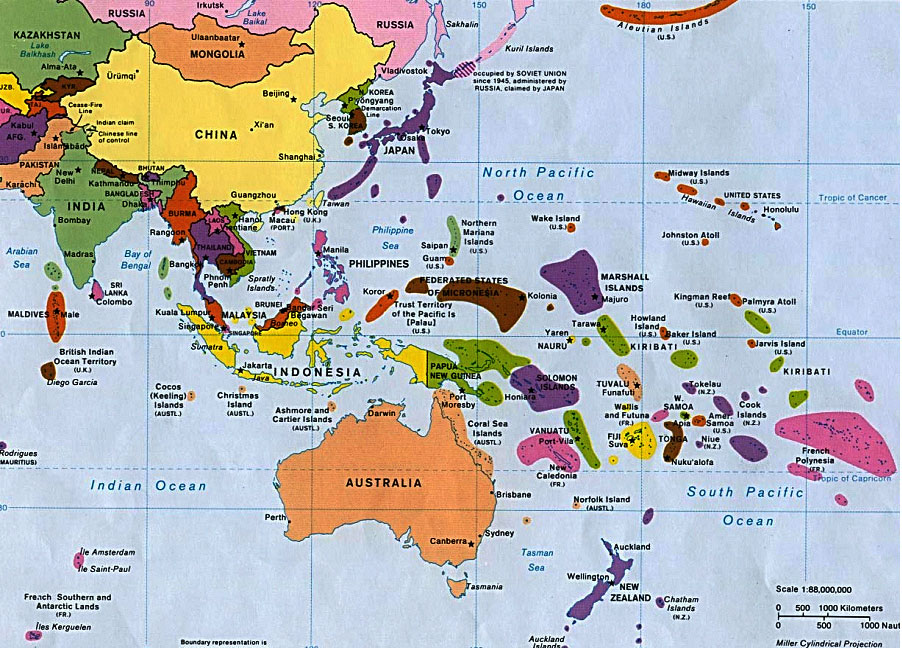
The strategists highlight China’s growing dominance in the Indo-Pacific and consider Beijing as is the United State’s primary adversary and strategic opponent in the area. While the document does not mention the South China sea dispute, it reflects a concern over China’s claims there and in other parts of the Western Pacific. The strategy to counter China aims to build US capabilities until they are “capable of, but not limited to” denying China control of the air and the sea in the “first island chain”, referring to a string of Pacific islands surrounding China that include Russia’s Kamchatka peninsula, Japan, Taiwan, Philippines, Malaysia and Vietnam. China claims most of these waters. Second, it emphasizes the strategy emphasizes the need to defend the first island chain, and dominate all areas outside it.

disputed zones in the South China Sea

A US Navy oceanographic survey

Since last September, a US Navy oceanographic survey ship has been conducting extensive activities in a large area of the South China Sea to collect underwater geographical and hydrological data to support its submarine warfare in the region against China.

This situation also drew attention from some military observers after a US nuclear-powered attack submarine struck an unidentified underwater object in the South China Sea earlier this month, which again highlighted the US Navy’s need to learn more about the region.

The USNS Mary Sears (T-AGS 65), a Pathfinder-class oceanographic survey ship, entered the South China Sea on September 26 and started extensive surveys. From October 1 to 4, the ship operated in waters south of China’s Hainan Island, from October 5 to 9, it approached the coastline of Vietnam, and by Sunday it had arrived in waters near the Nansha Islands. The Pathfinder-class oceanographic survey ship is specialized in the detection and surveying of underwater terrain, meteorology and hydrology.

The USNS Mary Sears (T-AGS 65)

While the ship seems to be conducting scientific research, its true mission is to support submarine and anti-submarine warfare, the USS Connecticut, a Seawolf-class nuclear-powered attack submarine, struck an underwater object in the South China sea on October 2.

the USS Connecticut, a Seawolf-class nuclear-

This accident means the sea map the submarine was using was outdated, and the US Navy was conducting scientific research to draw underrates maps with the mission to support submarine and anti submarine warfare and help navigate friendly submarines or place detection device to locate hostile submarines.

Countering China and Russia in the Middle East

President Joe Biden’s Interim National Security Strategic Guidance Lt. Gen. Ronald Clark, who spoke at the Association of the U.S. Army’s annual conference Oct. 12 emphasized the challenges of strategic competition with Russia and China to American interests, including nonmilitary events taking place across the Middle East. The major challenges to the command’s operations are China, Russia, Iran and “violent extremist organizations around the world,” he said. But the commander primarily cited Russia and China, which he said are making moves in the Middle East to “set conditions for future operations.” 

Both nations blur the lines between competition, crisis and conflict. While it falls short of actual conflict, Clark said these actions are a part of strategic competition and will shape future conflicts in the Middle East and beyond. Events in one theater will spill over — undoubtedly — to another,” he said. “Bottom line: All of our competitors are setting conditions in the [command’s area of responsibility] right now that we need to respond to.”

Middle East map

For example, China engages in unrestricted warfare, which consciously expands the battlefield from traditional domains such as land, air and sea to social spaces, politics, culture and economics. An important piece of that in the Middle East is the Belt and Road Initiative, which consists of a number of economic investments by the Chinese government and Chinese-owned companies in foreign countries. The Belt and Road Initiative touches virtually every country in [the command’s area of responsibility],” said Clark, pointing to a $300 billion investment by a Chinese-owned company into the port of Abu Dhabi in the United Arab Emirates. China continues to import massive amounts of oil from the Middle East, helping Iran build a new export facility that will allow it to continue pumping oil past the Strait of Hormuz. 

Hormuz Strait

Meanwhile, Russia is practicing its own form of hybrid warfare using nonmilitary means to create an operational environment where a smaller military force can come in and achieve its objective, Clark said. For example, a 2017 deal allowed Russia to expand the Port of Tartus in Syria, and it can now hold up to 12 nuclear-powered ships or submarines, he added. That now allows the Russians — if they want to — to project power into the Mediterranean and into Eastern Europe,” he said.

Syria’s Tartus port

The US Central command’s area of responsibility is vast. It includes 21 countries that make up more than 4 million square miles and are home to 550 million people in 22 ethnic groups speaking 20 different languages.

Oil locations in the Middle east

Importantly for American interests, he added, it’s also home to vast oil reserves. Nearly 30 percent of the petroleum and crude oil products from around the world flow through three chokepoints that fall under the command’s purview. Clark pointed to when the supercargo ship Ever Given recently clogged up the Suez Canal for days as an example of the importance of those chokepoints. That incident disrupted 12 percent of global trade with an estimated cost of $9 billion.


Catégories
Anti China Crusade Asia Pacific Blog Geopolitics NATO WARS & CRISES

THE QUAD, AN »ASIAN NATO » TO CONTAIN CHINA IN THE ASIA PACIFIC REGION

On September 24, President Biden hosted Prime Minister Scott Morrison of Australia, Prime Minister Narendra Modi of India, and Prime Minister Yoshihide Suga of Japan at the White House for the first-ever in-person Leaders’ Summit of the Quad. A the top of their agenda the COVID-19 pandemic, infrastructure; the climate crisis; emerging technologies, space, and cybersecurity; and last but not least, fellowshi consisitng of cultivating 100 selected students(25 from each QUAD member) to be trained in the USA universities.

Biedn,Modi,Morisson and Suga meeting QUAD summit in Washington September 2021

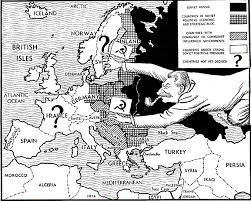
THE QUAD, CONTINUATION OF THE TRUMAN DOCTRINE OF CONTAINMENT OF COMMUNISM 

The father of the containment is not Truman nor John Foster Dulles but George Kennan who was considering the soviet union and the communism as evil and conspiratorial trend within “liberal democracy” For that reason, Kennann had preached continued fight against the USSR and communism by confronting the Russians with counterforce at every point and to block the Soviet Union with “superior force and with “unassailable barriers in its path”

The policy of containment was supported and implemented in 1947 by the Truman administration asserting the need to “act and act decisively” to sustain the open Door policy. As the direct descendant of Churchill militancy anti Russia “Iron curtain” speech of march 1946, the Truman doctrine blamed the Soviet Union for the troubles of the world and announced the determination of the united States to halt the spread of revolutionary radicalism. As a result, Truman administration had elaborated a program to promote “trouble on the other side of the Iron curtain” Consequently, as Acheson revealed to the Congress, the cold war was inevitable.

George Kennan(Left),father of the containment and the politician who coind the term of « Cold war »

The QUAD is a new military alliance targeting China in the Asia Pacific region like NATO set up in 1949 with the main objective: containing the Soviet Union in Europe. Long after the triumph of the Revolution in China, a large part of the American people refused to accept the result. After the fall of China to communism in October 1949, Truman Doctrine was activated to contain the new born communist revolution in China. The USA initiated the Korean war in 1950 with the hope to put a break to the rising tide of revolution in Asia. The snowballing effect of communist triumphes might make Thailand and Burma relatively easy conquests. Since Indi China is strategically the key to all South East Asia. A communist sweep in asia would tend to « paralyse the defense of Europe ». In West europe the feeling might well spread that resistance to the Red  » wave of the future » was hopeless. Thus far the Truman Doctrine had been enforced, but il had been a dismal failure in east Asia. these considerations were sufficient to induce resolute action in Korea.

Truman doctrine of containment of communism

QUAD, US TOOL TO CONTAIN RISING CHINA IN THE ASIA PACIFIC REGION

The Quad has been described as a U.S.-led project, an alliance, an axis of democracies, a security diamond to contain China. The story of the QUAD has begun in spring 2007 by quadrilateral discussion followed later by a naval exercise in the fall of this year. In 2006, Japanese prime ministerial candidate Shinzo Abe made a more limited but focused case for a values-based foreign policy and closer ties with Australia and India. Once Abe won the election, his foreign minister Taro Aso reiterated this call in a speech laying out the new government’s foreign policy. In December 2006, Indian Prime Minister Manmohan Singh visited Japan. In a joint statement, he and Abe noted “the usefulness of having dialogue among India, Japan and other like-minded countries in the Asia-Pacific region on themes of mutual interest.” Then, reports emerged that U.S. Vice President Dick Cheney, despite hesitation in some quarters in the Bush administration, endorsed the idea of a quadrilateral involving Australia, Japan, the United States, and India — in addition to the Trilateral Strategic Dialogue that the first three had started in 2002. He discussed it with Prime Minister John Howard on a visit to Australia in February 2007. When Howard visited Tokyo the next month, he and Abe highlighted the four countries’ shared democratic values. A few days later, the Indian foreign minister visited Japan, and then, in April, Aso traveled to India and Abe to Washington. The Australian participant later described it as an “informal meeting … to look at issues of common interest” (like disaster relief) involving countries that “share some values and growing cooperation in the Asia-Pacific.”

Dick Cheney, G.Bush’s vice president

The meeting might have been exploratory, but observers thought it was or could be much more. Australian members of parliament asked if this was a security arrangement, an alliance, or an expansion of the Trilateral Strategic Dialogue. Indian lawmakers wanted more details on this “four-cornered dialogue.” Advocates and critics suggested it was an “Asian NATO” to constrain China.

There was still momentum behind the Quad. When Abe visited India in August, he didn’t explicitly mention it, but told the Indian parliament, “the Confluence of the Two Seas is coming into being.” He spoke of a “broader Asia” that would also incorporate Australia and the United States. The quadrilateral found more explicit mention in the United States that fall, when presidential candidate Sen. John McCain wrote that he would “institutionalize” the Quad

John Mc Cain

QUAD, MILITARY ALLIANCE DIRECTED AGAINST CHINA IN THE ASIA PACIFIC REGION

Before the recent meeting of the Quad, both the United States and the Indian sides denied that it was a military alliance, even though the Quad countries conduct joint naval exercises—the Malabar exercises—and have signed various military agreements. The September 24 Quad joint statement focuses more on other “security” issues: health security, supply chain and cybersecurity.

QUAD Malabar exercice

Before the Quad meeting in Washington, the United States and the UK signed an agreement with Australia to supply eight nuclear submarines—the AUKUS agreement. Earlier, the United States had transferred nuclear submarine technology to the UK, and it may have some subcontracting role here. Nuclear submarines, unlike diesel-powered submarines, are not meant for defensive purposes. They are for force projection far away from home. Their ability to travel large distances and remain submerged for long periods makes them effective strike weapons against other countries.

The AUKUS agreement means that Australia is canceling its earlier French contract to supply 12 diesel-powered submarines. The French are livid that they, one of NATO’s lynchpins, have been treated this way with no consultation by the United States or Australia on the cancellation. The U.S. administration has followed it up with “discreet disclosures” to the media and U.S. think tanks that the agreement to supply nuclear submarines also includes Australia providing naval and air bases to the United States. In other words, Australia is joining the United States and the UK in a military alliance in the “Indo-Pacific.”

AUKUS,new military alliance with Australia against China

Behind the rhetoric about the Indo-Pacific and open seas is the U.S. strategic vision to project its maritime power against China and contest for control over even Chinese waters and economic zones. This is the 2018 U.S. Pacific strategy doctrine that it has itself put forward, which it de-classified recently. The doctrine states that the U.S. naval strategy is to deny China sustained air and sea dominance even inside the first island chain and dominate all domains outside the first island chain. .

The U.S. is using the other members of the Quad as mere tool to regain its strategic and global dominance. The United States wants to use the disputes that Vietnam, the Philippines, Indonesia, Thailand and Malaysia have with China over the boundaries of their respective exclusive economic zones. The same strategy used by the United States to use European continent as bullwark against the Soviet Union. That is why old colonial UK, France, Germany and today the United States all have large aircraft carriers: they are naval powers who believe that the gunboat diplomacy through which they built their empires still works. The United States has 700-800 military bases spread worldwide; Russia has about 10; and China has only one base in Djibouti, Africa.


Catégories
Blog

HOW US,UK AND EUROPEAN UNION TRIGGERED REGIME CHANGE IN BELARUS

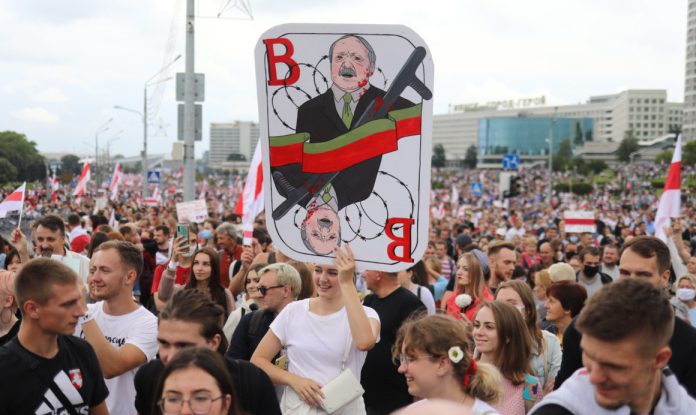
The recent Kidnapping by Belarus of the Neo Nazi Toman Protasevith catapulted back to the top of the mainstream news the at-times fiery protests that raged across Belarus throughout 2020. Similar to previous color revolution for regime change, western propaganda created leader and Belarus was not the exception with the creation of a stooge of the west in the person of Svetlana Tikhanovskaya recognized by Western leaders as the legitimate Belarusian leader.

Western propaganda has deigned to mention that for many years prior to the unrest’s eruption, London and Washington had funded, trained, and promoted the very elements that took to the streets in opposition to President Alexander Lukashenko. Belarusian opposition movement promoted the killing of Belarusian President Alexander Lukashenko in a similar way to Muammar Qaddafi of Libya.

RAND, US think tank published report with a dedicated section of the 354-page report dealt with “promoting regime change in Belarus.” with the objective to undermine Moscow’s proposed Eurasian Economic Union, complicating “any attempt to employ military force against the Baltic States,” and further isolating Kaliningrad,” the Russian exclave situated between Lithuania and Poland.Furthermore, there was little tangible public appetite for democratization. RAND cited a 2015 survey conducted by the Independent Institute for Socio-Economic and Political Research, which found that 78% of Belarusians believed regime change was “not worth people’s blood” and 70% “did not want a Ukrainian-style revolution.”“People don’t want more freedom. They want more government. They want the better life they used to have,” a Belarusian expert quoted in the report said in 2017.

Trigering unrest in Belarus aiming at removing a long-standing Russian-allied dictator “could come in a variety of forms, ranging from public declarations of support by U.S. leaders to more direct financial and organizational assistance helping the opposition parties.”

Promoting liberalization in Belarus was predicted to require European support, and given the bloc faced “a host of other challenges from Ukraine to refugees to Brexit,” Brussels [European Union] “might not want to add Belarus to the mix” and “rock the boat.”

Still, there was perceived value to attempting to precipitate regime change even if the effort ultimately failed as such a campaign would “create apprehensions among Russian leaders,” making them “worry about the prospect of such a movement in their own country.” This would in turn prompt Moscow to reinforce its military presence and political influence within Belarus, burdening Russia with a “weak, corrupt dependency” and possibly even generating “some degree of local resistance,” the report approvingly suggested.

Prior to this section of RAND’s report, U.S. policymakers subsequently is somewhat moot, given Washington had been engaged in precisely the destabilization efforts proposed therein, by way of the National Endowment for Democracy (NED). Founded in November 1983, then-U.S. Central Intelligence Agency (CIA) Director William Casey was central to its creation. He sought to construct a public mechanism to support groups and individuals overseas to engage in propaganda and political action undermining “enemy” governments from within—activities historically organized and paid for clandestinely by the Agency—under the bogus aegis of democracy and human rights promotion. For example, during the Reagan administration’s brutal secret war against Nicaragua’s progressive Sandinista government during the 1980s, in which tens of thousands died, NED allocated millions of dollars to “civic opposition” entities—including La Prensa, the country’s primary anti-Sandinista newspaper. The CIA trained, funded, and armed the Sandinistas’ fascist opponents, the Contras. In particular, the Agency’s “Tayacan” manual on guerrilla warfare was highly influential, leading the group to incite mob violence, “neutralize” government officials and civilian leaders, and attack “soft targets” such as schools and hospitals, among other hideous atrocities. The NED funded at least 159 civil society initiatives in Belarus, costing $7,690,689, from 2016 to 2020 alone aiming at promoting

Publicly available data indicates the NED funded at least 159 civil society initiatives in Belarus, costing $7,690,689, from 2016 to 2020 alone, coordinated with the Warsaw-based Belsat TV station promoting anti Lukashenko propaganda were behind the unrest aiming at regime change in Belarus. According to  investigative journalist Robert Parry  after the March 2014 Maidan coup, the NED bankrolled 65 projects in Ukraine in the years prior to that uprising.

In September 1991, The Washington Post published an article on the subject of “spyless coups” abroad, in which it referred to the NED as the “sugar daddy of overt operations,” and noted that throughout the late 1980s, it had “dispensed money to anti-communist forces behind the Iron Curtain.”

“Covert funding for these groups would have been the kiss of death, if discovered. Overt funding, it would seem, has been a kiss of life,” the newspaper concluded.

NED funding has very clearly been a “kiss of life” to a large number of oft-dubious opposition actors within and without Belarus, in turn unleashing all manner of chaos—and what’s more, its “sugar daddy” status is now being challenged by a number of other spectral, malign Western actors.

U.S. meddling in Belarus dates much further back than 2016. Five years earlier, an official White House press release on U.S.-Polish “efforts to advance democracy worldwide” had a dedicated section on the pair’s work to “pressure” the Lukashenko government and “support civil society,” which stated the Broadcasting Board of Governors (BBG) would work with the Warsaw-based Belsat TV station “to develop content and programming on democracy education.”

Founded in December 2007 by the Polish Ministry of Foreign Affairs, Belsat dubs itself “reminiscent of” U.S. propaganda outlets Radio Free Europe and Voice of America—assets of BBG [now U.S. Agency for Global Media]—describes its mission as “promoting democratization processes” in Minsk, and boasts that events in Ukraine “have shown Belsat TV has influenced the public opinion not only in Belarus, but elsewhere in the region, too.”

On an official visit to Warsaw in late 2017, then-UK Prime Minister Theresa May allocated £5 million of UK funding to Polish organizations to “detect and counter the spread of Russian information operations,” with some of the money specifically earmarked for Belsat. UK Foreign, Commonwealth & Development Office (FCDO) files leaked by hacktivist collective Anonymous shed some light on the support provided by London to the station via Thomson Reuters Foundation (TRF), the internationally renowned newswire’s charitable arm.

In all, Belsat received 150 days of intensive consultancy in a three-month period—“of which 97 were delivered in-country”—from consultants, interpreters, and project and finance managers, among them Reuters staff. If TRF sought to greatly ramp up Belsat’s propaganda capabilities, then its counsel was certainly successful. TRF’s guidance was informed by the findings of an extensive “target audience analysis” of Belarusian citizens’ perceptions and motivations conducted in January 2017, which sought to “identify opportunities” to “appropriately communicate” with them. The study was commissioned by the FCDO in January 2017, under the auspices of a £100 million Whitehall effort to weaken Russia’s influence in its “near abroad.”  In particular, London was interested in Belarusians’ “existing or potential grievances against their national government” that could be leveraged, and “channels and messages” through which the UK government could “appropriately engage with different sub-groups.”

The FCDO’s “target audience analysis” was carried out by long-time Whitehall contractor Albany Associates, central to a number of London’s covert information warfare operations aimed at Russia.

In one such connivance, the firm sought to “develop greater affinity” among the region’s Russian-speaking minority for the UK, European Union, and NATO. In another, it collaborated with French NGO IREX Europe to “promote media plurality, balance and literacy in Central Asia.”

In its submissions to the FCDO, Albany noted IREX had been working in Belarus since 2006 “with print, online and radio outlets,” to “improve the quality of their coverage,” and “increase their understanding of the EU and EU member states.” As part of its youth audience offering in the country, the organization was said to have founded Warsaw-based Euroradio, along with online outlet 34mag.

IREX is closely connected with the NED, and created Euroradio in 2006 with funding from the U.S. Agency for International Development (USAID), another entity that has frequently been used to insidiously undermine governments in Washington’s crosshairs. Just like the FCDO, USAID—now under the direction of war hawk Samantha Power—operates a multi-faceted program targeted at Russia’s “near abroad,” Countering Malign Kremlin Influence, “in alignment with U.S. national security strategy.”

A 2015 report on backing provided by IREX to “independent” media across Eastern Europe under the terms of its “cooperative agreement” with USAID details Euroradio’s exponential rise following its launch. Within four years, it was also receiving sizable funding from the European Union and numerous foreign governments, and running elaborate promotional multimedia campaigns.

By 2008, it was sponsoring 300 events in the region annually, receiving “significant free exposure” by “placing its banners at music and cultural events,” including the annual Right to be Free concert in Lviv, Ukraine. Bands from Belarus, Ukraine, and elsewhere played to a 10,000-strong crowd, “with many bused in from Belarus.”

During the 2010 election, it broadcast live footage of protests following the vote via the web, Skype, and various instant messaging platforms, “interviewed leading opposition candidates, reported on the arrests of protesters, reported from the election commission, and provided reports from six regions through regional stringers,” tailoring its “content and marketing efforts” specifically for 17-35-year-olds.

These activities among others cemented Euroradio as Belarus’s “leading external radio broadcaster” and, come 2012, its “potential audience for terrestrial broadcasts” was two million, more than one-fifth of the country’s population, the website receiving hundreds of thousands of visitors monthly.

Throughout 2020 and beyond, Euroradio almost endlessly published footage of violent crackdowns on protesters in Minsk, which in turn was routinely aired by the mainstream media. The BBC went to the extent of issuing an open call for activists on the ground to submit pictures and videos for use in its coverage, which Euroradio enthusiastically amplified.

Much of the content featured in Western news reporting on the unrest was created by individuals and organizations secretly in receipt of funding and training from Open Information Partnership (OIP), the “flagship” strand of the FCDO’s multi-pronged propaganda assault on Russia. OIP maintains a network of 44 partners across Central and Eastern Europe, including “journalists, charities, think tanks, academics, NGOs, activists, and factcheckers.”

Internal Whitehall documents reveal one of its primary objectives is influencing “elections taking place in countries of particular interest” to the FCDO. It achieves this disruption by helping organizations and individuals produce slick propaganda masquerading as independent citizen journalism, which is then amplified globally via its network.

In Ukraine for example, OIP worked with a dozen online “influencers” to “counter Kremlin-backed messaging through innovative editorial strategies, audience segmentation, and production models that reflected the complex and sensitive political environment,” allowing them to “reach wider audiences with compelling content that received over four million views.”

Similarly, in Russia and Central Asia, OIP established a network of YouTubers, helping them create videos “promoting media integrity and democratic values.” Participants were taught to “make and receive international payments without being registered as external sources of funding” and “develop editorial strategies to deliver key messages,” while the consortium minimized their “risk of prosecution” and managed “project communications” to ensure the existence of the network, and OIP’s role, were kept “confidential.”

Belarus, along with Moldova and Ukraine, is referred to in the leaked files as “the most vital space in the entire [OIP] network,” and a “high-impact priority” country for London. This suggests its 2020 election was very much “of interest”—and the shock results of Moldova’s November 2020 presidential vote suggest OIP’s informational influence can be decisive.

In Moldavia, that election pitted upstart pro-Western Maia Sandu against incumbent pro-Russian leader Igor Dodon, with the former emerging victorious in a win widely acknowledged by the Western media to be surprising. Two Moldovan organizations, the Association of Independent Press and Newsmaker, are fellow OIP network members, and could well have served as conduits for FCDO-funded, pro-Sandu, anti-Dodon material. Maia Sandu speaks to reporters during election. Slovakian OIP member MEMO 98, coincidentally also funded by NED, published an extensive study of the election campaign, attributing Sandu’s upset to her social media Nous.

MEMO 98 similarly kept a close eye on the Belarus protests, publishing several analyses of media reporting and social media activity related to the strife, in the process drawing particular attention to the output of none other than Belsat, praising its “extensive coverage of protests and related intimidation of activists.”

An American father-son duo ­accused of orchestrating former Nissan chief Carlos Ghosn’s audacious escape from Japan admitted their role on Monday as they made their first appearance before a Tokyo court.

Former special forces operative Michael Taylor, 60, and his 28-year-old son Peter,now in trial in Japan for orchestrating former Nissan chief Carlos Ghosn’s audacious escape, who is currently an international fugitive living in Lebanon,smuggled in a music equipment case received 144 million yen ($1.3 million) spent on preparations for the escape including the costs of chartering a private jet 

An American father-son duo ­accused of orchestrating former Nissan chief Carlos Ghosn’s audacious escape from Japan admitted their role on Monday as they made their first appearance before a Tokyo court.

Former special forces operative Michael Taylor, 60, and his 28-year-old son Peter were ­extradited by US authorities over claims they smuggled Ghosn out of Japan in a music equipment case as he awaited trial.

At the Tokyo district court on Monday, the pair said they did not contest the facts laid out by prosecutors in an indictment, effectively conceding their role in the saga.

The pair face up to three years in prison if convicted of helping Ghosn, who is currently an international fugitive living in Lebanon, which has no extradition treaty with Japan.

Ghosn was out on bail while awaiting trial on four counts of financial misconduct, which he denies, when he managed to slip past authorities onto a private jet, transit in Turkey and land in Lebanon.

The escape was hugely embarrassing for Japanese authorities, who termed it « one of the most brazen and well-­orchestrated escape acts in ­recent history. »

The Taylors, along with a Lebanese national still at large, are suspected of orchestrating the December 2019 escape – including putting Ghosn inside an audio equipment case to get him onto the private jet.

The pair fought their extradition to Tokyo, claiming they could face torture-like conditions, and have not commented on their case since arriving in early March.

Tokyo’s Deputy Chief Prosecutor Hiroshi Yamamoto has declined to comment on their arraignment, but local media said both men have admitted wrongdoing during questioning.

Public broadcaster NHK has said Peter received 144 million yen ($1.3 million) from the Ghosns for their help. The Asahi Shimbun daily said the pair spent most of the money on preparations for the escape, including the costs of chartering a private jet,

HOW US,UK AND EUROPEAN UNION TRIGGERED REGIME CHANGE IN BELARUS
Catégories
Blog

FRANCE’S GEOPOLITICAL GAME IN LEBANON TO COUNTER TURKEY

FRANCE’S GEOPOLITICAL GAME IN LEBANON TO COUNTER TURKEY

On August 6, only two days after the deadly explosion that literally destroyed Beirut’s port and ravaged a large part of the Lebanese capital, killing 190 people, injuring another 6,500 and leaving 300,000 citizens homeless,  French President Emmanuel Macron has made his first trip to Lebanon before returning for the second time in less than a month. According to a World Bank, the damages caused by the explosion could be between $6.7 billion and $8.1 billion in total in addition to a crippling financial crisis.

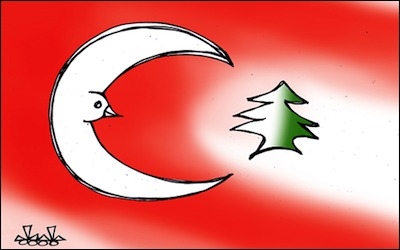
After landing on August 31, Macron announced clearly the main objective of his second visit aimed to avoid Lebanon ending up “in the hands of the vileness of the regional powers” and to prevent the country from falling into a new civil war. What did Macron mean by “the hands of evilness of the regional powers”? Those regional powers are Turkey, Saudi Arabia and Iran, which are competing to carve out an area of influence in this tiny country of 10000m² and barely seven million inhabitants.

Macron’s declared objective is to provide financial assistance to Lebanese people following the deadly explosion but his undeclared objective is to reaffirm France’s former colonies as its spheres of influence, to protect and to guarantee the French political and commercial interests, not only in the East Mediterranean, but also in the Middle East. This is occurring most notably in Africa, where it is currently challenging Turkish attempts to spread its interests. By gaining a foothold in Lebanon, Macron can weaken Turkish attempts to become the gatekeeper of the Sunni stronghold of north Lebanon.

Turkey’s activities are centered around the northern port of Tripoli, a stronghold of Sunni political Islam and an urban center for the Lebanese Sunni population. As such, the area is a natural focus for Turkey. The Akkar Governorate, home to Lebanon’s tiny Turkmen minority, is also an area of interest.

Turkey seeks to leverage both its Sunni Islamist credentials to appeal to Sunni Arab populations, and where relevant its Turkic ethnicity to appeal to Turkic remnant populations in the Levant. Available evidence suggests that in Lebanon, a similar pattern is being followed. Turkey has been working slowly and assiduously, via NGOs and government relief organizations such as the Turkish Cooperation and Coordination Agency – TIKA to establish its foothold in the country. On July 4 two Turkish and two Syrian citizens on a flight to Lebanon from Turkey were arrested as they attempted to smuggle $4 million into the country. Lebanese Interior Minister Mohammed Fahmi claimed that the money was intended to finance street-level protests against the Lebanese government. As of now, however, the first signs are emerging that Sunni Islamist Turkey is seeking to fill the vacuum, and to recruit the Lebanese Sunni street to its banner.

Catégories
Blog

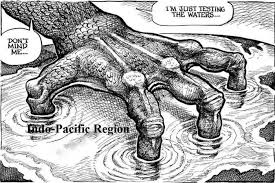
US BUILDING UP OF INDO PACIFIC NATO TO COUNTER CHINA

US BUILDING UP OF INDO PACIFIC NATO TO COUNTER CHINA

On August 31,in the framework of the ongoing summit of the US-India Strategic Partnership Forum, the US Deputy Secretary pf State Stephen Biegun said in an online discussion that the US is working to strengthen closer defence ties with countries of the India-Pacific region, India, Japan and Australia, to build up Indo- Pacific Alliance modeled on the North Atlantic Treaty Organisation (NATO) with an aim to counter China

Stepehn Biegen is a necons, he’s the number 2 official in the US state department, an American businessman, fluent Russian-speaking diplomat former staffer on the National Security Council in the George W Bush administration and the US special Representative for North Korea in the Trump administration.

Washington’s aim is to create in the Indo-Pacific region a strong multilateral structures, ultimately to align in a more structured manner, similar to those of NATO. The Donald Trump administration’s Indo-Pacific Strategy is the role played by the Quadrilateral Security Dialogue, or “Quad,” comprised of Australia, India, Japan, and the United States. Since the Quad’s resurrection from a decade-long hiatus in November 2017, the group has met five times and has emphasized maintaining the liberal rules-based international order, which China seeks to undermine or overturn. Washington’s aim is to get the Quad grouping of four countries to work together as a bulwark against a potential challenge from China and to create a critical mass around the shared values and interests.

It is expected that the Quad grouping will meet in New Delhi this autumn with Australia’s possible participation in India’s forthcoming Malabar naval exercise as an example of progress towards a formal defence bloc.

The US wants to see Vietnam, South Korea and New Zealand to eventually join an expanded version of the ‘Quad’ to form an alliance grouping the seven nations working together in order to safeguard their common and shared interests in the Inod Pacific region.

The ongoing standoff with China provides a pretext for the Modi government to unveil its real agenda, the timing alibi to align the Indian foreign policy establishment to openly transform the Quad into a Indo Pacific NATO.

Catégories
Blog

WILL INDIA FIGHT A TWO-FRONT WAR WITH CHINA AND PAKISTAN ?

WILL INDIA FIGHT A TWO-FRONT WAR WITH CHINA AND PAKISTAN ?

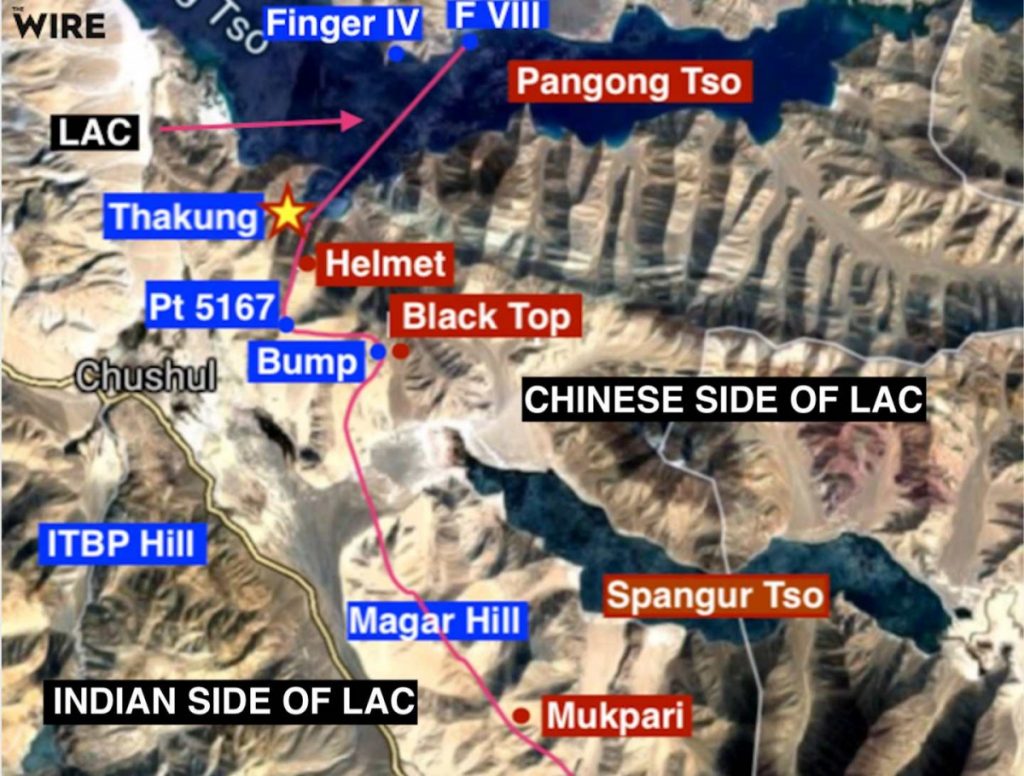
Like China’s Popular of Liberation Army that recently conducted military exercises simultaneously in four seas in preparation for a multi-front war, India military prepares for a possibility to fight a two-front war against collusive military and nuclear allies Pakistan and China. The latest fracas taking place on the night of August 29-30 between China’s People’s Liberation Army and Indian Army along the Line of Actual Control (LAC) in eastern Ladakh along the southern bank of the Pangong Tso lake, has further exacerbated the military standoff continuing since early May and raising the spectre of military confrontation between the most two populous nations.

The key area and the hardest point of friction remains Pangong Lake and Depsang, particularly the Finger Area — a set of eight cliffs jutting out of Sirijap range overlooking Pangong where both armies have deployed almost 100,000 soldiers and weaponry in their forward and depth areas. the quantum of forces currently deployed by both sides of the LAC was also unprecedented. In a sign of dissuasion, Indian army has deployed three additional Indian Army divisions of around 60,000-70,000 personnel to supplement some 20,000 troops from the Leh-based 3 Division tasked with minding the LAC in eastern Ladakh against the PLA. These formations are backed by over 120-odd T72M1 and T90S main battle tanks positioned at various sensitive locations in eastern Ladakh, which in turn are augmented by the newly inducted BAE Systems M777 155mm light weight howitzers, varied missile batteries and associated systems. All these platforms have furthermore been airlifted to the region by the Indian Air Force’s (IAF’s) latest CH-47F Chinook heavy lift helicopters and C-17 and C-130J-30 fixed wing transport aircraft.These extra troops had escalated the situation ominously along the LAC as the corresponding PLA ‘forces-in being’ too are amply supported by formidable armour, artillery and missile assets.

In recent years, Pakistan’s and China’s strategic and territorial interests with regard to India had coalesced, hinting that he anticipated increased military collaboration between the two against Delhi, especially with regard to the strategic Siachen Glacier. Pakistan as a whole, its military, polity and people have longtime suspected India working to break their country into pieces. Consequently, in case of war between India and China, Pakistan will not hesitate to side with China and could swing into action to take advantage of India’s preoccupation with China.

The opening up of a second live conflict front for India, in addition to the one prevailing with Pakistan along the restive Line of Control or LOC in Kashmir, further reinforces the operationally apocalyptic ‘two-front’ war scenario for India. Despite all three countries possessing nuclear arms, conventional war would not be excluded along India’s northern and western borders with China and Pakistan.

Catégories
Blog

How EU is playing India against China in Indo-Pacific geopolitical rivalry

How EU is playing India against China in Indo-Pacific geopolitical rivalry

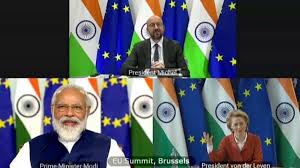
On Wednesday, European Council President Charles Michel held a news conference in Brussels following a virtual summit with the Indian prime minister Narendra Modi in the framwork of what officially called the Bilateral Trade and Investment Agreement set up in 2007.

European Council President Charles Michel pleaded for reinforcement of “ strategic goals” and an “indispensable partner” amid increasingly tensions with China. “The EU and India are more than economic partners – we are political partners,” Michel told reporters after the summit. “India can count on the European Union, and we count on India to be a key partner.”

Michel justified the warmth EU leaders bestowed on India, by the fact that both partners share common values grounded on democracy and human rights against what it calls a systemic rival in China, witnessed by the last development  in Hong Kong prompting Europe to consider a “revision” in its approach to Beijing. Michel cast light on the shared values between Europe and India saying “India and the European Union are two democracies with traditions and respecting human rights and the international rule of law. So we do have the potential to make further strides forward when it comes to the economy, the environment or digital issues,” he said. “When it comes to the political side of things, India is a partner because we share the same vision of globalisation, inspired by democratic standards, principles of freedom and liberty and inclusivity,” he added.

The EU and India will further develop security and defence consultations and military contact, including maritime security in the Indian Ocean.

Ursula von der Leyen, president of the European Commission, said that India is a partner for the EU’s role of “defending our values”.

 “We share a human-centric approach. That means using secure digital technologies to improve the quality of life of citizens, but at the same time respecting privacy and individual freedoms,” von der Leyen added.

The EU’s foreign policy chief, Josep Borrell, said this week that the “draconian” national security law Beijing imposed on Hong Kong “would require revision of our approach and will clearly have an impact on our relations”.

As a sign of increasing tensions with Beijing, New Delhi and Brussels also came up with a joint statement after the summit – a contrast to the inability of Beijing and Brussels to come to terms with President Xi Jinping and Premier Li Keqiang last month.

Catégories
Archives

The myth of Soviet expansionism in Eastern Europe (2)

The myth of Soviet expansionism in Eastern Europe (2)

What were the main motives, aims and purposes behind Soviet presence in Eastern Europe ? What did the Soviet they seek to achieve through their presence in Eastern Europe at the end of the Second World War ? The first driving and continuing motive was is security which was also the dominating factor in the outbreak of the so called Cold War. This imperative of security was not new in the Soviet foreign policy and its geopolitical perspective. The cardinal and outstanding motive behind the conclusion of the western propaganda called falsely Molotov-Ribbentrop or Hitler Stalin Pact was in fact a truce having requested by the Soviet Government for a security  purpose aiming at gaining enough time in order to build up its military defence and fortifications. how could anyone who lived the horrible war doubt it ?

Consider briefly the key facts. The Soviet Union had lost roughly 25 million of its citizens, 30 million made homeless and 60 million treated to very degrading and brutalising experience . The Nazis and their satellites destroyed completely or largely 15 large cities 1710 towns and 70 000 villages they burned or demolished 6 million buildings and deprived 25 million people of shelter. they demolished 31 850 industrial enetrprises, 65 000 kilometres of railway track and 41 000 railway stations ; 36 000 postal, telegraph and telephone officies ; 56 000 miles of main highway, 90 000 bridges and 10 000 power stations. The germans ruined 1135 coal mines and 3000 oil wells, carrying off to Germany 14 000 steam boilers, 14 000 turbines and 11 3000 electric generators. the Germans and their satellites sacked 98 000 collective farms and 2890 machine and tractor stations, slaughtered 7 million horses, 17 million cattle, 20 million hogs, 27 million sheep and goats 11 million poultry. the Nazis and their satellites attacked even Soviet cultural institutions by looing and destroying 40 000 hospitals and medical centres, 84 000 schools and colleges and 43 000 public libraries with 110 millions volumes. Some 44 000 theatres were destroyed and 427 museums and more than 2800 churches being wrecked.

keeping all this figures in mind, we can say that no people in the world who had first suffered as the soviet people have and then won a tremendous military victory would go into eastern Europe merely for the ride. They would be bound to make sure that the invasion gate was closed. Only then could we understand how the Russians feel about their security from future attack through East Europe, since Russia had been invaded three times through eastern Europe  Surely the Reds must know also that frontiers do not mean anything any more. After all those devastations of their country, the Soviets must ask themselves why they were denying the right to buffer zone in Eastern Europe when in the same time they observe  American military bases mushroomed all over the world, located many thousands of miles from home, in Japon and the Philippines, in Greece and Turkey, in the Mediterranean and western Europe all around the Soviet Union. How then can the Russians forget what they have suffered at Germany’s hands through eastern Europe during the next century. Soviet-Union’s security is the beginning of all wisdom in the period after World War II. without a keen understanding of the deepest and strongest psychological posture left by that war all else is vain.  On November 6, 1944, Stalin made it clear in his Party speech in a strikingly statesmanlike utterance recognized that « the only fact which overrides all others is that the aim of Russia is security »

Catégories
Archives

Was the U.S.S.R imperialist power ?

Was the U.S.S.R imperialist power ?

In its binary and manihean approach, the mainstream in the West has to use the term expansionism instead of imperialism to hide the really long and bloody European and American  imperialism while the word imperialism is automatically and unconsciously reserved  to the U.S.S.R. The question that deserves to put is : was really the U.S.S.R imperialist power ? To be put it otherwise, through the 1939 Nazi-Soviet Pacts, and the division of Europe at the end of the Second World War, could the Soviet Union be qualified as imperialist and conquering nation ?

According to the 1939 Nazi-soviet pacts, during the truce period between Germany and the U.S.S.R.,the Soviet union seized areas such as Latvia, Estonia, half of Poland and Bessarabia.  Why precisely these areas and not other ones ? the answer is very easy when we think in terms of geopolitics. All tehse areas were seized by the Soviet Union as defense buffer zones and valuable strategic positions against Germany; the Baltic states region is the most vital and at a planning conference on « Barbarossa » on February 3, 1941, Hitler declared that « the main aim is to gain possession of the Baltic States and Leningrad »  . On can remember also before World War I Estonia, Latvia and Lithuania had been provinces of Russia. Then at the time of the Bolshevik Revolution, Germany had forcibly annexed them. During the subsequent years of western intervention the Allies encouraged and sponsored the White forces and finally they established the three countries as part of the cordon sanitaire designed to contain the Soviet Union.

Translate »