Catégories
Non-classé

Moon landing and Modi’s regime propaganda

Of course, Modi’s regime and Indian brainwashed elite will not go without instrumentalizing this event aimed at more exacerbating nationalism that’s is gonna go up a notch since Bharatiya Janata party took over the power in India in 2014.India became the most populous nation on the earth with 1,4 billion surpassing China. After its independence in 1947, India was the founder in of the Non-Aligned Movement which had its origins in the 1947 Asian Relations Meeting in New Delhi and the 1955 Asian-African Conference in Bandung, Indonesia. India also participated in the 1961 Belgrade Conference that officially established the Non-Aligned Movement. India of the time had friendly relationships with the USSR.

Western propaganda looks at India like a democracy which is not, its political system is imported from its colonizer English system to be considered a mere representative parliamentarism with elections at Olympic Intervale and two headed single party ruled by subservient politicards working for the interests of the wealthy and the few. As witnessed by reactionary and pro business policy of Modi government, the nefarious Farm laws bluntly privatizing Indian agriculture putting the Indian peasants under the control of Agrobusiness multinationals similar to control of Ukrainian agriculture and its underground wealth by Blackrock and Monsanto in Ukraine. Comparing with today’s foreign policy implemented by Modi’s regime since 2014, India cease to be nonaligned country to become a mere puppet of the West and a tool into its hand in geopolitical rivalries by participating regularly in joint military drills with the USA in the Indo Pacific region to fight China and to contain the so called China’s imperialism in the south China sea and mainly in African continent.

Catégories
Blog

BLOW TO INDIAN FARMING COMMUNITY AS MODI’S GOVERNMENT OPENS AGRICULTURE SECTOR TO MONOPOLE AND AGRIBUSINESS

BLOW TO INDIAN FARMING COMMUNITY AS MODI’S GOVERNMENT OPENS AGRICULTURE SECTOR TO MONOPOLE AND AGIOBUSINESS

The lower house passed on Thursday two farm bills, the Farmers’ Produce Trade and Commerce (Promotion and Facilitation) Bill, 2020 and The Farmers (Empowerment and Protection) Agreement on Price Assurance and Farm Services Bill, 2020. Both bills are aiming at deregulating the agriculture sector, one to free up agricultural trade from all restrictions and the other to create a new contract farming putting the Indian farmer at the mercy of big agro industry and multinationals. The bills seek to open up the Indian farming community to monopole and enabling bigger agribusinesses to control the access to markets, which are currently fragmented.

The bills were first announced by finance minister Nirmala Sitharaman on May 15 in the second of her series of briefings on proposed reforms. The main provisions of the Farming Produce Trade and Commerce (Promotion and Facilitation) Bill, 2020 abolish regulations of the inter-state and intra-state trade of primary agricultural commodities. Under the old system, farm produce are sold mainly in notified wholesale markets run by so-called agricultural produce marketing committees, or APMCs, under state laws which require farmers to only sell to licensed middlemen in these notified markets, usually in the same area where the farmers reside, rather than in open markets. The bill enables farmers and buyers of their produce to trade outside these tax-free markets and will therefore open up APMCs to competition. The bill will enable food traders to buy farmers’ produce from any market, rather than bind them to the specific markets where they are licensed to operate.

The Farmers (Empowerment and Protection) Agreement on Price Assurance and Farm Services Bill, 2020 abolishes the old regulations related to contract farming. It provides for a national framework on farming agreements, enabling a farmer to engage with agribusiness firms, processors, wholesalers, exporters or large retailers for sale of future farming produce at a pre-agreed price imposed by big agribusiness.

Union minister Harsimrat Kaur Badal of the Shiromani Akali Dal (SAD) has resigned on Thursday from Prime Minister Narendra Modi’s government, as the BJP ally on Thursday opposed the two farm bills that seek to liberalise the agriculture sector, exposing a crucial rift on the issue of farmers and agricultural reforms. “I have resigned from Union Cabinet in protest against anti-farmer ordinances and legislation. Proud to stand with farmers as their daughter & sister,” tweeted Harsimrat Badal. “I think I was probably the lone voice who came from a 100% agrarian state. The officers who made the ordinances were unable to see Punjab differently from rest of the country” she saif in interview to the Hindustan news agency.

On September 12, the party had formally asked the Centre not to enact three farm ordinances during the monsoon session of Parliament, which began on September 14.

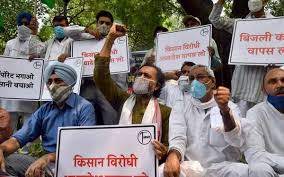
Farmer groups said they feared the new changes would lead to big monopolies. Farmers are already protesting these ordinances in food bowl states, such as Haryana and Punjab, and influential farmers’ unions are also preparing to square off with the government on the demand of making profitable sales in the form of minimum support prices, or MSPs, a legal right. The All-India Kisan Sangharsh Coordination Committee (AIKSCC), a front for nearly 200 farmers’ groups, has opposed the bills. The Rashtriya Swayamsevak Sangh (RSS)-affiliated Bharatiya Kisan Sangh demanded safeguards for the farming community, so has the Bhartiya Kisan Union.

Major parties that opposed the bills were the main opposition Congress, Bahujan Samaj Party, Siromani Akali Dal, Samajwadi Party, the Trinamool Congress, the Aam Aadmi Party, the Left parties, Nationalist Congress Party, the Indian Union Muslim League and the Dravida Munnetra Kazhagam. The Congress’s Adhir Ranjan Chowdhury said: “Show me one farmer who is happy over this bills. Haryana and Punjab are on fire.” Adding ““I appreciate the sentiments of Harsimrat Kaur (the minister who resigned from Modi Cabinet) who had the gumption to oppose the bills. These bills are no silver bullet.”

Parties opposing the bill accused the government of taking advantage of the Covid pandemic to introduce “anti-farmer legislations”. “Had there been no corona, farmers’ anger would have been visible in the streets , who does the BJP stand with, foreign investors, Adani-Ambani, dhanna seth (moneyed traders) or farmers?” asked Ritesh Pandey of the Bahujan Samaj Party, registering the opposition of party chief Kumari Mayawati.

Catégories
Blog

CHINA-INDIA’S DEFENSE MINISTERS MEETING : TURNING POINT OR FOOL’S GAME?

CHINA-INDIA’S DEFENSE MINISTERS MEETING : TURNING POINT OR FOOL’S GAME?

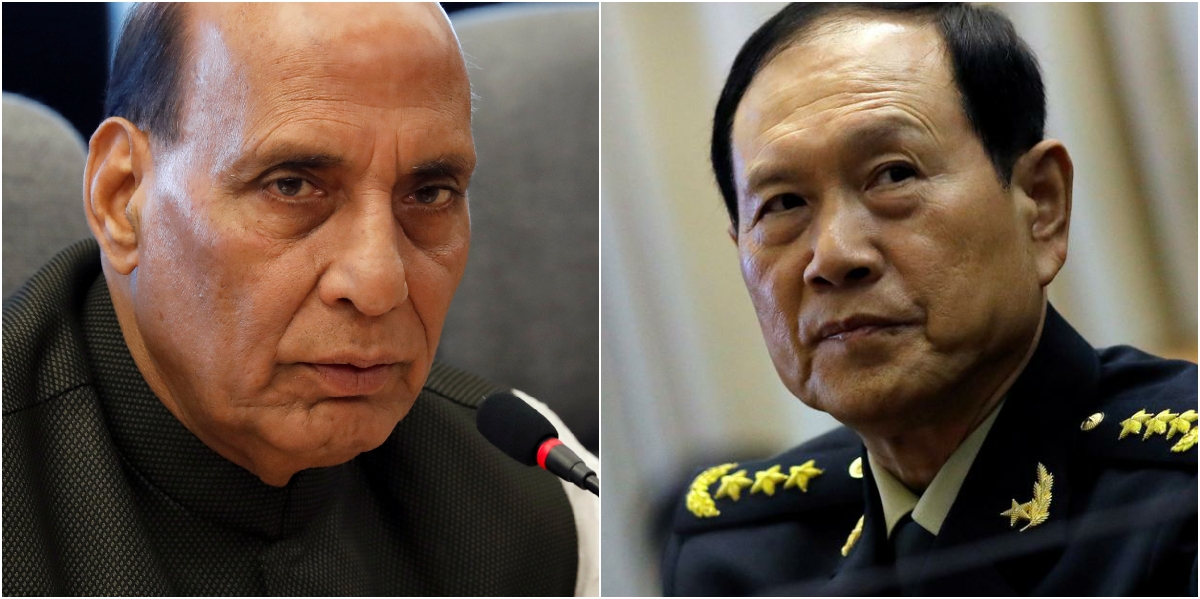
While thousands of Indian and Chinese troops have been poured into eastern Ladakh in a stand-off which has lasted for over four months, Indian defence minister Rajnath Singh and his Chinese counterpart Wei Fenghe have accepted to start talks on the sidelines of the Shanghai Cooperation Organisation (SCO), the highest face-to-face political contact between India and China since the current stand-off began in early May. The fact that the two defense ministers are sitting face-to-face is in itself a positive signal and provides the necessary atmosphere for the two countries to manage their border disputes and cool down the situation on the ground.

Both countries asserted their positions, the talks concluded with each country stating that the other side had agreed to peacefully “de-escalate” the situation. Following the meeting which lasted nearly two and half hours in a Moscow hotel, both countries had agreed to peacefully “de-escalate” the situation. Both sides asserted that they will protect their own sovereignty and territorial integrity.

The Indian statement issued on Saturday afternoon stated that Singh had “emphasised that the actions of the Chinese troops including amassing of large number of troops, their aggressive behaviour and attempts to unilaterally alter the status quo were in violation of the bilateral agreements and not in keeping with the understandings reached between the Special Representatives of two sides”. The Chinese ministry of defence conveyed that “it was important for the two defence chiefs to have a frank exchange of views on relevant issues face-to-face”. Wei had noted that the “causes and truth of the current tension on the China-India border are clear, and the responsibility is entirely with India”.

There also seemed to be a consensus that talks are the only way forward, with China claiming that Singh had underlined that “both sides should keep the channels of military and diplomatic dialogue open.

The fact that the two defense ministers are sitting face-to-face is in itself a positive signal and provides the necessary atmosphere for the two countries to manage their border disputes and cool down the situation on the ground. Chinese State Councilor and Foreign Minister Wang Yi and Indian Minister of External Affairs Subrahmanyam Jaishankar will also plan to meet on September 10. The meeting between Wei and Singh laid an important foundation for the meeting between the two foreign ministers. The complex border issue between China and India cannot be resolved in one meeting, but the role of the two defense ministers will be crucial in cooling border frictions.

The tensions might persist in the near future because the boundary issue is very difficult to solve immediately. The China-India boundary issue, which had been dormant for decades, has become « an active volcano » again in recent years, and it should not be. Before delimiting the border, it should be a common goal for both countries to manage the border issue by letting the disputes become « dormant » between the two sides again.

China and India have not yet demarcated their borders and the Line of Actual Control (LAC) shouldn’t be subject to constant change and different interpretations. The LAC of November 7, 1959 should be the base for both sides.

In the ongoing border tensions, the United States is encouraging India to take aggressive line on the border issue, by waging a border war « at any cost. » The right wing government in New Delhi also believes its alignment with the United States has increased India’s strategic strength and provided it with additional capital for risky adventure along the China-India border. Objectively, China’s military strength, is much stronger than India’s. Although China and India are both great powers, when it comes to the ultimate competition of combat capability, the Indian side will lose. If a border war starts, India will have no chance of winning.

Catégories
Blog

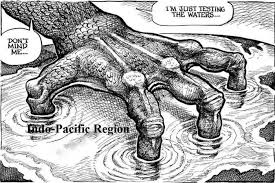
US BUILDING UP OF INDO PACIFIC NATO TO COUNTER CHINA

US BUILDING UP OF INDO PACIFIC NATO TO COUNTER CHINA

On August 31,in the framework of the ongoing summit of the US-India Strategic Partnership Forum, the US Deputy Secretary pf State Stephen Biegun said in an online discussion that the US is working to strengthen closer defence ties with countries of the India-Pacific region, India, Japan and Australia, to build up Indo- Pacific Alliance modeled on the North Atlantic Treaty Organisation (NATO) with an aim to counter China

Stepehn Biegen is a necons, he’s the number 2 official in the US state department, an American businessman, fluent Russian-speaking diplomat former staffer on the National Security Council in the George W Bush administration and the US special Representative for North Korea in the Trump administration.

Washington’s aim is to create in the Indo-Pacific region a strong multilateral structures, ultimately to align in a more structured manner, similar to those of NATO. The Donald Trump administration’s Indo-Pacific Strategy is the role played by the Quadrilateral Security Dialogue, or “Quad,” comprised of Australia, India, Japan, and the United States. Since the Quad’s resurrection from a decade-long hiatus in November 2017, the group has met five times and has emphasized maintaining the liberal rules-based international order, which China seeks to undermine or overturn. Washington’s aim is to get the Quad grouping of four countries to work together as a bulwark against a potential challenge from China and to create a critical mass around the shared values and interests.

It is expected that the Quad grouping will meet in New Delhi this autumn with Australia’s possible participation in India’s forthcoming Malabar naval exercise as an example of progress towards a formal defence bloc.

The US wants to see Vietnam, South Korea and New Zealand to eventually join an expanded version of the ‘Quad’ to form an alliance grouping the seven nations working together in order to safeguard their common and shared interests in the Inod Pacific region.

The ongoing standoff with China provides a pretext for the Modi government to unveil its real agenda, the timing alibi to align the Indian foreign policy establishment to openly transform the Quad into a Indo Pacific NATO.

Catégories
Blog

WILL INDIA FIGHT A TWO-FRONT WAR WITH CHINA AND PAKISTAN ?

WILL INDIA FIGHT A TWO-FRONT WAR WITH CHINA AND PAKISTAN ?

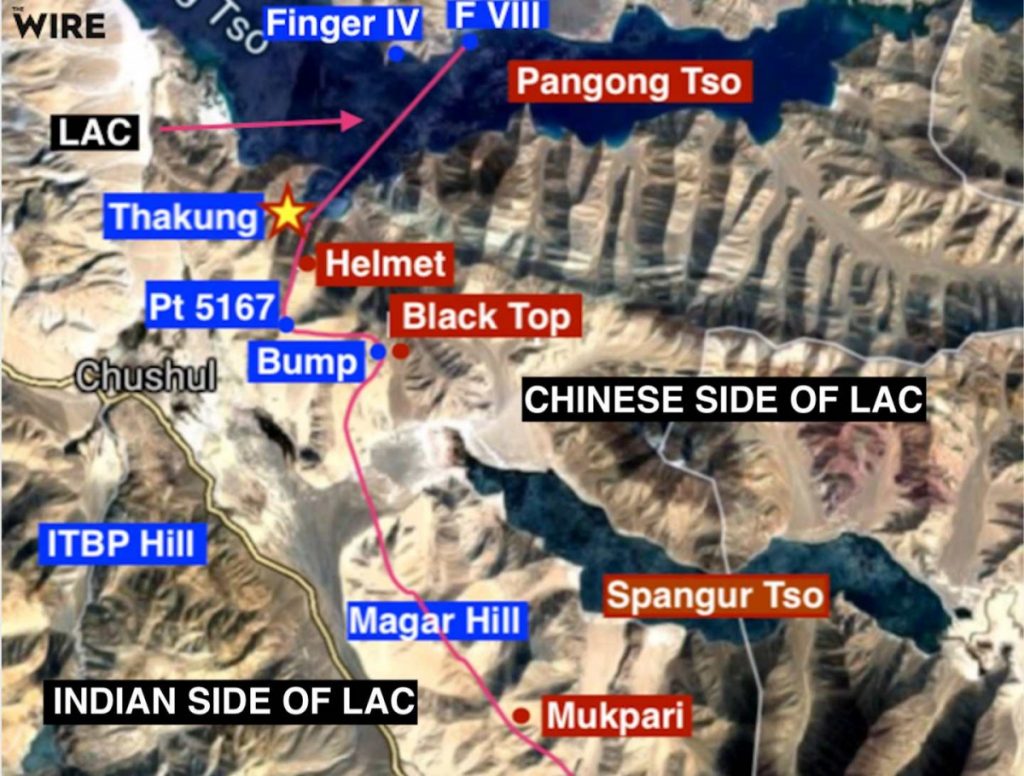
Like China’s Popular of Liberation Army that recently conducted military exercises simultaneously in four seas in preparation for a multi-front war, India military prepares for a possibility to fight a two-front war against collusive military and nuclear allies Pakistan and China. The latest fracas taking place on the night of August 29-30 between China’s People’s Liberation Army and Indian Army along the Line of Actual Control (LAC) in eastern Ladakh along the southern bank of the Pangong Tso lake, has further exacerbated the military standoff continuing since early May and raising the spectre of military confrontation between the most two populous nations.

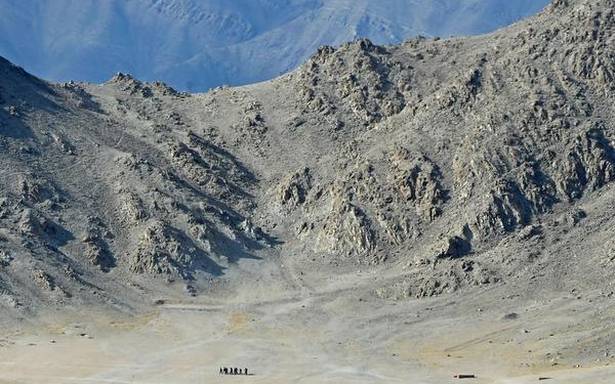
The key area and the hardest point of friction remains Pangong Lake and Depsang, particularly the Finger Area — a set of eight cliffs jutting out of Sirijap range overlooking Pangong where both armies have deployed almost 100,000 soldiers and weaponry in their forward and depth areas. the quantum of forces currently deployed by both sides of the LAC was also unprecedented. In a sign of dissuasion, Indian army has deployed three additional Indian Army divisions of around 60,000-70,000 personnel to supplement some 20,000 troops from the Leh-based 3 Division tasked with minding the LAC in eastern Ladakh against the PLA. These formations are backed by over 120-odd T72M1 and T90S main battle tanks positioned at various sensitive locations in eastern Ladakh, which in turn are augmented by the newly inducted BAE Systems M777 155mm light weight howitzers, varied missile batteries and associated systems. All these platforms have furthermore been airlifted to the region by the Indian Air Force’s (IAF’s) latest CH-47F Chinook heavy lift helicopters and C-17 and C-130J-30 fixed wing transport aircraft.These extra troops had escalated the situation ominously along the LAC as the corresponding PLA ‘forces-in being’ too are amply supported by formidable armour, artillery and missile assets.

In recent years, Pakistan’s and China’s strategic and territorial interests with regard to India had coalesced, hinting that he anticipated increased military collaboration between the two against Delhi, especially with regard to the strategic Siachen Glacier. Pakistan as a whole, its military, polity and people have longtime suspected India working to break their country into pieces. Consequently, in case of war between India and China, Pakistan will not hesitate to side with China and could swing into action to take advantage of India’s preoccupation with China.

The opening up of a second live conflict front for India, in addition to the one prevailing with Pakistan along the restive Line of Control or LOC in Kashmir, further reinforces the operationally apocalyptic ‘two-front’ war scenario for India. Despite all three countries possessing nuclear arms, conventional war would not be excluded along India’s northern and western borders with China and Pakistan.

Catégories
Non-classé

Pakistan’s new political map for Kashmir region

Pakistan’s new political map for disputed Kashmir region

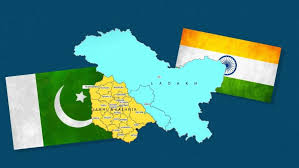
During a meeting in Islamabad attended by his cabinet and senior officials, speaking in Urdu, Pakistan Prime Minister Imran Khan released the political map depicted as a “historic” move reflecting the desires of the people of Pakistan and Kashmir and rejection of India’s illegal action of August 5 last year,” and the first step towards a political struggle to achieve the right of self-determination for the Kashmiri people under the UN Security Council resolutions, which clearly give the right to the Kashmiri people to vote on whether to go with Pakistan or India.  

In the new map, Pakistan lays claim to the Union Territories of Jammu & Kashmir and Ladakh, and Junagadh in Gujarat state. The announcement was made ahead of the first anniversary of the Indian government’s decision on August 5, 2019 to scrap Jammu & Kashmir’s special status under Article 370 of the Constitution. As it was expected, India on Tuesday described Pakistan’s political map an “exercise in political absurdity”

India’s decision to nullify Article 370 last year had triggered a strong reaction from Pakistan, as well from China, which believed it would affect its territorial claims in Ladakh, especially after India included Aksai Chin region in new maps of the union territories.

In the new map, Pakistan claims the whole of the Union Territories of Jammu & Kashmir is a part of the country’s territory whose final status is to be decided in line with UN Security Council resolutions. The boundary of Himachal Pradesh is depicted as the international border.

The map includes an annotation related to the Ladakh region whose boundary will be decided by “sovereign authorities concerned after the final settlement of the Jammu & Kashmir dispute”. In the map, Pakistan claims Siachen glacier as part of the country boundary as well as the disputed Sri Creek region of Gujarat. The map also depicts the Junagadh and Manavadar region of India’s Gujarat state as part of Pakistan. The nawab of Junagadh had opted to accede to Pakistan in September 1947, before fleeing from India with his family the following month. Junagadh voted overwhelmingly to stay with India in a plebiscite held in the region in 1948.The new map will be “used in schools and colleges and internationally”

On Monday, Pakistan’s foreign and defence ministers visited areas along the Line of Control (LoC) to raise the Kashmir issue. Pakistan plans to observe August 5 as “Youm-e-Istehsal” (day of exploitation) and Khan is scheduled to go to Muzaffarabad, the capital of Pakistan-occupied Kashmir (PoK), to deliver a speech. Pakistan’s new political map on Kashmir has the support of the country’s traditional allies, with only Turkish President Recep Tayyip Erdogan assuring Khan and President Arif Alvi of his country’s backing on the issue.

Kashmir issue is a legacy of colonial rule. Kashmir was a princely state during British rule with a Hindu ruler and at least two-thirds Muslim population. To date, it is the only Muslim majority state in India. Legally speaking, Kashmir’s accession, in October 1947, was no different from the other 550 princely states that joined India and were subsequently erased as geographical entities.

Catégories
Blog

War of low intensity in the Himalayan China-India border

WAR OF LOW INTENSITY IN THE HIMALAYAN CHINA-INDIA BORDER

Since the bloody skirmish, the Chinese and Indian Corps Commanders have held four rounds of talks so far on June 6, 22, 30 and July 14 to de-escalate from the build-up areas in Galwan Valley, Gogra-Hot Springs and Finger area along the Pangong Tso (lake) in Ladakh. The fourth talks on July 14 went lasting for 15 hours failed to implement the disengagement process despite a consensus for full disengagement and de-escalation. On August 2, the fifth round of talks between Chinese and Indian top diplomats resumed at Moldo on the Chinese side to take forward the stalled process of disengagement on the Line of Actual Control (LAC).

The stumbling blocks relates to the Finger area. The ‘fingers’ are mountain spurs on the northern bank of the lake, a set of eight cliffs jutting out of the Sirijap range overlooking the Pangong Lake. India accused China’s PLA of grabbing positions on Finger Four overlooking Indian deployments, curtailing the scope of Indian patrols right up to finger 8. Fingers Four and Eight are eight kilometres apart.

At Pangong Lake, following earlier talks, Chinese troops pulled back from the base of Finger 4, where Beijing’s claimed border is, and moved to Finger 5, still well within where India sees the LAC at Finger 8.

As a sign of determination of the PLA to hold its positions on the north bank of Pangong Tso, the new constructions in the Finger Area where  set up permanent bunkers, pillboxes, observation posts and tented camps over the last three months.

De-escalation of the border conflict with China can only begin complete disengagement between the two armies along the LAC. The ground situation remains unchanged in the Ladakh sector where both armies have deployed almost 100,000 soldiers and weaponry in their forward and depth areas and are prepared for a long haul through the winter months.

Catégories
Blog

How EU is playing India against China in Indo-Pacific geopolitical rivalry

How EU is playing India against China in Indo-Pacific geopolitical rivalry

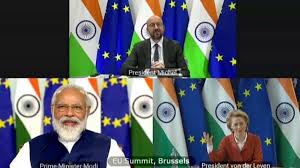
On Wednesday, European Council President Charles Michel held a news conference in Brussels following a virtual summit with the Indian prime minister Narendra Modi in the framwork of what officially called the Bilateral Trade and Investment Agreement set up in 2007.

European Council President Charles Michel pleaded for reinforcement of “ strategic goals” and an “indispensable partner” amid increasingly tensions with China. “The EU and India are more than economic partners – we are political partners,” Michel told reporters after the summit. “India can count on the European Union, and we count on India to be a key partner.”

Michel justified the warmth EU leaders bestowed on India, by the fact that both partners share common values grounded on democracy and human rights against what it calls a systemic rival in China, witnessed by the last development  in Hong Kong prompting Europe to consider a “revision” in its approach to Beijing. Michel cast light on the shared values between Europe and India saying “India and the European Union are two democracies with traditions and respecting human rights and the international rule of law. So we do have the potential to make further strides forward when it comes to the economy, the environment or digital issues,” he said. “When it comes to the political side of things, India is a partner because we share the same vision of globalisation, inspired by democratic standards, principles of freedom and liberty and inclusivity,” he added.

The EU and India will further develop security and defence consultations and military contact, including maritime security in the Indian Ocean.

Ursula von der Leyen, president of the European Commission, said that India is a partner for the EU’s role of “defending our values”.

 “We share a human-centric approach. That means using secure digital technologies to improve the quality of life of citizens, but at the same time respecting privacy and individual freedoms,” von der Leyen added.

The EU’s foreign policy chief, Josep Borrell, said this week that the “draconian” national security law Beijing imposed on Hong Kong “would require revision of our approach and will clearly have an impact on our relations”.

As a sign of increasing tensions with Beijing, New Delhi and Brussels also came up with a joint statement after the summit – a contrast to the inability of Beijing and Brussels to come to terms with President Xi Jinping and Premier Li Keqiang last month.

Translate »