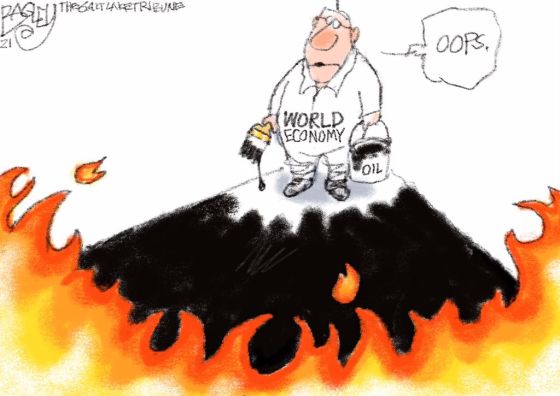
Historian and author Dr. Gerald Horne is right and deserves to be known and read by naming the things by their names as saying “ The crisis goes beyond just the media, Horne argued, saying it is a crisis of “the entire capital system” and is part of “the inevitable demise of capitalism.” In fact, if capitalism survived its periodic and cyclical crisis as depicted by Marx in his seminal work, the Capital, it is because of two determinant factors,(1) imperialism and colonialism in order to control and to steal the huge wealth of mineral resources outside EUROPE and North America, (2) the manipulation and the reap of the masses by political propaganda researched and as very well explained by these two authors, the Freud’s nephew, Edward Bernay in his seminal book published in 1928, “propaganda,” with this very telling subtitle, “how manipulating public opinion in democracy” and Serge Tchakotine, from Russian descent, in his voluminous book “the reap of the crowd by political propaganda”. In this time, the former colonizing peoples and regions all over the world, in particular in Africa, are realizing and are becoming aware that the main cause of their chronic under development is due to the plunder and the theft of their underground riches, the very precious mineral and agricultural wealth and by the way, the new generation in Africa is waking up, determined to accomplish a second struggle for independence as we have seen last year during the second summit Russia Africa at St Petersburg with the very historical speech of the Burkinabe young president Ibrahim Troaré calling the African people to take their destiny in their hands without waiting for former colonizers’s aid. When it comes to the manipulation of the masses by political propaganda, capitalism shouldn’t survive so long without manipulating the human psychology by the mass media of communications(MMC) which always were the monopole of under the control of big capital and financial corporations whose main objective consists of manipulating and influencing the choice of the voters called to vote in spite of themselves for the same ruling class and for its corrupt political establishment. The emergence of internet early XXI century giving place to diversification of sources of information and analysis, the monopole of political propaganda by the ruling class and the political establishment has been undermined, that is why the western governments in Europe and North America were eager since 20 years to restrict the so called free of speech, to control internet and to silence the dissident voices through legislations witnessed by the latest European legislation called Digital Acts Services( DAS) promoted by the French commissioner André Breton.
Étiquette : capitalism
BRICS for what purpose ?
Since the end of the 15th BRICS summit in Johannesburg, veteran and renowned analysts and academics are gloating about expanded BRICS presented as something announcing the dawn of so called new era symbolized by a new currency alternative to US dollar and to financial and economic institutions created by the Bretton Woods agreements in 1944. The question that begs : is the BRICS a really original organization grouping members from the global south, different from other transnational organizations such for example, the group of twenty, called G20 that will take place in new Delhi, India, on September 9 and 10, or from the Group of seven, called the G7 ? The original acronym « BRIC », or « the BRICs », was coined in 2001 by Goldman Sachs economist Jim O’Neill who predicted that countries of the global south like India and Brazil would emerge as key players on the global economy by 2050. The main purpose of the BRICS was to look at investment opportunities. The historical context of its emergence in 2009 was a response to 2008 financial crisis, similar context that triggered the birth of the Group of Twenty in the wake of Asian financial crisis in 1997-98 or the Group of Seven triggered by the oil crisis of 1973 in the wake of the Israeli Arab war. By looking closely to these three transnational organizations, one can discover behind their emergence, chronical, recurrent and uncurable capitalist crisis. Main objective of the BRICS like the G20 and G7, is the research of an antidote to endless crisis of capitalist system and fitting mainly the economies of the global south into global capitalist market
Representatives from nearly 200 countries are meeting in Kunming, China, to halt and reverse biodiversity loss. A COP15 is being hosted by China, but will be a mixture of in-person and virtual meetings. The meeting was meant to go ahead in 2020, but, well, 2020 happened. It will launch this week with further negotiations to occur in April and May next year. ll promised goals set from 2010 to 2020 — through the Aichi Biodiversity Targets — failed. Nature is being destroyed at a rate never before seen in human history, that rate is accelerating and almost all of the destruction, 1 million species could be lost, according to the most comprehensive report on the matter produced by the United Nations. More than 40 per cent of amphibian, 33 per cent of reef-forming corals and a third of all marine mammals are now threatened. According to the UN, climate change is one of the biggest causes of biodiversity loss. The biggest is changes in land use like clearing forests to make way for agriculture and mining. The next biggest is simply the direct exploitation of animals — like overfishing. Many people see nature as having an intrinsic value. But the loss of nature has a direct catastrophic impact on humanity too.

ANTHROPOCENE OR CAPITALOCENE ?
“ A man may take to drink because he feels himself to be a failure, and then fail all the more completely because he drinks. It is rather the same thing that is happening to the English language. It becomes ugly and inaccurate because our thoughts are foolish, but the slovenliness of our language makes it easier for us to have foolish thoughts. The point is that the process is reversible. Modern English, especially written English, is full of bad habits which spread by imitation and which can be avoided if one is willing to take the necessary trouble. If one gets rid of these habits one can think more clearly, and to think clearly is a necessary first step toward political regeneration: so that the fight against bad English is not frivolous and is not the exclusive concern of professional writers”(George Orwell, Politics and the English language,1946)
Media of propaganda routinely uses misleading names to manipulate and deceive the masses and to hide reality of political, economic and social system in which they are living. For example, through masquerading election organized at the Olympic interval, dictatorship has become democracy to hide the rule of minority over majority, security forces to hide the defense of established order, ministry of the war has become ministry of defense. The US ministry of endless wars has become Department of defense, all these misleading names are an illustration of how deeply the mindsets of the nation’s warfare state are embedded in the political culture of the United States.
The same media of propaganda is doing the same manipulation and decption of the masses about climate change, climatic warming and extinction of biodiversity, caused by the so called “human activities” The Anthropocene is a comforting story with uncomfortable facts. It fits easily within a conventional description – and analytical logic – that separates humanity from the web of life. Nature becomes a factor, a variable, a part of the story. This logic runs deep. It is a reflex, a part of our intellectual muscle memory. It shapes our thinking of planetary crisis and its origins, preconceptualizing humanity and nature as separate first, connected second. The dominant Anthropocene argument also nestles comfortably within a conventional narrative of modernity. The Industrial Revolution is understood as a set of technical, class, and sometimes political relations emerging around coal and steam.
The Anthropocene has become a wider conversation around humanity’s place in the web of life. The Anthropocene elides decisive questions of difference amongst humans, and the lancinate question of capitalist origins and historical capitalism as a world-ecology of power, capital, and nature, dependent on finding and co-producing what Jeson Moore called the cheap Natures, which is also the origins of ecological crisis.

Capitalism is based on the separation of Humanity and Nature.The violence inscribed in Nature/Humanity was there from the beginning. The era of primitive accumulation gave rise not only to the “accumulation of capital” but also a new world praxis: Cheap Nature.
Capitalism does, however, advance an epistemic rift: a rift about how humans organizations are embedded in nature. The heart of the problem is that Nature/Society dualism poses not only analytical barriers but reproduces “real world” systems of domination, exploitation, and appropriation. This ontological rift is the symbolic expression of the separation of the direct producers from the means of production. Together, these moments constituted the origins of capitalism not only as world-system but as ontological formation: as a world-ecology. Humanity/Nature is a doubly “violent” abstraction: violent in its analytical removal of strategic relations of historical change but also practically violent in enabling capitalism’s world-historical praxis – a praxis of cheapening the lives and work of many humans and most non-human natures. This is a praxis of domination and alienation operative simultaneously through the structures of capital, knowledge, and feeling.
WHAT DOES REALLY MEAN WESTERN DEMOCRACY ?
The brainwashed western elitism depicts the United States of America as the first and accomplished democracy in the world. This cliché becoming with time commonplace has been perpetuated through educational system chiefly in law schools dedicated to form and train the future on one side and political propaganda used as a powerful tool of manipulation by the wealthy and the ruling class to deceive the masses and to orient the choice of voters, propagandizing for subservient conservative and liberal candidates and parties who, once elected,would legislate in the best interests of big business and the monopolies.
BLOW TO INDIAN FARMING COMMUNITY AS MODI’S GOVERNMENT OPENS AGRICULTURE SECTOR TO MONOPOLE AND AGIOBUSINESS
The lower house passed on Thursday two farm bills, the Farmers’ Produce Trade and Commerce (Promotion and Facilitation) Bill, 2020 and The Farmers (Empowerment and Protection) Agreement on Price Assurance and Farm Services Bill, 2020. Both bills are aiming at deregulating the agriculture sector, one to free up agricultural trade from all restrictions and the other to create a new contract farming putting the Indian farmer at the mercy of big agro industry and multinationals. The bills seek to open up the Indian farming community to monopole and enabling bigger agribusinesses to control the access to markets, which are currently fragmented.
The bills were first announced by finance minister Nirmala Sitharaman on May 15 in the second of her series of briefings on proposed reforms. The main provisions of the Farming Produce Trade and Commerce (Promotion and Facilitation) Bill, 2020 abolish regulations of the inter-state and intra-state trade of primary agricultural commodities. Under the old system, farm produce are sold mainly in notified wholesale markets run by so-called agricultural produce marketing committees, or APMCs, under state laws which require farmers to only sell to licensed middlemen in these notified markets, usually in the same area where the farmers reside, rather than in open markets. The bill enables farmers and buyers of their produce to trade outside these tax-free markets and will therefore open up APMCs to competition. The bill will enable food traders to buy farmers’ produce from any market, rather than bind them to the specific markets where they are licensed to operate.
The Farmers (Empowerment and Protection) Agreement on Price Assurance and Farm Services Bill, 2020 abolishes the old regulations related to contract farming. It provides for a national framework on farming agreements, enabling a farmer to engage with agribusiness firms, processors, wholesalers, exporters or large retailers for sale of future farming produce at a pre-agreed price imposed by big agribusiness.
Union minister Harsimrat Kaur Badal of the Shiromani Akali Dal (SAD) has resigned on Thursday from Prime Minister Narendra Modi’s government, as the BJP ally on Thursday opposed the two farm bills that seek to liberalise the agriculture sector, exposing a crucial rift on the issue of farmers and agricultural reforms. “I have resigned from Union Cabinet in protest against anti-farmer ordinances and legislation. Proud to stand with farmers as their daughter & sister,” tweeted Harsimrat Badal. “I think I was probably the lone voice who came from a 100% agrarian state. The officers who made the ordinances were unable to see Punjab differently from rest of the country” she saif in interview to the Hindustan news agency.
On September 12, the party had formally asked the Centre not to enact three farm ordinances during the monsoon session of Parliament, which began on September 14.
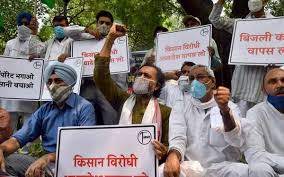
Farmer groups said they feared the new changes would lead to big monopolies. Farmers are already protesting these ordinances in food bowl states, such as Haryana and Punjab, and influential farmers’ unions are also preparing to square off with the government on the demand of making profitable sales in the form of minimum support prices, or MSPs, a legal right. The All-India Kisan Sangharsh Coordination Committee (AIKSCC), a front for nearly 200 farmers’ groups, has opposed the bills. The Rashtriya Swayamsevak Sangh (RSS)-affiliated Bharatiya Kisan Sangh demanded safeguards for the farming community, so has the Bhartiya Kisan Union.
Major parties that opposed the bills were the main opposition Congress, Bahujan Samaj Party, Siromani Akali Dal, Samajwadi Party, the Trinamool Congress, the Aam Aadmi Party, the Left parties, Nationalist Congress Party, the Indian Union Muslim League and the Dravida Munnetra Kazhagam. The Congress’s Adhir Ranjan Chowdhury said: “Show me one farmer who is happy over this bills. Haryana and Punjab are on fire.” Adding ““I appreciate the sentiments of Harsimrat Kaur (the minister who resigned from Modi Cabinet) who had the gumption to oppose the bills. These bills are no silver bullet.”
Parties opposing the bill accused the government of taking advantage of the Covid pandemic to introduce “anti-farmer legislations”. “Had there been no corona, farmers’ anger would have been visible in the streets , who does the BJP stand with, foreign investors, Adani-Ambani, dhanna seth (moneyed traders) or farmers?” asked Ritesh Pandey of the Bahujan Samaj Party, registering the opposition of party chief Kumari Mayawati.