Catégories
Anti China Crusade Anti Russia Crusade Blog Geopolitics OIL WARS & CRISES

US NEW STRATEGY TO COUNTER CHINA AND RUSSIA

In 2018, the United States government has declassified its Indo-Pacific strategy initially set to be released to the public at the end of 2042. The strategy was initially devised throughout 2017, going on to be approved and enforced by President Donald Trump in 2018 shortly after the US National Defense Strategy was finalised. At its heart, the strategy highlights a deep concern with China’s rising influence in the Western and Central Pacific and plans to deal with an increasingly belligerent North Korea, while seeking to use its South-East Asian allies to contend with China and North Korea and to strengthen India to counter Chinese military power.

Countering China in the South China Sea

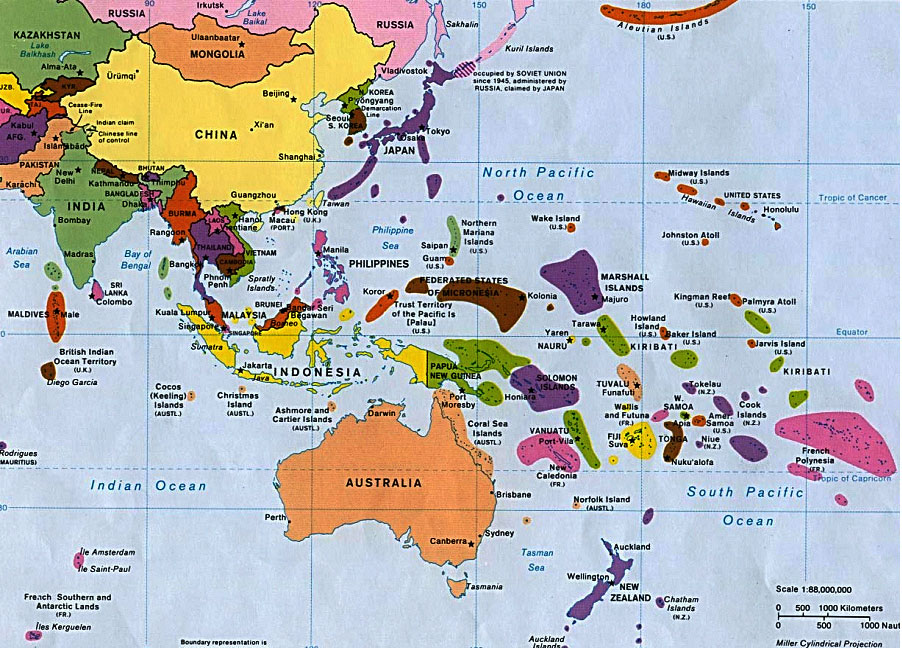
The strategists highlight China’s growing dominance in the Indo-Pacific and consider Beijing as is the United State’s primary adversary and strategic opponent in the area. While the document does not mention the South China sea dispute, it reflects a concern over China’s claims there and in other parts of the Western Pacific. The strategy to counter China aims to build US capabilities until they are “capable of, but not limited to” denying China control of the air and the sea in the “first island chain”, referring to a string of Pacific islands surrounding China that include Russia’s Kamchatka peninsula, Japan, Taiwan, Philippines, Malaysia and Vietnam. China claims most of these waters. Second, it emphasizes the strategy emphasizes the need to defend the first island chain, and dominate all areas outside it.

disputed zones in the South China Sea

A US Navy oceanographic survey

Since last September, a US Navy oceanographic survey ship has been conducting extensive activities in a large area of the South China Sea to collect underwater geographical and hydrological data to support its submarine warfare in the region against China.

This situation also drew attention from some military observers after a US nuclear-powered attack submarine struck an unidentified underwater object in the South China Sea earlier this month, which again highlighted the US Navy’s need to learn more about the region.

The USNS Mary Sears (T-AGS 65), a Pathfinder-class oceanographic survey ship, entered the South China Sea on September 26 and started extensive surveys. From October 1 to 4, the ship operated in waters south of China’s Hainan Island, from October 5 to 9, it approached the coastline of Vietnam, and by Sunday it had arrived in waters near the Nansha Islands. The Pathfinder-class oceanographic survey ship is specialized in the detection and surveying of underwater terrain, meteorology and hydrology.

The USNS Mary Sears (T-AGS 65)

While the ship seems to be conducting scientific research, its true mission is to support submarine and anti-submarine warfare, the USS Connecticut, a Seawolf-class nuclear-powered attack submarine, struck an underwater object in the South China sea on October 2.

the USS Connecticut, a Seawolf-class nuclear-

This accident means the sea map the submarine was using was outdated, and the US Navy was conducting scientific research to draw underrates maps with the mission to support submarine and anti submarine warfare and help navigate friendly submarines or place detection device to locate hostile submarines.

Countering China and Russia in the Middle East

President Joe Biden’s Interim National Security Strategic Guidance Lt. Gen. Ronald Clark, who spoke at the Association of the U.S. Army’s annual conference Oct. 12 emphasized the challenges of strategic competition with Russia and China to American interests, including nonmilitary events taking place across the Middle East. The major challenges to the command’s operations are China, Russia, Iran and “violent extremist organizations around the world,” he said. But the commander primarily cited Russia and China, which he said are making moves in the Middle East to “set conditions for future operations.” 

Both nations blur the lines between competition, crisis and conflict. While it falls short of actual conflict, Clark said these actions are a part of strategic competition and will shape future conflicts in the Middle East and beyond. Events in one theater will spill over — undoubtedly — to another,” he said. “Bottom line: All of our competitors are setting conditions in the [command’s area of responsibility] right now that we need to respond to.”

Middle East map

For example, China engages in unrestricted warfare, which consciously expands the battlefield from traditional domains such as land, air and sea to social spaces, politics, culture and economics. An important piece of that in the Middle East is the Belt and Road Initiative, which consists of a number of economic investments by the Chinese government and Chinese-owned companies in foreign countries. The Belt and Road Initiative touches virtually every country in [the command’s area of responsibility],” said Clark, pointing to a $300 billion investment by a Chinese-owned company into the port of Abu Dhabi in the United Arab Emirates. China continues to import massive amounts of oil from the Middle East, helping Iran build a new export facility that will allow it to continue pumping oil past the Strait of Hormuz. 

Hormuz Strait

Meanwhile, Russia is practicing its own form of hybrid warfare using nonmilitary means to create an operational environment where a smaller military force can come in and achieve its objective, Clark said. For example, a 2017 deal allowed Russia to expand the Port of Tartus in Syria, and it can now hold up to 12 nuclear-powered ships or submarines, he added. That now allows the Russians — if they want to — to project power into the Mediterranean and into Eastern Europe,” he said.

Syria’s Tartus port

The US Central command’s area of responsibility is vast. It includes 21 countries that make up more than 4 million square miles and are home to 550 million people in 22 ethnic groups speaking 20 different languages.

Oil locations in the Middle east

Importantly for American interests, he added, it’s also home to vast oil reserves. Nearly 30 percent of the petroleum and crude oil products from around the world flow through three chokepoints that fall under the command’s purview. Clark pointed to when the supercargo ship Ever Given recently clogged up the Suez Canal for days as an example of the importance of those chokepoints. That incident disrupted 12 percent of global trade with an estimated cost of $9 billion.


Catégories
Anti China Crusade Asia Pacific Blog Geopolitics NATO WARS & CRISES

THE QUAD, AN »ASIAN NATO » TO CONTAIN CHINA IN THE ASIA PACIFIC REGION

On September 24, President Biden hosted Prime Minister Scott Morrison of Australia, Prime Minister Narendra Modi of India, and Prime Minister Yoshihide Suga of Japan at the White House for the first-ever in-person Leaders’ Summit of the Quad. A the top of their agenda the COVID-19 pandemic, infrastructure; the climate crisis; emerging technologies, space, and cybersecurity; and last but not least, fellowshi consisitng of cultivating 100 selected students(25 from each QUAD member) to be trained in the USA universities.

Biedn,Modi,Morisson and Suga meeting QUAD summit in Washington September 2021

THE QUAD, CONTINUATION OF THE TRUMAN DOCTRINE OF CONTAINMENT OF COMMUNISM 

The father of the containment is not Truman nor John Foster Dulles but George Kennan who was considering the soviet union and the communism as evil and conspiratorial trend within “liberal democracy” For that reason, Kennann had preached continued fight against the USSR and communism by confronting the Russians with counterforce at every point and to block the Soviet Union with “superior force and with “unassailable barriers in its path”

The policy of containment was supported and implemented in 1947 by the Truman administration asserting the need to “act and act decisively” to sustain the open Door policy. As the direct descendant of Churchill militancy anti Russia “Iron curtain” speech of march 1946, the Truman doctrine blamed the Soviet Union for the troubles of the world and announced the determination of the united States to halt the spread of revolutionary radicalism. As a result, Truman administration had elaborated a program to promote “trouble on the other side of the Iron curtain” Consequently, as Acheson revealed to the Congress, the cold war was inevitable.

George Kennan(Left),father of the containment and the politician who coind the term of « Cold war »

The QUAD is a new military alliance targeting China in the Asia Pacific region like NATO set up in 1949 with the main objective: containing the Soviet Union in Europe. Long after the triumph of the Revolution in China, a large part of the American people refused to accept the result. After the fall of China to communism in October 1949, Truman Doctrine was activated to contain the new born communist revolution in China. The USA initiated the Korean war in 1950 with the hope to put a break to the rising tide of revolution in Asia. The snowballing effect of communist triumphes might make Thailand and Burma relatively easy conquests. Since Indi China is strategically the key to all South East Asia. A communist sweep in asia would tend to « paralyse the defense of Europe ». In West europe the feeling might well spread that resistance to the Red  » wave of the future » was hopeless. Thus far the Truman Doctrine had been enforced, but il had been a dismal failure in east Asia. these considerations were sufficient to induce resolute action in Korea.

Truman doctrine of containment of communism

QUAD, US TOOL TO CONTAIN RISING CHINA IN THE ASIA PACIFIC REGION

The Quad has been described as a U.S.-led project, an alliance, an axis of democracies, a security diamond to contain China. The story of the QUAD has begun in spring 2007 by quadrilateral discussion followed later by a naval exercise in the fall of this year. In 2006, Japanese prime ministerial candidate Shinzo Abe made a more limited but focused case for a values-based foreign policy and closer ties with Australia and India. Once Abe won the election, his foreign minister Taro Aso reiterated this call in a speech laying out the new government’s foreign policy. In December 2006, Indian Prime Minister Manmohan Singh visited Japan. In a joint statement, he and Abe noted “the usefulness of having dialogue among India, Japan and other like-minded countries in the Asia-Pacific region on themes of mutual interest.” Then, reports emerged that U.S. Vice President Dick Cheney, despite hesitation in some quarters in the Bush administration, endorsed the idea of a quadrilateral involving Australia, Japan, the United States, and India — in addition to the Trilateral Strategic Dialogue that the first three had started in 2002. He discussed it with Prime Minister John Howard on a visit to Australia in February 2007. When Howard visited Tokyo the next month, he and Abe highlighted the four countries’ shared democratic values. A few days later, the Indian foreign minister visited Japan, and then, in April, Aso traveled to India and Abe to Washington. The Australian participant later described it as an “informal meeting … to look at issues of common interest” (like disaster relief) involving countries that “share some values and growing cooperation in the Asia-Pacific.”

Dick Cheney, G.Bush’s vice president

The meeting might have been exploratory, but observers thought it was or could be much more. Australian members of parliament asked if this was a security arrangement, an alliance, or an expansion of the Trilateral Strategic Dialogue. Indian lawmakers wanted more details on this “four-cornered dialogue.” Advocates and critics suggested it was an “Asian NATO” to constrain China.

There was still momentum behind the Quad. When Abe visited India in August, he didn’t explicitly mention it, but told the Indian parliament, “the Confluence of the Two Seas is coming into being.” He spoke of a “broader Asia” that would also incorporate Australia and the United States. The quadrilateral found more explicit mention in the United States that fall, when presidential candidate Sen. John McCain wrote that he would “institutionalize” the Quad

John Mc Cain

QUAD, MILITARY ALLIANCE DIRECTED AGAINST CHINA IN THE ASIA PACIFIC REGION

Before the recent meeting of the Quad, both the United States and the Indian sides denied that it was a military alliance, even though the Quad countries conduct joint naval exercises—the Malabar exercises—and have signed various military agreements. The September 24 Quad joint statement focuses more on other “security” issues: health security, supply chain and cybersecurity.

QUAD Malabar exercice

Before the Quad meeting in Washington, the United States and the UK signed an agreement with Australia to supply eight nuclear submarines—the AUKUS agreement. Earlier, the United States had transferred nuclear submarine technology to the UK, and it may have some subcontracting role here. Nuclear submarines, unlike diesel-powered submarines, are not meant for defensive purposes. They are for force projection far away from home. Their ability to travel large distances and remain submerged for long periods makes them effective strike weapons against other countries.

The AUKUS agreement means that Australia is canceling its earlier French contract to supply 12 diesel-powered submarines. The French are livid that they, one of NATO’s lynchpins, have been treated this way with no consultation by the United States or Australia on the cancellation. The U.S. administration has followed it up with “discreet disclosures” to the media and U.S. think tanks that the agreement to supply nuclear submarines also includes Australia providing naval and air bases to the United States. In other words, Australia is joining the United States and the UK in a military alliance in the “Indo-Pacific.”

AUKUS,new military alliance with Australia against China

Behind the rhetoric about the Indo-Pacific and open seas is the U.S. strategic vision to project its maritime power against China and contest for control over even Chinese waters and economic zones. This is the 2018 U.S. Pacific strategy doctrine that it has itself put forward, which it de-classified recently. The doctrine states that the U.S. naval strategy is to deny China sustained air and sea dominance even inside the first island chain and dominate all domains outside the first island chain. .

The U.S. is using the other members of the Quad as mere tool to regain its strategic and global dominance. The United States wants to use the disputes that Vietnam, the Philippines, Indonesia, Thailand and Malaysia have with China over the boundaries of their respective exclusive economic zones. The same strategy used by the United States to use European continent as bullwark against the Soviet Union. That is why old colonial UK, France, Germany and today the United States all have large aircraft carriers: they are naval powers who believe that the gunboat diplomacy through which they built their empires still works. The United States has 700-800 military bases spread worldwide; Russia has about 10; and China has only one base in Djibouti, Africa.


Catégories
Anti China Crusade Blog Geopolitics WARS & CRISES

AUKUS,BIRTH OF NEW MILITARY PACT TARGETING CHINA

On Wednesday September 15, in a virtual press conference with British Prime Minister Boris Johnson and Australian Prime Minister Scott Morrison, US President Joe Biden announced the formation of a new Indo-Pacific security alliance with the UK and Australia. The so called security alliance named « AUKUS »Washington’s hottest acronym abbreviations for Australia, the United Kingdom and the United States, is but a new military pact conceived and set up by imperialist and hegemonic power flanked by two satellites Anglo saxon proxies aimed at containing China’s rise to global power. AUKUS is Washington’s latest NATO-like alliance in the Asia Pacific region alongside other alliances, the US-Japan and US-South Korea alliances and the Quad including India, not US ally but a political and geopolitical challenger to China.

AUKUS, the new military pact could endanger the Asia Pacific region as Australia will become a nuclear power by acquiring 9 nuclear powered submarines. The centrepiece of the deal announced involves Australia acquiring nuclear-powered submarines and abandoning a deal with France,tearing up an agreement with French Naval group to build conventionally powered submarines. Under the arrangement, the United States will divulge its most-guarded naval nuclear secrets to Australia. The details and inner workings of the alliance will be nutted out over the next 18 months. Playing on words by alleging the deal does not extend to nuclear weapons, only to the propulsion system, as the future nuclear-powered submarines would be able to carry nuclear weapons aboard.

Allied naval presence is expected to increase north of Australia, including in the contested South China Sea, as part of a coordinated tricontinental push against Beijing territorial aggression. Australia, the United States and Britain are expected to reorient their submarine and warship fleets to counter China’s increasing regional presence.

The new military pact would allow a far greater presence of American troops on Australian soil as more US warplanes of all types, including bombers, will come to Australia, along with a larger presence of maintenance crews and military logistics personnel.

Beijing vigorously reacted denouncing the new military as AUKUS deal supplying Australia with nuclear submarines « seriously damages regional peace and stability, intensifies the arms race, and undermines the Treaty on the Non-Proliferation of Nuclear Weapons » A senior Chinese military expert commented on the new nuclear deal considering only nuclear-armed countries have nuclear submarines, and a nuclear submarine is one tasked to launch a second-round nuclear strike in a nuclear war.

Aware of the danger from the new military pact New Zealand, member of the Five Eyes Alliance, wants to stay away from it, especially Australian nuclear submarines. New Zealand Prime Minister Jacinda Ardern said on Thursday that Australia’s new nuclear-powered submarines would not be allowed in New Zealand’s territorial waters under a long-standing nuclear-free policy.

The new military pact will benefit directly the merchants of death in US and UK and indirectly a leading French company Thales based in England. In UK, BAE System is currently building a fleet of Astute- class nuclear powered attack submarines and designing a fleet of Trident ballistic missile submarines for the Royal Navy at its Barrow yard in northern England. The company has a substantial stake in the Australian shipbuilding industry in part due to Canberra’s 2018 selection of the companies Type 26 frigate for anti-submarine duties. Thales, a great success, a French company has a very large workforce in the UK working for submarine industry. After Australia has scrapped the French deal, the company was quick to announce in a statement on Sept. 15 that its business outlook would remain untouched by the Australian decision to drop Naval Group.

Translate »