Catégories
Archives

Anti-communism : Formation of the  » cordon sanitaire » against Bolchevism

Anti-communism : Formation of the « Cordon sanitaire » against Bolchevism

In his message to Congress of 8 January 1918, President Wilson announced his Fourteen Points fixing the terms of peace. Wilson’s Fourteen points served as the basis for the peace settlement and the Versailles Treaty of 1919. Chronologically, Wilson’s Fourteen Points came immediately after the victory of the Bolshevik Revolution in Russia two months ago, in November 1917. When Wilson announced his Fourteen Points, he and his European partners, France and Great Britain didn’t have a clear picture of the nature and the development of the new upheaval taking place in the former tsarist empire as one can observe for example Point 6 of the Fourteen Points, claiming “the evacuation of the Russian territory and the independent determination by Russia of her own political development and national policy”. It would be interesting to mention other assertions included in Wilson Fourteen Points announcing the redrawing of new map in Europe and the organization of the new states whose creation could only be justified by their role as bulwark against Bolshevism. We can observe this hidden motive through the points 10 to 14. For example Point 10 claims the self determination for the peoples of Austria Hungary ; point 11 calls for a redrawing of the boundaries of the Balkan states along historically established lines of nationality ; point 12 asserts the self-determination for the people under Turkish rule and freedom; point 13 claims the Independence of Poland with free access to the sea guaranteed by international covenant and finally point 14 appeals to the formation of a general association of nations for the purpose of affording mutual guarantees of political independence and territorial integrity to great and small states alike.

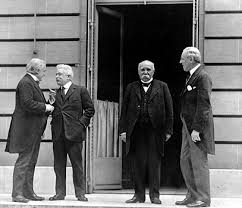
The first forma session of the peace conference took place on 18 January 1919, A Peace conference dominated by the “Big Four” England, France, Italy and the United States. Russia was not represented since the Allies hoped that the new Soviet government would shortly collapse. The main preoccupation of Wilson, Clemenceau, Lloyd George and Orlando was less the sort of peace with vanquished Germany than this new menace henceforth haunting Europe, Bolshevism “that hung over Paris like a dark cloud” Everyone was thinking of it many were talking of it. Rumors and false flag circulated and widespread about Hungary going Bolshevik with Bela Kun, that Germany and Italy the next before invading the entire bourgeois capitalist world. For this reason, Wilson who planned to return to home was forced to stay in Paris in order to thwart Bolshevism reaping the profit.

In order to fight Bolshevism in Russia, The treaty of Versailles had erected a bulwark knowing as the “cordon sanitaire” a ring of anti-communist states to isolate the Soviet Union and formed from pseudo and proxy states created from nothing by the only will of three imperialist victors, the united states, England and France. The first piece of the “cordon sanitaire” was Germany wrested only from her colonies and commercial rights in Africa and the Far East, from Alsace-Lorraine, Posen and parts of Schleswig and Silesia. For United States, Germany was the principal bulwark against Bolshevism and that is why Wilson resisted the  Allies to charge Germany with the whole cost of the war, and opposed Clemenceau claim over Rhineland, the Polish demand for East Prussia. From Austria-Hungary and Tsarist Russia came the newly independent states of Austria, Hungary, Yugoslavia,  The other pieces of the Cordon sanitaire created by other treaties  were Czechoslovakia, Yugoslavia, Finland and a new Poland created from the historic Polish territories that had been parts of three empire with a corridor to the sea according to Wilson willingness.  Wilson and his European colleagues also built a cordon sanitaire (buffer zone) of new westward-proxy nations(Finland, Estonia, Latvia and Lithonia) around Russia to quarantaine the Bolchevik contagion.
 

Catégories
Archives

Anti-communism :Early Anti-Reds Crusade

Anti-communism : Early Anti-Reds Crusade

On November 18, 1918, Kolchak overthrow the somewhat democratic regime at Omsk;  The allied intervened in behalf of Admiral Kolchak six months afzetr the armictice six months after any . This Allied intervention was done to a country which no one of the four nations(Britian, france, Japan and America) was at war. Tit constituted an official open and avowed attack on the Soviet government of Moscow Allied support to Kolchak constituted an intervention in a civil war a subsidy of one side against the other. In support of the Allied attempt to, defeat and destroy the Bolshevik government THE British Government gave Kolchak seventy-nine shiploads of supplies arms and equipment for 100 000 men but this army while advancing toward Moscow had been defeated and driven back thousands of miles along the Siberian railway in one of the most disastrous retreats of all time. The red Army captured Kolchak and shot him at Irkutsk. Lloyd George declared in the House of Commons Kolcjak’s effort to suppress the Reds had been aided by the presence of British, French American and Japanese troops east of Lake Baikal based on Vladivostok. The decision of the Allied to send troops to Vladivostok was made in July 1918 On July 2 the Allied Supreme War Council decided for intervention and on the 17th Washington notified the Allies that the United States would join the japanese in landing troops at Vladivostok the  American troops remained in Siberia from mid—1918 to early 1920 But the Japanese stayed two years longer. In south Russia the intervention of France was still inglorious when the government sent 140 000 men to the Odessa region and the Crimea On April 4, 1919 General Denikine was informed that the French would control everything in their zone of occupation including “operations against the Bolsheviks. British intervention in South Russia was concentrated in the Caucasus provinces of Turkestan Georgia and Azerbaijan Denikine was forbidden to undertake any operations in the oil regions thus taken under British control. The British clung to Batum until July 1920

In December 1918 the British and French Governments made a special agreement dividing European Russia into two zones of occupation and influence the British zone including the Cossack regions the Caucasus Armenia Georgia and Kurdistan; the French zone comprised the Ukraine, Crimea and east to the Don river in this area the French made agreements with the White leaders giving them “control of Russian railways for fifty years and of economic and military policy for five years”

After the overthrow of Tsarist regime in Russia, there were some 45 000 to Czech deserters in western from the Austrian armies who had been fighting with the Russians. these men were organized by Thomas A Mazaryck for return to the Western front. In western Siberia suspicion developed between the Soviets and the Czechs. Trotsky ordered all the Czechs to be disarmed on pain of being shot on sight.  While their National Council ordered them to comply they defied the authority of the Soviets and very soon controlled much of the Ural region and nearly all of the trans-Siberian railroad; British, French and American agents encouraged them and under their protection two anti-Soviet governments were  set up. The seizure of effective power in Siberia by the Czechs was received with great satisfaction in Allied governmental circles the Czechs could be used to prevent the return of hundreds of thousands of prisoners of war to the central Powers in the wake of this gain it soon became apparent that the Soviet-Czech clash supplied the one element necessary for an international war against the reds with the hope of military success with such a vast area apparently torn from Soviet hands, it seemed feasible to the Allies to arm white forces for assaults on the central red area.

The Polish Invasion

After the Czechs invasion followed the Polish Invasion immediately after the defeat of Denikin’s greta advance toward Moscow the Red Army was confronted with a major war with Poland from December 22, 1919, to February 4, 1920, the Soviet government addressed three separate appeals for peace negotiations to Poland.

Translate »