American and British anti-communist crusade during the WWII 1939-1945
On June 22, 1941, German troops invaded Russia’s borders, from the Baltic to the Black Sea. Finland, Hungary Rumania and Italy joined in the War. The first gesture of American and European political establishment was they all were overjoyed cherishing fondly the idea that Nazi Germany represented the only bulwark against Bolshevism and that Hitler was the only western leader having enough power to get rid the whole world of Communism. Senator Robert A . Taft expressed the state of mind of the American political establishment and also the European appeasers by declaring » A victory for communism would be far more dangerous to the United states than a victory for Fascism » (quoted by Foster rhea Dulles, The Road to Teheran).
After the invasion and occupation of France, it was Britain’s turn where German bombers had spread fear and terror among Britons. Now, British leaders, those who had helped Hitler and Nazi Germany to relive during the interwar years through the appeasement policy, were well aware that Britain could never defeat Germany without tremendous military aid. Winston Churchill anti-communist crusade was common knowledge, he who had been the power house of Britiain’s huge effort to ward out Bolchevism in Russia during the wars of intervention from 1918 to 1920. in his greatest war-time radio speeches Churchill had said no word of his anti-communist crusade. For the British political establishment, it was matter of life or death and no matter how could be the ally able to save the power, be it communist.
When Hitler invaded Russia, the anti-communist political class both in United States and Europe was convinced that Soviet Russia was doomed to quick conquest and Russia would soon be eliminated from the war and the Soviets would be smashed quickly before aid could arrive. American War Department intelligence officers estimated only one to three months the German campaign in the Soviet Union and this opinion was widespread among military officers in both the United States and Britain they all agreed that the Germans would slash through Russia like a knife through butter and most gave the Reds no more than four to six weeks. This miscalculation was the product of western ideological blindness based on the impression that the Soviet system was a totalitarian system being maintained only by terror, purges and the so called Gulag system. This false ideas had been deepened by Russia’s poor performance in the early stages of the war with Finland.
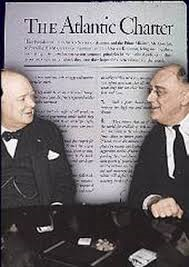
After four weeks of heroic resistance opposed by Russia’s armies to Nazi war machine, which was longer than the minimum life assigned to the Soviet government, American and British leadership began a new stratagem toward Communist Russia shaped at Argentia Conference off Newfoundland on August 9, 1941 at which the Atlantic Charter was drawn up. At this meeting, it was decided to send a joint mission to Moscow for « help to Russia » through a lend-lease which was only a trickle and ridiculous support regarding the huge military need to resist the Nazi war machine. The Russians had turned the tide at Stalingrad before the alleged American and British help arrived.
the Atlantic Charter must be considered as the first step in the American and British anti-communist crusade during the second World War. This was confirmed by President Roosevelt’s message sent on December 5, 1941, to British Foreign Minister Anthony Eden preventing him of any agreement with Stalin about political agreement concerning Russia’s 1940 boundaries and in eastern Europe..