Catégories
Archives

United States and the making of Europe

United States and the making of Europe

In early November 1946, the Republicans had won control of both houses of Congress and this unexpected election of an extremely conservative Republican Congress  gave an impetus to the anti-communist crusade inaugurated by Winston Churchill at Fulton, Missouri.  In their campaign of 1946, the Republicans moved over to the offensive and identified all dissent voice with communism which was one of the most potent forces in their electoral victory. It was expected the implementation of  a conservative foreign policy and a strong line against communism and Russia everywhere in the world. This new shift in American foreign policy in the aftermath of WWII was symbolized by The Truman doctrine.

 On January 17, 1947, John Foster Dulles adviser to the State department made a speech urging Western Europe to unite economically around the coal and steel power of the Rhine basin as a bulwark against Soviet Russia. Echoing Winston Churchill, Dulles was trying to establish hurriedly a military bloc of the united States, Britain and France. French diplomatic circles approved Dulles proposition. Dulles sought to restore Germany as bulwark against the Soviet Union and supported her reconstruction by pushing the German industrialists and cartelists to power.  Dulles’s posture was not starnge considering Mr Dulles long pre-war association with the same German interest.
Catégories
Archives

Churchill’s anti-communist crusade and the making of Europe

Churchill’s anti-communist crusade and the making of Europe

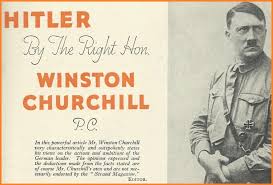
 What is really the origins of the European Union ? To answer this question and to well understand the real origins of Europe,  the mainstream of International relations and European historiography would not be in any way of useful help.  The man who made Europe was the former British warmonger, Winston Churchill who vowed his lifetime, since the infancy of the Bolshevik revolution, for fighting and for ferociously struggling against Communism and its spread first in Europe and then later over the world.  Let us begin by the real origins of the story of what we call today the European Union presented in the media and among the academic circles as the result of a long and a painful history beginning with the utmost willingness of its leaders and its people to unite their efforts within a political and economic framework.

the man who made Europe was Winston Churchill. After launching his anti-communist crusade in his infamous speech of March 5, 1946 at Fulton, Missouri in presence of another warmonger , the American president Harry Truman, and further speeches in pursuit of his aim, Winston Churchill returned to Europe with the main objective to wage his ant-communist crusade within the European continent. Soon he was waging a campaign for united Europe as a means of pushing Russia out of eastern Europe.  As he did in Fulton, Missouri, Churchill gave at the University of Zurich on September 19, 1946, a similar speech bewailing the tragedy of Europe saying « that is all that the Germanic races have got by tearing each other to pieces and spreading havoc far and wide » This meant that the Nazis might not have been so far wrong was followed by an appeal to France and Germany to establish « partnership ». He suggested  the union, as a first step the European states which were out of the « iron curtain »; the implication was clear that the states of east Europe would be brought in eventually. On May 14, 1947, Churchill made it absolutely plain when he said that « our aim is to bring about the unity of all nations of all Europe »; He explained that « the whole purpose of a united democratic Europe is ot give decisive guarantees against aggression ». In short words, Europe must unite with her nearly 400 000 000 people under the American atomic umbrella so that to wage a common anti-communist and racist crusade against inferior races, those of the Soviet Union.


Catégories
Archives

European totalitarianism (2)

European totalitarianism (2) 

In the aftermath of the First World War, the main concern of the victorious powers was less the peace in itself that of how dealing with this new and dangerous threat which was the Bolshevism. Indeed, Versailles’s peace-settlement imposed by the major victors (USA, Britain, France, Italy) was dominated by  two main considerations  : First how the surviving dictatorial regimes in Europe and in the USA  would deal with  the new revolutionary regime in Russia and second how to avoid its spread and its contamination of West European countries, the old and new ones,  by an alternative revolutionary regime, that of Bolshevism.  In short, the main preoccupation of the Victor powers during Versailles negotiations was how making the world safe from Bolshevism  and how re-mapping Europe domestic politics either within the Victor countries as well within the new states in eastern Europe those which had been built on the overthrow of the Russian and Habsurg empires. The  priority for the Allied was  to thwart Bolchevism through direct intervention into Russian territory or by setting up a mercenary and proxy troops, the « Whites » in order to stamp out the new revolutionary Bolshevik regime. The second thing was to redraw the map of Europe by creating proxies regimes and proxies states around dedicated to isolate it behind a « quarantine belt » (cordon sanitaire), in the contemporary language of diplomacy) of  anti-communist states built both on the spoils of the formerly Russian lands and on those of Austro-Hungary empire. This « quarantaine belt » went from north to South : from Finland an autonomous region allowed by lenin to secede; three new little Baltic republics(Estonia, Latvia, Lithuania) proxies states created ex-nihilo having any historical precedent ; Poland restored to independent statehood after 120 years and an enormously enlarged Rumania in size doubled by accessions from the Hungarian and Austrian lands of the Habsburg empire and ex-Russian Bessarabia. The attempt to form proxies states into the Caucasus failed because of the support brought by an anti-communist but  revolutionary Turkey to revolutionary Bolshevik Russia. The attempt to create proxies states such as Armenian and Georgian proxies states setting up after Brest Litowosk and attempts under the British to detach oïl-rich Azerbaijan, had failed after the victory of the Bolsheviks in the Civil War of 1918-1920 and the Soviet-Turkish treaty of 1921;  Other proxies states had been created out of nothing like Czechoslovakia and Yugoslavia combinations.

Catégories
Archives

Rise of Bonapartism (2)

Rise of Bonapartism (2)

Behind the The rise and the srenghtening of Bonapartism after the Napoleonic wars in europe lay major changes and  radical innovation and the major and determinant fact the emergence of the working-xclass as an indepdendent and self-concious force in politics in Britina and in France. urban discontent was universal in the West a proletarian and socialist movement was chiefly visible and palpable in the countries biritna and France  because of Jacobinism and babouvism France possessed the was more predisposed and rmorre ready for revolution  working class or urban revolution and socialism appeared very real dangers in Western Europe. Radical democracy had made major advances both in the USA Under President Andrew Jackson(1829-37) as in Europe where the European revolution rehained its momentum. For the mass of the common people the problem pushed them inevitably towards social revolution.  their hatred of the rich and the greta gave their desperation eyes and a purpsoe were concious of taht purpose.  the greta awakening provoked by the jacobin model had taught them that common men. this was the « spectre of communism » which haunted Europe the fear of « teh proletariat » which affected not merely with the revolution which broke out in the firts months of 1848 was not a social revoltuion merely that it involved and mobilized all social classes. it was the rising of the labouring poor.

In 1848, Revolution triumphed In France and the republic was proclamied on 24 February. during the firts months of the springtilme of people all governements were swept away or reduced to impotence. In France where the revolution succeded rapidly  in France the firts Landmark of conservative revival was the lecetion of April in which universal suffarge teh second Landmark was the isolation and defeta of the revolutionary workers in paris defeated in the June insurrection where the urban plebeians or more the enw proletarians came within the ardius of jacobin, socialist or democratic republcan idleogy they became a political force at least as rioters.

As Thermidorean reaction during the French revolution and its subsequent napoloenic miliatry dictatorship which had destroyed the Jacobin Revolution and its ideals, the dream of equality liberty and fraternity, Louis Napoleon coup d’état of dcemeber 1851 played the same role than that of his illustrous uncle by destroying the dream of popualr democracy and the people rising to shake off oppression after 1848 Revolution in franxce and in Europe too. The revolution of 1848 in France was not merely a brief historical episode without consequence. it was, like the jacobinism, the achievment of real popualr democracy with large popualr political participation by contrast with the cosntitutional monarchy where barriers and institutional hurdles had been erceted based on property or educational quallifications for the voters and where there wasthere was only 168 000 voters. the Jacobin experience servend as set of models and patetrs for popualr upheavals during the post-napoleonic period in europe and over the world.

Translate »