Catégories
Archives

Marshall plan, tool of US informal imperialism in Europe

Marshall plan, tool of US informal imperialism in Europe 

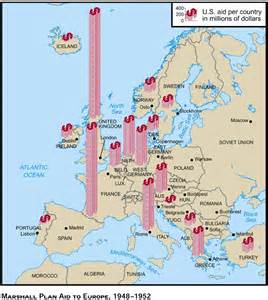
On March 25, 1947, shortly after the Truman Doctrine speech, rumours circulated that koura would be the next beneficiary of American aid after Greece and Turkey, but by June, the Marshal plan idea had replaced this program. The Marshall Plan’s idea originated both from the vacuum left by Britain after her bankruptcy and her collapse as important centre of world power and from the speech delivered by Under Secretary of State dean Acheson at Cleveland in which he proposed to add economic tool along the military aid of the Truman Doctrine. According to Acheson, American economic aid and assistance must be concentrated in « areas where it will be most effective in building world political and economic stability in promoting human freedom and democratic institutions, in fostering liberal trade policies and in strengthening the authority of the United nations » The terms « human freedom » and « democratic institutions » mean that American aid and assistance should be go to those countries which accepted U . S understanding and interpretation of these words.

On June 5, 1947, Secretary Marshall delivered his famous speech at Harvard University. exploiting the destruction of Europe’s economy, Marshall proposed American help so as to contribute to the revival of a working economy and to permit the emergence of political and social conditions in which free institutions can exist. Undoubtedly, the Marshal plan was the continuance of the Truman doctrine of containment and encirclement of the Soviet Union especially when he warned that « governments, political parties or groups which seek to perpetuate human misery in order to profit therefrom political or otherwise will encounter the opposition if the United States »  This was a cry from the principle of the Truman Doctrine that the Soviets must be ringed in and contained. Coming after the Truman Doctrine  the Marshall Plan must be seen as  economic weapon aiming at implementing the Truman doctrine. It was obvious that Marshall’s offer would not go to countries under Soviet control ; it was rather a move to consolidate Western Europe as a counter-weight to the concentration of Russian power in the east
Catégories
Archives

Cold War : the making up of legend

Cold War : the making up of legend

the Cold War is often misinterpreted as a global rivalry between the United States and the Soviet Union, According to dominant and wide-spread mythology in the West, the so-called Cold War began in the wake of the Second World War when  “pacific” western democracies and generally what we called the “Free world” led by the United States of America were assaulted and threatened by totalitarian system and by the thrust of “ remorseless Soviet expansion”. The binary and Manichean picture surrounding the Cold War reduced the post-war period to a mere rivalry and to a simplistic scheme between the “good and evil ”, a  struggle between two rival superpowers and two antagonizing ideologies competing both for the domination of international affairs and looking each and other for world hegemony. Basically, the Cold War was about the Free World versus Communist slavery and its outbreak was to be attributed to the Soviet Union accused to be the full responsible for the onset of the conflict while the United States was tally innocent. In the face of Soviet aggressiveness and territorial and ideological expansionism the United States had no choice only to protect both its own legitimate security interests and democracy in the various European nations and to cope with a real danger, the spread and the contagion of international communism sponsored by the government of the Soviet Union. At the end of his account Potsdam Conference Mr Truman accused the Soviet Union for “planning world conquest”

These assumptions by no means exhaust the various fallacies found in the literature on Cold War. When discussing the matter weal with abstractuions and try to isolate to mix and to generalize.  As declasiified U.S. policy documents revealed, the primary threat posed by the soviet Union was not its aggressivessness or its expansionary policy but rather its emergence as alternative pattern and a model for the newly independent countries born from the “decolonization” and its willingness to supply military and economic support to third world regimes that were targets of U.S aggression and subversion. The Soviet Union thus served to deter and restrain U.S imperialism and to restrain its actions in the Third World.


Translate »