Catégories
Archives

WEST-USSR’s unnatural Alliance

 WEST-USSR’s unnatural Alliance

By entering the Second World War, war along the united States, Britain and France, the Soviet leadership was well aware not only that their alliance had been, all things considered, dictated by fortuitous conjunction of circumstances but also and at first, unnatural alliance. . Indeed, Stalin who directly participated in the Bolshevik revolution, the Soviet Government had learned the lessons of the their country since 1917 onwards and particularly the numerous declared and undeclared wars western imperialist powers the permanent war waged by the western imperialist powers during the interwar period until the breakup of the Second World War.  A survey of key facts provided by the diplomatic, political and military history and the policies implemented toward the Soviet Union since 1917 till the Nazi invasion of the U.S.S.R on June 22, 1941 were sufficiently eloquent and talking so that the Soviet leadership would aware and  could realize quickly that its Alliance with the West was but a short truce, an interlude dictated by exceptional circumstances before the re-starting of longer and continued anti-communist crusade.

Since 1917, the Soviet leadership understood the situation accurately and clearly  when the Western powers and its objective allies in the interwar period had adopted a definite position regarding the Soviet Union in the International life. Here it is not the appropriate place for detailing exposition of the West-U.S.S.R relations, but it is useful to mention briefly some of these hostile and ostracized diplomatic and political actions toward the Soviet Union or at least  they had been seen and interpreted as such by the Soviet Government. In reviewing the chronology of key facts characterizing the West-U.S.S.R relations during the Bolshevik revolution afterwards, and the interwar period till the outbreak of the Second World War, the Soviet leadership and Stalin at first, that the West supported by its natural offspring, the fascism and Nazism in Europe and in Japan, did not allowed the establishment first in European Continent and then over the world, of a political system based on the abolition of  the private ownership of the means of production and the setting up of collective ownership of these means of production. In short words, for the West and  its leading power, the United States, the struggle against  Bolshevism, and later against the Soviet Union during the interwar period and in the aftermath of the Second World War, against the communism and even against any political regime having any sympathy with the Soviet Union, became a matter of life or death.

here are some key facts suggesting this unnatural alliance and irreducible antagonism between the West and the Soviet Union.

-Western intervention on behalf the anti-Reds forces, the Czechs, the Kornilovs, the Kolchaks, the Denikins, the Yudenitchs, the Alexiev, the Wrangel, the Miller, the Der Glotz

-Allied intervention and foreign invasion by   United states (1918-21), Britain, France, Germany (after armistice=, Japan, Poland) of North and South Russia, Siberia, Odessa, Crimea, Murmansk, occupation of Kiev, in the Baltic (Estonia, Latvia Lithuania), Finland

British War Minister, Winston Churchill directed general Ironside to prepare for an offensive in the direction of Kotlas with the object of making a junction with Kolchak

The failure of foreign intervention to crush the Bolshevik revolution

the Social democrat leader Ebert called for the Army high Command, General Groner, Hindenburg and Ludendorff to crush with artillery the Communist Spartacus

The Soviet Russia not desired a a member of the League of Nations

An anti-red Crusade in the United States, in Britain and in France after the failure of their intervention in Russia

Pretexting the forged story called « Zinoviev », the British Conservatives  severed on May 26, 1927 their diplomatic with the Soviet Union

Chicherin ostracized and treated as pariah during the Genoa economic conference in April 10, 1922

In response, Chicherin concluded the Treaty of Rapallo on April 16, 1922 with Germany

It was notorious that the so called Stalin-Churchill-Roosevelt Alliance was in fact an unnatural, hypocritical and fortuitous Alliance. At the end of the WWII, when the Russians came out of the war and they decided to take their own security measures, they were through with being treated as pariahs and inferiors and undermenschen.
Catégories
Archives

The myth of Soviet expansionism (5)

The myth of Soviet expansionism (5)

When President Truman took office and announced the main features of what became later the Truman Doctrine, he was angry and outraged about the « Russian occupation of eastern Poland and the occupation of that part of Germany east of the Oder River. the charge that Russia controlled Eastern Europe merely because she was a World aggressor, was of course, without foundation. She came there because the pre-war Allied practised with Hitler and allowed him in order to push his imperialist and expansionist lebenraum to the East  and in last run until invading the Soviet union. the Truman Doctrine was backed by immensely powerful anti-Russian and anti-Communist propaganda inside and outside the United States presenting Russia in east Europe as a brutal barbaric aggressor obviously out to conquer the world.

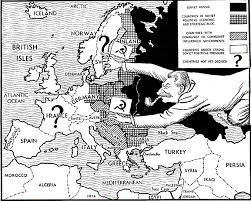
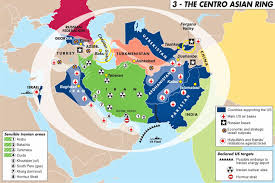
The Truman Doctrine began its boiling in the President’s mind  on 23 April 1945, before becoming two years later, on March 12, 1947,  with  the Marshall plan, the most powerful weapon in the hands of the United states seeking to contain and to encircle the Soviet Union during the post-war period.  Indeed, from the brief review of teh scope and use of the United States power in initial post-war period, it clearly seems to the Russians that they found themselves ringed in and contained and faced with a new and unfriendly threat coming now from her old western Allies. In addition, the Russians could not fail to realize quickly that the Aid provided by the Marshall Plan did not intend to help the Soviet reconstruction. On the contrary, during this period  and the immediately preceding this period, the Soviet Government witnessed an expansion of American leadership and American power on a prodigious scale, including new areas of American dominance with the reconstruction of the two defeated nations, Japan in Asia and Germany in Europe. This American leadership appeared in 1946, through US troops still stationed in fifty-six countries and on every continent and by 1949 America had some four  hundred world-wide naval and air bases. Now American imperialism stretched to areas located at 7000 miles distant from her borders.

after her bankrupt in Greece during the winter of 1947, this country and Turkey passed under American control. On May 1946, the United States and Britain had forced the Soviet Union to withdraw from Iran. Western troops were present also in Indonesia, Syria-Lebanon, Iceland and other areas.


Catégories
Archives

Double-standard Western Democracy

Double-standard Western Democracy

« Free elections » in Eastern Europe but not in Western Europe

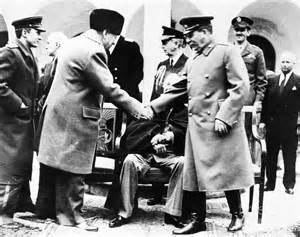
Among the principal issues dealt with at Yalta Conference was the question of free elections in Eastern Europe. At Yalta Conference the West still believed that eastern Europe could be kept in its orbit, though these puppet states had never known what democracy means and no any democracy had ever been practised in this region since it was still ruled by feudalistic groups. At Yalta the Big Three agreed to assist all liberated countries in Europe  » to create democratic institutions of their own choice » and to « form interim governmental authorities broadly representative of all democratic elements in the population and pledged to the earliest possible establishment through free elections of governments responsive to the will of the people ».  The West would like to apply to the remainder of eastern Europe where the upper classes had generally collaborated with the Nazis. Also war-time propaganda and cooperation had obscured the differences between Russian and Western ideas of democracy.

As events speedily proved in Poland and Rumania and later in  France and in Italy, the Soviets and the Western leaders had different interpretation of democracy in their zone of influence. The first clash between Stalin, Churchill and Roosevelt at Yalta was related to Poland, its boundaries and the character of its Government. At Yalta, the three leaders had to resolve the existence of two Polish Governments, one exiled in London supported by Britain and another the new Lublin Government formed behind the red Army. the result was an agreement that the Lublin Government should be « reorganized by including a broader democratic basis with the participation of democratic leaders from Poland itself  and from the Poles abroad and pledged to hold « free and enfettered elections as soon as possible on the basis of universal suffrage and secret ballot » all « democratic and anti-Nazi parties » were to have the right to campaign.

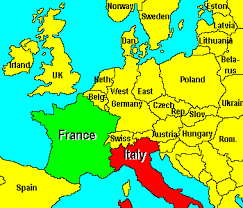
As events speedily proved in Western Europe, the rule of « free elections » was a mere slogan and a propaganda directed against the Soviet Union and the socialist regimes in eastern Europe. these cocnlusions seemed to be buttressed by the venets between 1948 and 1951. On April 18, 1948 an election was held in Italy which was quite openly a contest between the United states and the Soviet Union. this was the first post war  election in Italy  and the Communist-Socialist bloc was given  en « even chance » by Western observers  to win  a 51 per cent majority.  When the vote were in, the pro-Western Christian Democrats  had 53 per cent of the ballots a stunning victory while the pro communist bloc polled but 30 per cent. the most important factor in the victory of the pro-Western Christian Democrats was the western propaganda  and the open entrance of America into the campaign the West proposed the return of Trieste to Italy. American motion picture appeals radio broadcasts bulletins and private letters flooded the land.  Not a day passed without the anti-communist majority of the press having a new effective American gesture to put in its headlines President Truman made Italy badly needed gift of 29 merchants ships ; gold looted from Italy b the Nazis returned the first Marshall Aid ships arrived and were unloaded amid ceremony and with a speech by the American Ambassador; the State department announced that Italians who were known to have voted Communist would be denied that dream of all Italians emigration to America;

Another example of the Western double-standard democracy. In the summer of 1951 parliamentary elections were held in France ; As in Italy the election law was rigged against the communists. the other parties could combine their votes in any given election district and if they won a majority, take all the seats except in communist Paris where proportional representation was preserved to protect the democratic minorities the two-sided election law reduced the number of communist deputies very sharply from 183 to 101 but the Red popular vote fell only 2,2 per cent. still standing at 26 per cent.


Catégories
Archives

The myth of Soviet expansionism after WWII(4)

The myth of Soviet expansionism after WWII(4)

 Before the use of the atomic bomb by the United States, before the creation of Nato, before Western and West German rearmament before the spiralling  and debilitating arms race had seized hold of Europe, the Soviet Union and communism were adequately  and effectively « contained » by the greater and more vastly extended power of U.S.  And this was fully realized by by the very man who was the foremost proponent of a rearmed and re-miliatrized world who attempt to to revive the military will of atom-blasted Japan. In March 1949,  John Foster Dulles declared « the Soviet Government, under conditions now prevailing, does not contemplate the use of war as an instrument of its national policy.  I do not  know any responsible official, military or civilian in this government or any Government who believes that the Soviet Government  now plans conquest by open military aggression » Dulles statement  is corroborated by more than half  a dozen  estimates of America leaders from 1946 to 1949 cited in the Forestal Diaries. On June 10, 1946, Forestall himself wrote that he thought the Russians « would not move this summer in fact at any time »   On August 3, 1948, two months after Berlin Blockade, General Walter bided Smith ambassador to the Soviet Union reported to the War Council his impression  » that the Russians do not want war »   and of course Kennan  who was Chairman of the Policy planning staff at the State department had been categorical on this question « I cannot think of a time when the Soviet Government desired that there should be such a conflict(war with the West) planned to launch it .

Undoubtedly, as showed by Gar Alperovitz’s Atomic diplomacy, the main reasons behind the mass killing in the two Japanese cities, Hiroshima and Nagasaki, on August 6 and 9, 1945, were political and that the A-bomb used to Japan before Russia could enter the war Against Japan and in the long run to restrict Russia’s gains and voice in the Far East.Indeed, after Hiroshima and Nagasaki, American highest military authorities, the testimony of the surviving Japanese leaders and Survey’s opinion  produced detailed investigations of all the facts showing that certainly prior to December 31, 1945, Japan would have surrendered even if the atomic bombs had not been dropped even if Russia had not entered the war and even if no invasion had been planned . Even Secretary of States Byrne has also admitted that the bomb did not end the war that Japan was beaten and suing for peace when it was dropped. At the time the bomb was used on Hiroshima and Nagasaki Japan was exhausted because of the destruction of her navy and her air force, Japan cities and industries were being destroyed at will . It was apparent even to headline readers that Japanese resistance could not continue much longer.  On July the daily news releases made it plain that japan was defeated.

As has been showed by Gar Alporowitz, the first goal of using the atomic bomb was rather political than militarily directed against the Soviet Union in order to minimize her gains both in Eastern Europe and the Far East. When economic coercion failed to achieve United States goals in eastern Europe, Truman bided his time until  acquiring the atomic bomb with which he meant to cow the Russians into submission the sue of nuclear weapon aganst an already defeated Japan amounted to a diplomatic rather than a military act. the bombs were used primarily to demonstrate to the Russians the enormous power America would have in its possession during subsequent negotiations. Up to this time control of eastern Europe had seemed vital to the Russians as a means of preventing a German come-back. Now the same region was even more vital as buffer against the atomic-armed West. the wish for the United States to end the war quickly before the Russians could establish a strong position in the Far East. As it was the case in eastern Europe, Stalin was trying to attain for the Soviet Union its legitimate security needs in the face of increasing American militance.

Catégories
Archives

The myth of Soviet expansionism after WWII (3)

The myth of Soviet expansionism after WWII(3)

When the framework of United Nations was being prepared in the state Department, The Soviet-Union was one of its founding members  met at the Dumbarton Oaks conference on August 21, 1944. the most important and difficult issue discussed in the debates between the Russian, British and Americans was the veto power and the conditions of its implementation. The principle of the great -power veto was not under discussion at Dumbarton Oaks but only the extent to which it should be used when a great power is a party to a conflict. On December 5, 1944, the State department forwarded a compromise proposal to Russia and britian providing that only the greta powers should have the right to veto any sanctions or other action against themselves but not to prevent the discussion of a dispute with another member of the UN, little or big. this was accepted and became the permanent provision in the UN charter. It was agreed that the United States must retain a veto over the ultimate use of force and the same weapon was conceded only to the other great powers. This was a real gain since in the League of nations every member had had a veto in both the Assembly and the Council.

During the San Francisco Conference, Molotov in his opening address that the Soviet Governement was  » sincere and firm champion of the estabslshment of a strong international organization of security » andthat in « our country During the San Francisco Conference the Russians fully cooperated with West. Among these concessions there were Russian opposition to any autonomy for regional security systems unless directed at a renewal of German aggression, accepted three important modifications of the veto power acquiesced in strong outlawry war proposals after opsoing them earlier compromised with the Unietd states on the trusteeship , made two important concessions to the middle-sized nations in connection with the Security council agreed finally to an amendment on peaceful change agreed at last that the Security council should have real power to recommend terms for the settelement of disputes.

This was certainly not the recod of an expansionst and domineering government vetoing everthing right and left and refusing to play except on its own terms on the contrary that was the recod of a government willing to make real and important concessions which might be used gainst later in order to get agreement for a greta undertaking in cooperation. Compared with these concessions made at san Francisco Conferenced ended on June 26, 1945, it might be unfair to label the Soviet government an aggressor nation. the Soviet Union played a key role in the creation of the UN as a new organization devoted to preserve peace and security in the aftermath of the Second World War. The United Nations was an improvement on the old, rejected League of Nations in many details notably the curtailment of the veto right to the greet powers. at every Allied conference the Russians made known their conception of the UN it should be a body led by the greet powers preferably by the USA and the USSR

As it was the case with the League of nations, the United Nations was conceived by the Soviet Union as a bulwark against future aggression and future aggressive powers. That was the real meaning of the veto right insistently claimed by the Soviet Government aiming at containing irresistible inclination of the United States for her quest for hegemony and imperialism after the collapse of the two old colonial empire, the British and the French;


Catégories
Archives

The myth of Soviet expansionism in Eastern Europe (2)

The myth of Soviet expansionism in Eastern Europe (2)

What were the main motives, aims and purposes behind Soviet presence in Eastern Europe ? What did the Soviet they seek to achieve through their presence in Eastern Europe at the end of the Second World War ? The first driving and continuing motive was is security which was also the dominating factor in the outbreak of the so called Cold War. This imperative of security was not new in the Soviet foreign policy and its geopolitical perspective. The cardinal and outstanding motive behind the conclusion of the western propaganda called falsely Molotov-Ribbentrop or Hitler Stalin Pact was in fact a truce having requested by the Soviet Government for a security  purpose aiming at gaining enough time in order to build up its military defence and fortifications. how could anyone who lived the horrible war doubt it ?

Consider briefly the key facts. The Soviet Union had lost roughly 25 million of its citizens, 30 million made homeless and 60 million treated to very degrading and brutalising experience . The Nazis and their satellites destroyed completely or largely 15 large cities 1710 towns and 70 000 villages they burned or demolished 6 million buildings and deprived 25 million people of shelter. they demolished 31 850 industrial enetrprises, 65 000 kilometres of railway track and 41 000 railway stations ; 36 000 postal, telegraph and telephone officies ; 56 000 miles of main highway, 90 000 bridges and 10 000 power stations. The germans ruined 1135 coal mines and 3000 oil wells, carrying off to Germany 14 000 steam boilers, 14 000 turbines and 11 3000 electric generators. the Germans and their satellites sacked 98 000 collective farms and 2890 machine and tractor stations, slaughtered 7 million horses, 17 million cattle, 20 million hogs, 27 million sheep and goats 11 million poultry. the Nazis and their satellites attacked even Soviet cultural institutions by looing and destroying 40 000 hospitals and medical centres, 84 000 schools and colleges and 43 000 public libraries with 110 millions volumes. Some 44 000 theatres were destroyed and 427 museums and more than 2800 churches being wrecked.

keeping all this figures in mind, we can say that no people in the world who had first suffered as the soviet people have and then won a tremendous military victory would go into eastern Europe merely for the ride. They would be bound to make sure that the invasion gate was closed. Only then could we understand how the Russians feel about their security from future attack through East Europe, since Russia had been invaded three times through eastern Europe  Surely the Reds must know also that frontiers do not mean anything any more. After all those devastations of their country, the Soviets must ask themselves why they were denying the right to buffer zone in Eastern Europe when in the same time they observe  American military bases mushroomed all over the world, located many thousands of miles from home, in Japon and the Philippines, in Greece and Turkey, in the Mediterranean and western Europe all around the Soviet Union. How then can the Russians forget what they have suffered at Germany’s hands through eastern Europe during the next century. Soviet-Union’s security is the beginning of all wisdom in the period after World War II. without a keen understanding of the deepest and strongest psychological posture left by that war all else is vain.  On November 6, 1944, Stalin made it clear in his Party speech in a strikingly statesmanlike utterance recognized that « the only fact which overrides all others is that the aim of Russia is security »

Catégories
Archives

The myth of Soviet expansionism in Eastern Europe (1)

The myth of Soviet expansionism in Eastern Europe(1)

According to dominant belief and widespread ideas in the West, the Cold War was the logical answer to Soviet expansionism in Eastern Europe. Russian-Communist control of East Europe was the basis of western propaganda trying very hard to make believe that the Soviet Union was out to conquer the World. Was there really planned Soviet expansionism in Eastern Europe in the aftermath of the Second World War ?

it will be ridiculous to attribute to the Soviet Union any expansionist motives in Eastern Europe in comparison with Hitler’s crazy dream which was really based on  expansionist and imperialist motives. Contrary to France after Sedan defeat and her loss of Alsace Lorraine and Hitler claim to recover German territories lost after the First World War, there was no any claim on the part of the soviet union to recover all the gains of Peter the Great after the conclusion of the treaty of Brest-Litovosk. for example in Poland the Reds had a perfect reason to recover the 8 million Ukrainains and White Russians in east Poland but they never did so.

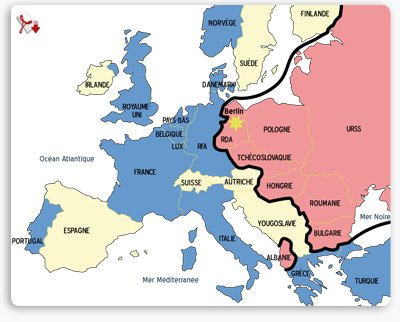
The Soviet occupation of east Europe was due simply and solely to the outcome of a huge war of aggression waged against the soviet Union. In this onslaught on Russia participated without exception all eastern European countries setting up by the West in the aftermath of the First World as buffer zone against Bolshevism; Finland, Rumania, Hungary and Austria were Hitler’s satellites and his step toward the soviet Union. Some 700 000 Austrians fought in Hitler’s armies and amount of human and matrial damage to Russains . the Finns also fought on several fronts other than their own. the Rumanuians carried out the brunt of the war in the southwestern Ukraine and they massacred 200 000 Soviet citizens in Odessa and troops were captured all the way to Stalingrad. All during 1944 there was no interference in Rumania’s internal affairs. Hungary helped Hitler in his invasion of Russia although the resistance of the Hungarian peasants who were forcibly conscripted by their native masters and sent off to Russia. At the Potsdam Conference Stalin said that the Hungarians had sent 26 divisions against Russia. Even Fascist Italy, as it was the case during the Spanish civil war, did her best by sending several divisions to Russia and Franco Spain contributed the large « Blue Division » Altogether the scores of divisions supplied by Hitler’s satellites contributed their full share to the immeasurable onslaught and devastation in the Soviet Union.

In conclusion, the Soviet Union presence and occupation of eastern Europe was not a planned aggression or the outcome of expansionist and imperialist motives but because of war of aggression waged by Hitler and his satellites to destroy red Russia. there is no other reason . It would be a mere folly on the part of the Soviets and the red Army to stop at their borders and wait. One can remember that at Teheran Conference Roosevelt and Churchill had agreed to concede a sphere of influence to Russia in eastern europe

Catégories
Archives

What did mean western Democracy for the Greeks in the postwar era ?

What did mean western Democracy for the Greeks in postwar era ?

Among the principal subject dealt with at Yalta Conference was « democracy » and « Free elections ». It had been agreed that the liberated peoples in Europe should » create democratic institutions of their own choice » by « free and unfettered elections »  in which « all democratic and anti-Nazi parties » should have a part. In order to well understand what the capitalist West do mean by the word of democracy, it will be obvious to take as illustration, the case of Greece during and after the Second World War.

After Nazi invasion of Greece and the fall of Athens on April 27 , 1941 and Crete a few days later, the resistance of the Greeks was organized but this heroic resistance very probably prevented the conquest of the old world by the Nazis. Indeed, Greek resistance and before it the Yugoslavs resistance had upset Hitler’s time table and delayed his « Barbarossa » postponed for  five weeks, setting back his Russian time-table from May 15 to June 22 and this delay allowed the Soviet Government to win five weeks of truce and to achieve in time ifs military preparedness.

On December 3, 1944, British intervention in Greece had Swiftly overthrow the mighty communist-led EAM-ELAS. Churchill’s effort to regain control of Greece was the climax of a long struggle for the control of Greece after the war. After the dethronement of King George II in march 1924 Greece became a republic until the royalist Popular party captured the governement and brought the King back in November 1935. Then new elections in June 1936 established such an equilibrium of royalist and Republican forces that fifteen Communist deputies held the balance of power. A coup d’état led by general John Metaxas dissolved the parliament and formed vigours and dictatorial government in order to crush the growing communist forces in the country. during the Italina invasion of the country in 1940 an peic resisatnce was formed driving back the Italians into Albania. in face of theis resiatnce Metaxas called on the British to honor Chamberlain’s guarantee of Greece  and Chruchill quickly responded  The victorious british army in Egypt which had just defeated the Italians was broken up and 60 000 men sent to Greece. By the late April 1941, the British had been defeated by german aircraft; Metaxas died in jnauary his sucecsor and the king fled abroad with a few offcials and formed the greek Governement in exile while a Quisling general headed a puppet governemetn in Athens in the cities the wealthy and cosnervtive classes collaborated with the germans and Italians.

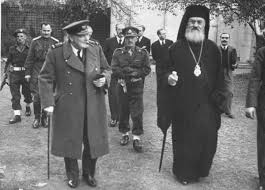
By the middle of 1942 dozens of guerrilla bands had formed spontaneously in the hills. two of the original leaders emerged Zervas a republican who commanded an army called EDES in Western Greece was backed by a group of politicians and business men in Athens. The communist party led by George Santos founded a political movement called EAM which enlisted a great mass composed especially of the youth and women. After cells had been formed in the whole of central Greece a guerrilla force was gradually built up called ELAS which numbered twenty thousand  by the summer of 1943.  A royalist guerrilla group under Colonel George Grivase secured arms from German and Italian sources and conducted street fights with ELAS in Athens EAM’s program called for active resistance to the Germans a resistance government, restoration of all popular liberties and free elections for a constituent assembly  a real state cantering in the Pindus Mountains was set up which ruled nearly all of Greece except the Epirus district controlled by EDES. In March 1944 an EAM provisional government was formally set up. On April 1, 1944 a mutiny was declared asking for the establishment of provisional government led by EAM in Greece. Churchill took personal change of its suppression sending frequent orders until it was over.  Nearly ten thousand mutineers were imprisoned by the British until after the British occupation of Greece. Immediately after the mutiny, general Vendiras who was bitterly anti-Communist, organized a new third Brigade with British  backing. In Greece EAM had swept nearly the whole country . Its members meant to make the country over without benefit of royalty. George Papandreou convinced the British that he could the country by summoning on May 17, 1944 a conference at Beirut in the Lebanon attend by twenty-five delegates EAM was represented by six men only one was communist  early in September five EAM ministers entered the Greek Cabinet in Cairo. At the end of September British troops landed in Greece after a bloody Sunday on December 3, Churchill charged General Scobie to neutralize and to destroy all EAM-ELAS  bands; the British conquered Athens and by January 11, 1945 ELAS was forced to sue for terms and an Agreement Varkiza Agreement was concluded on February 12. ALAS agreed to surrender and Rightists elements filled all the armed forces who hunted and killed leftists throughout the British occupation and deep into the American period.

In conclusion, Churchill created the Fascist dictatorship of General Metaxas and he was determined to restore a King hated by a large majority of hi people. Churchill had crushed a patriotic resistance movement which was fishing against the Italian and German occupation forces. EAM-ELAS, as a patriotic resistance movement and a valid popular movement was supported  by a great numbers of people. Soon after EAM had been crushed by American tanks and planes in British hands, Churchill declared to the House of Commons on January 18, 1945 that he had but one principle for the liberated countries » Government of the people by the people for the people set up on a basis of election by free and universal suffrage, with secrecy of the ballot and no intimidation »  that was « our only aim, our only interest and our only care » That was good democratic rhetoric but the last thing Churchill would have permitted in Greece was a free lection for he knew that EAM would win it. there could therefore no election in Greece until the Government was securely in Rightists hands including all the machinery of intimidation.

Stalin and the Soviet government learned very well the Greek lesson and very well understood what did really mean the western democracy. The Greek « democracy » gave Stalin a useful lesson to be learned when later the western leaders spoke about democracy and free election in East Europe.


Catégories
Archives

Katyn massacre : Another piece of nazi and anti-communist propaganda

Katyn massacre : Another piece of Nazi and anti-communist propaganda

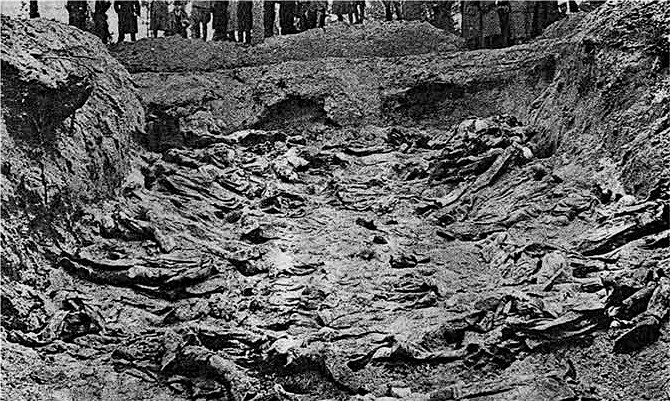
Katyn massacre, ostensibly evoked by all anti-communists and especially by the CIA sponsored « authors of totalitarianism », forms a part of the black legend of Stalinism making up out of nothing at the end of the Second World War and within the framework of Western crusade against the Soviet Union and generally against the communism over the world. The story of Alleged Katyn massacre began when first it was reported in April 1940 by the master and organizer  of Nazi Propaganda Goebbels and his controlled press and radio. This announcement had been relayed by western sponsored London Polish Government affirming that the German claim was true. Goebbels and his Polish Puppet alleged that about 8500 officers disappeared after the Russian began to break-up three camps containing Polish prisoners of war.  At Katyn, only men from one of the three Russian prison camps were found. Opinion in the Allied world agreed that the Poles had fallen into a Nazi trap. the question to be put is who was guilty. and who did kill the Polish officers. In January 1944, The Russians appointed a commission and invited the foreign correspondents to visit the scene where several hundreds of the bodies had been exhumed.  Foreign visitors among them Miss Kathleen Harriman daughter of U.S Ambassador Harriman, contended that the good condition of the bodies, uniforms belts and buttons made it scientifically impossible for them to have been there since march 1940 that is before July 1941 when the Germans overran the Smolensk region. After examination of literature related to katyn massacre, it appeared that there was no direct or credible evidence of Russian guilt but the Germans would have a more powerful motive for the crime confirmed by one first hand testimony, a Hungarian Ludwig victor von Tohathy then prisoner of war in the Marine hospital on Ellis island New York. In his long affidavit, he counted his experience in the Sachsenhausen concentration camp and being able to speak Russian he learned from some Russian war prisoners that they had been forced to bury 10 000 Polish officers who had been machinegunned by the Germans. Though there had no positive evidence in the case one thing we way be certain neither the Russians nor the Germans would have been interested in the survival of this key group of nationalistic Poles. it was notorious that the mania of the Germans for exterminating Polish leaders was amply demonstrated throughout the German occupation.


Catégories
Archives

Was the U.S.S.R imperialist power ?

Was the U.S.S.R imperialist power ?

In its binary and manihean approach, the mainstream in the West has to use the term expansionism instead of imperialism to hide the really long and bloody European and American  imperialism while the word imperialism is automatically and unconsciously reserved  to the U.S.S.R. The question that deserves to put is : was really the U.S.S.R imperialist power ? To be put it otherwise, through the 1939 Nazi-Soviet Pacts, and the division of Europe at the end of the Second World War, could the Soviet Union be qualified as imperialist and conquering nation ?

According to the 1939 Nazi-soviet pacts, during the truce period between Germany and the U.S.S.R.,the Soviet union seized areas such as Latvia, Estonia, half of Poland and Bessarabia.  Why precisely these areas and not other ones ? the answer is very easy when we think in terms of geopolitics. All tehse areas were seized by the Soviet Union as defense buffer zones and valuable strategic positions against Germany; the Baltic states region is the most vital and at a planning conference on « Barbarossa » on February 3, 1941, Hitler declared that « the main aim is to gain possession of the Baltic States and Leningrad »  . On can remember also before World War I Estonia, Latvia and Lithuania had been provinces of Russia. Then at the time of the Bolshevik Revolution, Germany had forcibly annexed them. During the subsequent years of western intervention the Allies encouraged and sponsored the White forces and finally they established the three countries as part of the cordon sanitaire designed to contain the Soviet Union.

Translate »