Catégories
Blog

Eskalation im Mittelmeer zwischen Griechenland und der Türkei

Eskalation im Mittelmeer zwischen Griechenland und der Türkei

Griechenland und die Türkei streiten sich um Gewässer rings um die griechischen Ägäisinseln; der Streit verbindet sich mit erbitterten Auseinandersetzungen zwischen der Türkei und Zypern um Erdgasvorkommen ebenfalls im östlichen Mittelmeer. Kern sind sich gegenseitig ausschließende Ansprüche auf große Seegebiete, insbesondere auf diejenigen, die rings um die zahlreichen griechischen Ägäisinseln liegen. Der Konflikt eskaliert, als ein türkisches Forschungsschiff unweit einer griechischen Insel Erkundungstätigkeiten durchführte und dabei von türkischen Kriegsschiffen eskortiert wurde.

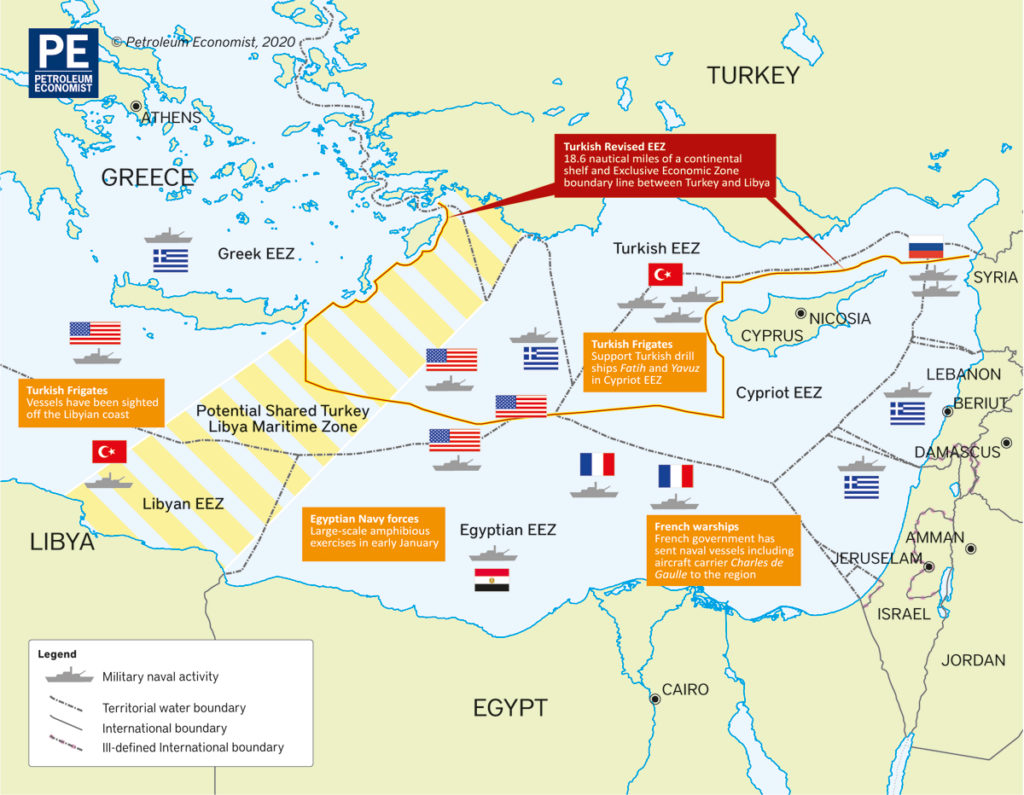
Der Streit zwischen Griechenland und der Türkei im östlichen Mittelmeer eskaliert. Der griechisch-türkische Konflikt droht jetzt militärisch zu eskalieren. Seit Mitte Juli ist der Konflikt mehrmals scharf eskaliert. Der Konflikt ist Teil eines Machtkampfs um Erdgasvorräte im östlichen Mittelmeer, in den neben Griechenland insbesondere das EU-Mitglied Zypern involviert ist Die Türkischen suche im östlichen Mittelmeer nach Öl und Gas wird kontert von Griechenland mit einer militärischen Übung im Verbund mit Frankreich. In den vergangenen Tagen hat sich Konflikt  zugespitzt seit Ankara am Dienstag angekündigt hat, vor der griechischen Insel Kastellorizo, liegt vor der türkischen Provinz Antalya, knapp zwölf Quadratkilometer groß, Erdgaserkundungen aufzunehmen. Athen protestiert gegen die türkischen Explorationspläne, da es das Meer um Kastellorizo für sich beansprucht.

Der Konflikt zwischen Griechenland und der Türkei im östlichen Mittelmeer hat sich in den vergangenen Wochen erheblich zugespitzt, um all seine Inseln eine « Ausschließliche Wirtschaftszone » (AWZ, « 200-Meilen-Zone ») für sich in Anspruch zu nehmen. Die Turkei hatte angekündigt, Erkundungen in den Gewässern vor Kastellorizo vorzunehmen, einer der östlichsten griechischen Inseln. Kastellorizo, lediglich zwölf Quadratkilometer groß, von nur 500 Menschen bewohnt, liegt unmittelbar vor der türkischen Provinz Antalya; laut griechischem Maximalanspruch darf es eine AWZ beanspruchen, die 200 Seemeilen weit reicht, wodurch Antalya den Zugriff auf große Teile seiner Küstengewässer verlöre. Ankara hatte im Juli Kriegsschiffe entsandt, um die Arbeit des Forschungsschiffs Oruç Reis vor Kastellorizo durchzusetzen. Athen wiederum hatte seine Streitkräfte in Alarmbereitschaft versetzt.

Am 6. August schloss Griechenland mit Ägypten ein Abkommen, in dem die Seegrenze zwischen den zwei Ländern im Mittelmeer abgesteckt wurde. Das Abkommen, das türkischen Ansprüchen offen zuwiderläuft, wurde am 18. August vom ägyptischen Parlament ratifiziert; das griechische Parlament soll dies am heutigen Mittwoch tun. Am 10. August, wenige Tage nach der Unterzeichnung des griechisch-ägyptischen Abkommens, nahm Ankara seine zuvor ausgesetzten Erkundungen vor Kastellorizo durch das Forschungsschiff Oruç Reis wieder auf, eskortiert von die Fregatte Kemal Reis, eine von vier Fregatten der türkischen Barbaros-Klasse, die von der Hamburger Werft Blohm & Voss gebaut wurden.

Der griechisch-türkischen Streit ist innerhalb der EU hoch umstritten; Frankreich etwa positioniert sich klar auf Seiten Griechenlands und baut seine Militärpräsenz im östlichen Mittelmeer aus. Die Differenzen in der EU sollen auf dem informellen Treffen der EU-Außenminister am Donnerstag und Freitag dieser Woche besprochen werden.

Catégories
Blog

The two main objectives aimed by the backers of the color revolution in Belarus

THE TWO MAIN OBJECTIVES AIMED BY THE BACKERS OF THE COLOR REVOLUTION IN BELARUS

Undoubtedly, the ongoing protests in Belarus look like a color revolution theorized by the late Gene Sharp writings. A color revolution instrumentalizes the psyche of the youth in order to change regime and to topple heads of states targeted by the US and the European Union. A color revolution is heavily funded by a myriad of foundations and NGO themselves financed directly or indirectly by the US government and the EU states. To mobilize the youth, the backers of the Color revolution resort to sophisticated methods and techniques of modern propaganda meticulously studied and researched by the eminent Russian physiologist, influenced by Ivan Pavlov Russian School, Serge Tchakoutine in his seminal classic book “the rape of the masses by the political propaganda”

The main trigger of color revolution consist in the contestation of presidential election results or increasing of prices of basic commodities in case of a severe economic crisis. The basic technique of color revolution is the civil disobedience and pacific gatherings organized generally in symbolic locations of the capital designed to form a crowd waving flags and chanting slogans against the authorities. A color revolution begins always peacefully with organizers seemly sympatric distributing cookies and flowers to the by passers. The second basic technique of color revolution is to provoke the police prompted to riposte with often wounded and dead protesters, triggering condemnation by the “international community” that is US and Europe

By observing the events in Belarus since August 9 and the victory of the incumbent president Alesander Lukashenko, one can say without fooling oneself, this pacific country is undergoing in this time a color revolution. It is an open secret to say that Belarus and Lukashenko were since longtime targeted by color revolution backed by the US and Europe.

The headquarter of Belarusian opposition propaganda is located in neighboring Poland. Poland’s Central Psychological Operations Group “King Stefan Báthory” is situated in Bydgoszcz. It is a city in northern Poland, on the Brda and Vistula rivers. Currently, to make it seem less “offensive” and “harmless”, PsyOps are called “Information operations”. Similarly, to how the UK transitioned

The question is to ask oneself what the backers of color revolution are looking for in this relatively tiny land. One element of the answer is easy to guess as Belarus is considered as a buffer zone against the advance of NATO towards the western Russian border. So Belarus is located in a strategically location viewed by the Kremlin as a bulwark against NATO expansionism

The second element of the answer is less evident as Belarus is not Libya with huge oil and gas reserves. But Belarus has natural resources coveted by the western corporations: the forest attracting the West after Carpathians are cut down to zero now and the decimation of the Białowieża Forest World Heritage site, on the border between Poland and Belarus, which is an immense range of primary forest including both conifers and broadleaved trees covering a total area of 141,885 hectares.

Catégories
Blog

What was behind the atomic attack against Japan ?

75th ANNIVERSARY OF HIROSHIMA AND NAGASAKI

What was behind the atomic attack against Japan?

At the occasion of the 75th anniversary of bombing the two Japanese cities Hiroshima and Nagasaki on August 6 and 9, 1945, the debate over the use of nuclear arms against Japan is not yet close. The official story propagated by conventional historiography assumes that the US resorted to the atomic bomb against Japan in order to put an end to the WWII, to save American lives and to alleviate the suffering of the Japanese people. Eminent historians shunned the dominant these rejecting the humanitarian motivation highlighting rather the geopolitical reasons behind the atomic attack against Japan.

By April, 1945, Japanese leadership had no choice but to surrender as American forces had gained a firm foothold on Okinawa. The combined US-Australian island-hopping attack from the Solomons, near New Guniea, all the way to Japan had begun in 1943. By April 1945 it had reached Japan’s Okinawa, close to three months before the deadline Moscow had set for its attack on Japan.

Through the Allied intelligence operations, in particular Australian Military forces, the US leadership knew all about the imminent Japan surrender. There are leakages of information and interception of Japanese signals which contained details of Allied ‘plans for certain operations in the Philippines’ and details of recent Australian army intelligence estimates of Japanese strength there. There were messages from Moscow being passed on to the Japanese consulate in Harbin, northern Manchuria, and then on to Tokyo and among those messages were those US plans for the island-hopping attack on Japan.

From then, the Japanese Foreign Ministry established contacts with Moscow to broker a peace agreement. The emperor also still pinned hopes on those contacts with Moscow while US requested unconditional surrender. That wishful thinking only ended on August 8 when the USSR formally declared war on Japan and immediately began to attack into Japanese-occupied territories in Manchuria and elsewhere. On August 9 the US nuclear bombed Nagasaki. Six days later Japan surrendered unconditionally to the Allied forces.

Non conventional historical findings show irrefutably it was the prospect of Soviet war against Japan more than the nuclear attacks that forced Tokyo to surrender. After Nazi Germany’s defeat, Soviet forces turned toward Japan with the aim to gain some lost territories – southern Sakhalin and the Kuril islands. It was only hours from landing Soviet troops at Rumoi for the occupation of Hokkaido when Truman reportedly said the troops should go to take some traditionally Japanese islands in the Kurils close to Hokkaido, a deed which Tokyo still uses to refuse a peace treaty with Moscow.

Catégories
Non-classé

Pakistan’s new political map for Kashmir region

Pakistan’s new political map for disputed Kashmir region

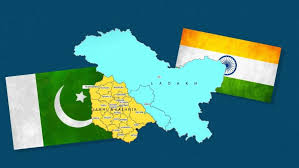
During a meeting in Islamabad attended by his cabinet and senior officials, speaking in Urdu, Pakistan Prime Minister Imran Khan released the political map depicted as a “historic” move reflecting the desires of the people of Pakistan and Kashmir and rejection of India’s illegal action of August 5 last year,” and the first step towards a political struggle to achieve the right of self-determination for the Kashmiri people under the UN Security Council resolutions, which clearly give the right to the Kashmiri people to vote on whether to go with Pakistan or India.  

In the new map, Pakistan lays claim to the Union Territories of Jammu & Kashmir and Ladakh, and Junagadh in Gujarat state. The announcement was made ahead of the first anniversary of the Indian government’s decision on August 5, 2019 to scrap Jammu & Kashmir’s special status under Article 370 of the Constitution. As it was expected, India on Tuesday described Pakistan’s political map an “exercise in political absurdity”

India’s decision to nullify Article 370 last year had triggered a strong reaction from Pakistan, as well from China, which believed it would affect its territorial claims in Ladakh, especially after India included Aksai Chin region in new maps of the union territories.

In the new map, Pakistan claims the whole of the Union Territories of Jammu & Kashmir is a part of the country’s territory whose final status is to be decided in line with UN Security Council resolutions. The boundary of Himachal Pradesh is depicted as the international border.

The map includes an annotation related to the Ladakh region whose boundary will be decided by “sovereign authorities concerned after the final settlement of the Jammu & Kashmir dispute”. In the map, Pakistan claims Siachen glacier as part of the country boundary as well as the disputed Sri Creek region of Gujarat. The map also depicts the Junagadh and Manavadar region of India’s Gujarat state as part of Pakistan. The nawab of Junagadh had opted to accede to Pakistan in September 1947, before fleeing from India with his family the following month. Junagadh voted overwhelmingly to stay with India in a plebiscite held in the region in 1948.The new map will be “used in schools and colleges and internationally”

On Monday, Pakistan’s foreign and defence ministers visited areas along the Line of Control (LoC) to raise the Kashmir issue. Pakistan plans to observe August 5 as “Youm-e-Istehsal” (day of exploitation) and Khan is scheduled to go to Muzaffarabad, the capital of Pakistan-occupied Kashmir (PoK), to deliver a speech. Pakistan’s new political map on Kashmir has the support of the country’s traditional allies, with only Turkish President Recep Tayyip Erdogan assuring Khan and President Arif Alvi of his country’s backing on the issue.

Kashmir issue is a legacy of colonial rule. Kashmir was a princely state during British rule with a Hindu ruler and at least two-thirds Muslim population. To date, it is the only Muslim majority state in India. Legally speaking, Kashmir’s accession, in October 1947, was no different from the other 550 princely states that joined India and were subsequently erased as geographical entities.

Catégories
Blog Histoire

For which was meant US Atomic bomb?

75 years ago

For which was meant US Atomic bomb ?

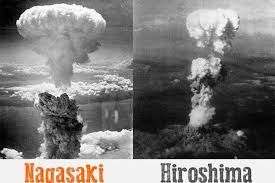
On August 6,1945, Japan’s Hiroshima was bombed by US atomic bomb, nicknamed “Fat Man,” exploded with a force equivalent to 21 kilotons of TNT fired an area that covered three square miles, killing instantly 140000 civilians. On August 9, Nagasaki was bombed by the plutonium core atomic bomb the U.S. dropped that day from the B29 Bockscar, captained by Major Charles Sweeney, killing instantly around 70000 civilians. Despite the Nagasaki bomb was more powerful than that of Hiroshima, material and human damage was limited by the fact that the bomb missed its target and that the mountains surrounding Nagasaki, which is located in a valley, contained the blast. However, in Urakami Valley, where the bomb landed, nearly 70 percent of the population perished.

In the aftermath of the WWII, politicians, military and historians have challenged the official narrative of Truman’s administration that the launch of atomic bomb was aimed at “saving American lives” Admiral William D. Leahy, Truman’s personal Chief of Staff, was critical of using the atomic bombs saying the U.S. “adopted an ethical standard common to the barbarians of the dark ages.” Even the National Museum of the U.S. Navy in Washington, DC acknowledges that the vast death and destruction wreaked by atomic bombings “made little impact on the Japanese military.

Truman even knew very well, through the intelligence reports, Japanese leadership were looking for honorable conditions to surrender. Truman was aware of civilians that were becoming increasingly demoralized for lack of food and energy supplies. To this must be added the huge destruction as the U.S. had firebombed and largely destroyed more than 100 Japanese cities, leaving millions homeless.

The question is not whether the atomic bombs were militarily or morally justifiable—they clearly were not. The question is why Truman chose to use them when he knew the end of the war was imminent and said so repeatedly and knew they were putting humanity on a glide path to annihilation.

Some studies point out that the U.S. wanted to test the uranium and plutonium-type bombs to show off their military muscle and take the advantage in the post-World War II diplomacy. As historians have increasingly come to realize, Truman had been obsessed with the Soviet Union since April 13, 1945—his first full day in office. Truman’s confrontation with Foreign Minister Vyacheslav Molotov on April 23, in which he erroneously accused the Soviets of having broken their Yalta promises, marked how dramatically the wartime alliance between the U.S. and the U.S.S.R. had deteriorated in the 11 days since Roosevelt’s death.

James Byrnes, who became Truman’s Secretary of State in early July but had been his most trusted advisor since his first day in office, and Gen. Leslie Groves, the driving force behind the Manhattan Project, both asserted that the Soviet Union loomed as the real target behind the bomb project. Groves stated on another occasion, “There was never from about two weeks from the time I took charge of the Project any illusion on my part that Russia was our enemy, and the Project was conducted on that basis.”

Byrnes told three visiting scientists in late May that the bomb was needed to reverse Soviet gains in Eastern Europe. The future Nobel laureate physicist Joseph Rotblat who quit the project a few months later, when he said in March 1944, “You realize of course that the main purpose of this project is to subdue the Russians.” Some studies point out that the U.S. wanted to test the uranium and plutonium-type bombs to show off their military muscle and take the advantage in the post-World War II diplomacy.

Catégories
Blog

War of low intensity in the Himalayan China-India border

WAR OF LOW INTENSITY IN THE HIMALAYAN CHINA-INDIA BORDER

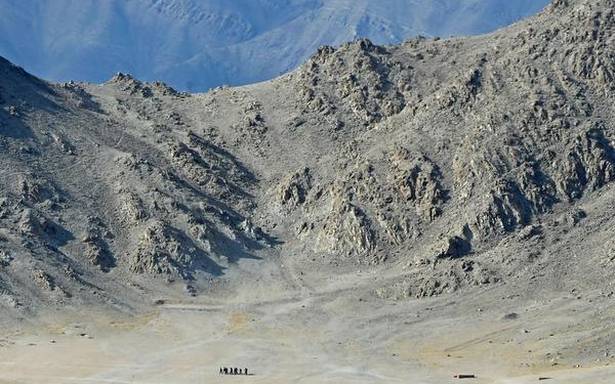
Since the bloody skirmish, the Chinese and Indian Corps Commanders have held four rounds of talks so far on June 6, 22, 30 and July 14 to de-escalate from the build-up areas in Galwan Valley, Gogra-Hot Springs and Finger area along the Pangong Tso (lake) in Ladakh. The fourth talks on July 14 went lasting for 15 hours failed to implement the disengagement process despite a consensus for full disengagement and de-escalation. On August 2, the fifth round of talks between Chinese and Indian top diplomats resumed at Moldo on the Chinese side to take forward the stalled process of disengagement on the Line of Actual Control (LAC).

The stumbling blocks relates to the Finger area. The ‘fingers’ are mountain spurs on the northern bank of the lake, a set of eight cliffs jutting out of the Sirijap range overlooking the Pangong Lake. India accused China’s PLA of grabbing positions on Finger Four overlooking Indian deployments, curtailing the scope of Indian patrols right up to finger 8. Fingers Four and Eight are eight kilometres apart.

At Pangong Lake, following earlier talks, Chinese troops pulled back from the base of Finger 4, where Beijing’s claimed border is, and moved to Finger 5, still well within where India sees the LAC at Finger 8.

As a sign of determination of the PLA to hold its positions on the north bank of Pangong Tso, the new constructions in the Finger Area where  set up permanent bunkers, pillboxes, observation posts and tented camps over the last three months.

De-escalation of the border conflict with China can only begin complete disengagement between the two armies along the LAC. The ground situation remains unchanged in the Ladakh sector where both armies have deployed almost 100,000 soldiers and weaponry in their forward and depth areas and are prepared for a long haul through the winter months.

Translate »